“If I had a world of my own, everything would be nonsense. Nothing would be what it is, because everything would be what it isn’t. And contrary wise, what is, it wouldn’t be. And what it wouldn’t be, it would. You see?”
That’s odd. What is that quotation from Alice in Wonderland doing there? Anyway, let’s talk about international law and the constitution again.
Since the Government won the vote on the second reading of the Safety of Rwanda Bill on Tuesday night, the war of words over its potential implications has continued to heat up. Yesterday Mark Elliott, a professor of public law, wrote in the Daily Telegraph that it risked a “constitutional crisis”, citing comments by Sir Geoffrey Cox that it might provoke the courts to “revisit” the “assumption” of parliamentary sovereignty.
Pedantic rhetorical skirmishes also rage over the very language used to discuss the Bill. Does the Bill challenge “the rule of law”? Imperil the “separation of powers”? Does parliamentary sovereignty mean Parliament can legislate its way past international obligations, or is anyone suggesting this making a very basic error, as Gavin Phillipson (another public law professor) alleges?
This row highlights several of the problems with the gradual capture by the law of our political process. Protean definitions, cunning (or careless) elisions, and hair-splitting pedantry – each, in their proper place, a proper part of the tradecraft of lawyers – serve to box laypeople out of the debate, obscure the terrain being fought over, and allow what are fundamentally political preferences to be presented in the borrowed feathers of disinterested, expert insight.
For the sake of space, let’s look at the most pressing example.
Can Parliament legislate to ignore international law, or not?
The problem with this question is that it can be answered on two levels, and the answer is different in each case. The real question is what the significance of this difference is.
The United Kingdom takes what is called a dualist approach to international law. Basically, it does not become part of our domestic law automatically, but only to the extent that it is deliberately incorporated into it via our constitutional processes. (Lord Mance, a former deputy president of the Supreme Court, explains this more thoroughly in a 2017 lecture.)
Thus, the two answers. Phillipson is quite right that the UK cannot unilaterally set aside treaty obligations as international law (unless the treaty permits it); they are in that sense still binding on the government who agreed those obligations, using royal prerogative, on behalf of the country.
But, and equally straightforwardly, in domestic law Parliament is supreme; it absolutely can legislate to stop giving international law any effect as far as our courts are concerned. Per Lord Diplock, in the 1966 judgment in Salomon:
“If the terms of the legislation are clear and unambiguous, they must be given effect to, whether or not they carry out Her Majesty′s treaty obligations, for the sovereign power of the Queen in Parliament extends to breaking treaties…”
That’s why New Labour felt it necessary to pass the Human Rights Act (HRA) at all: if the Convention rights were automatically UK law by dint of our signing it, the Act would be superfluous. It’s why the courts cannot strike down subsequent legislation they find to conflict with it, and why (most) prisoners can’t vote, despite our being obliged by “binding” international commitments to let them.
What this means, in short, is that whilst Parliament cannot decree that this or that does not break international law as a matter of international law, it can legislate to break international law in the domestic sphere, and this is perfectly constitutionally proper.
But should it?
That something is constitutional does not mean it is wise or good; a constitution (at least, a democratic constitution) is a thing of means, not ends. One can fairly argue that the UK ought not to break international law, either on philosophical and ethical grounds or because of the practical consequences of so doing for our diplomatic position.
One can argue equally fairly against either case. I have written before about the democratic deficit created by the ever-widening scope of international law; we might note that France just outright ignored an ECtHR ruling to deport a man with terrorist links without the sky falling in, and take a more bullish view on the UK’s practical scope to do something similar, especially in light of how often the UK breaches rulings of the International Labour Organisation (technically international law too!).
But one crucial feature of these arguments is that they are disputes about what we ought to do, and why. Or, put another way, they are political. They are thus completely different to arguments about facts, about which more or less can be (more-or-less) objectively known.
This poses a problem for gatekeepers, because expertise mostly applies to the latter. The opinions of the most learned lawyer or jurist on fundamental questions of what the law ought to be are no more valid than anyone else’s, however impressive their knowledge of the law we have or capacity to craft new ones.
Not very satisfying, if you happen to be, say, a professor of public law with strong views on the constitution. You’ve got rank, and want to pull it. But how?
By blurring the line between the two, of course. Keep labouring your point about international law; pretend your opponents’ failure to labour the same point can only be an embarrassing mistake.
This is irrelevant either to the constitutionality or morality of the Bill, of course, but split enough hairs and it might not seem so. Throw out enough patronising rhetorical chaff, and a political disagreement can show up on the untrained radar as a legal licking, especially if your target is making their case in non-technical language, perhaps because they’re not a lawyer.
And the more the debate is restricted to lawyers, the more it looks like a descriptive debate in which such expertise would be rightly decisive – even though the subject, how we ought to be governed, is the foundation of politics.
But what if it actually (suddenly) can’t?
Do that, and you suddenly open up the possibility of pulling off a spectacular heist. What if the version of the constitution I set out above, with its sovereign parliament and dualist approach to international law, could be swapped out for a new one – without a referendum, an election, an act of parliament, or any political input at all?
I say “swapped out” because both dualism and sovereignty are generally accepted; even dissenters such as Elliott (in this article) or Lord Kerr (in R (SG) v Secretary of State for Work and Pensions (2015), cited by Mance) concede that it is the “orthodoxy” (if one reads far enough).
To actually advocate for a change, or even to acknowledge that the overthrow of the prevailing orthodoxy would be a change, would be to stray dangerously close to the base world of political debate. Elliott takes great pains to stress he’s doing no such thing.
In order for such a transformation to be a decision for lawyers (that is, the experts) it would need to be a question of what the legal situation actually already is. Thus he cites Adam Tucker, another legal academic, who claims that:
“dicta that suggest Parliament’s legislative authority might be more qualified than hitherto assumed form ‘a subtle but pervasive background feature to the contemporary constitution’.”
You see? The real constitution was the dicta we found along the way.
[here be dragons]
However, the idea that the courts could do this (“revisit” the “assumption” of parliamentary sovereignty, as Sir Geoffrey put it), and on this basis, poses serious problems – problems which cut right to the core of the weird and fascinating thing that is constitutional law.
On the face of it, Sir Geoffrey’s concern is a circular argument. The Supreme Court could only decide it had the power to strike down legislation, for whatever reason, if it already possessed that power. Authority cannot be established by appeal to itself; if Parliament is sovereign, the twelve justices of the Supreme Court cannot, by their power combined, make it otherwise.
Elliott, Tucker et al thus frame their arguments as if they were uncovering evidence for this pre-existing authority; like archaeologists dusting off a find, the final shape of which will be what it will be irrespective of the opinions of its discoverers.
This is an old legal conceit, embedded in the cute language that judges make “discoveries” in law and in academics’ use of “orthodoxy”, a word which implies mere belief about something independent of the belief. No politics here.
But it’s a fiction, and was elegantly dismissed as such in the 1970s by Lord Reid in his seminal essay The Judge as Law Maker (p22):
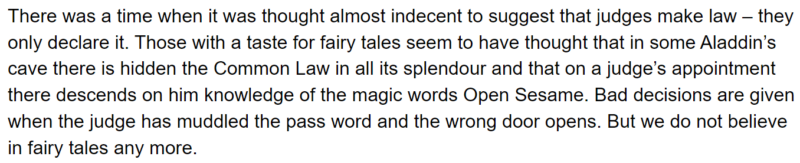
There is no Platonic realm in which the actual constitution exists, contrary to its current functioning and our current understanding of it. Or as JAG Griffith put it in another seminal essay, The Political Constitution (p19): “the constitution is no more or no less than what happens”; the actual operation of the constitution, informed as it is by prevailing “orthodoxy”, is as close to an is as the constitution gets.
That sword cuts both ways, of course. Griffith might sternly oppose the expansion of the courts into politics (seriously, read the whole thing), but the constitution is not about what is good and true. When something like Miller II happens, it happens; if lawyers can persuade enough people they possess a power, they will possess it.
But if judges (and jurists) are not archaeologists, but sculptors, then their law-making and theorising are political acts, and their proper position in our constitution a political question too – not one which can be independently and impartially decided, let alone by lawyers.
If we make the mistake of thinking otherwise, the real effect would be to cede political power to those we take for the experts. One can see why they might find that congenial, and encourage us in the error.