Gavin Rice is the Project Director of “Future of Conservatism” at the think tank Onward.
I have been laying out for ConservativeHome readers some of the key findings of Breaking Blue, Onward’s major post-election analysis.
In the first instalment of this three-part series for ConservativeHome, I explained how the 2019 vote splintered in multiple directions, with the party suffering its biggest losses with the groups with which it normally does best – older, white, Leave-voting homeowners. Labour carried all age groups under 64. There is no one silver bullet to reversing Labour’s loveless majority but multiple layers of support must be rebuilt.
In this post, part two, I’ll turn to the voters we need to win back: who are they, why did they abandon the Tories, and what are their priorities?
The next Leader of the Opposition will have to focus relentlessly on winning back these voters. “Uniting the right” will not be enough to win a majority. Yet at the same time the party cannot ignore the 23% of its support that went to Reform. It must fight on two fronts. The key things for the party to take away are:
- It must prioritise Liberal Democrat and Reform defectors who backed the Conservatives in 2019 (not Labour switchers)
- These defectors have conservative views on immigration but also care about public services and the NHS.
- These voters are more similar to each other than different, and more similar to current Conservatives than their destination parties – they can be targeted at the same time.
- It must win back electorally crucial voters with “super-demographics” who are disproportionately important in deciding elections (older, white, Leave-voting, C2 social grade, outright home owners)
The party must focus on both Liberal Democrat and Reform defectors
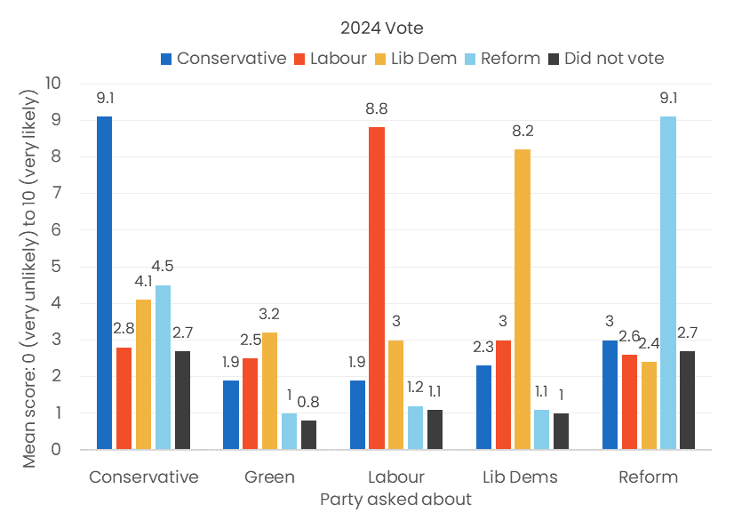
While it’s true that winning votes from Labour is more electorally efficient in Tory-Labour marginals — every vote won reduces Labour’s majority by two — Labour voters are presently much more reluctant to consider voting Conservative again. In contrast, Liberal Democrat and Reform defectors are most likely to give the Tories a second look.
How likely are you to consider voting for this party in the future? (scale of 0 – 10)
This seems like an impossible task.
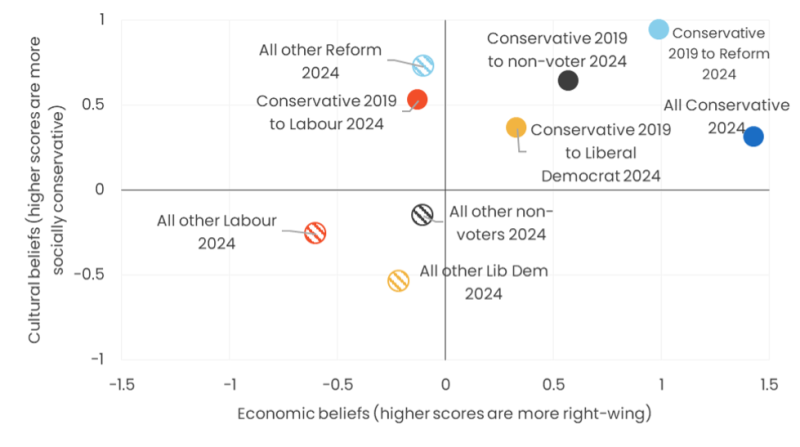
After all, surely those who defected to Ed Davey and to Nigel Farage have fundamentally different political values? Actually, no. Defectors to these parties who voted Tory in 2019 are actually more similar than they are different. And they are more akin to voters who stayed Conservative in 2024 than they are to their destination parties. Importantly, a deal with Farage would be hugely divisive (see below). Rather the Conservatives should seek to tackle the issues Reform defectors care about, such as immigration and crime, rather than making a deal with the party.
Economic and cultural beliefs (Conservative defectors and all voters)
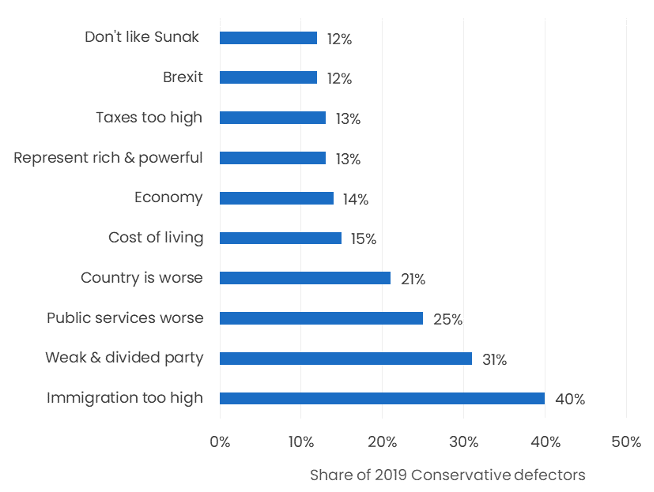
 There are common themes across all voters who abandoned the party this year. Immigration is the stand-out, number-one issue, followed by weakness and division in the party, then public services being worse.
Barriers to voting Conservative again among all 2019 Conservative defectors
 Perhaps surprisingly, a majority of 2019 Conservatives who switched to the Liberal Democrats say we should cut immigration “a lot” (along with 65% of current Tories and 82% of Reform switchers). This is a consensus issue for voters the party must win back.
This makes more sense if you consider a constituency like Yeovil, which voted Leave in 2016 and Conservative in 2019 but has gone back to the Liberal Democrats this time – the historic challenger in this seat. These voters are actually especially liberal, but have nevertheless suffered from cost of living rises and exhaustion with the Tories. The Lib DEMS benefited significantly from the anti-incumbency dynamic in their marginals with Conservatives.
Preferred approach towards immigration (2019 Conservative voters by their 2024 vote)
 And immigration is the top priority for defectors to the Liberal Democrats, followed by increasing public spending on services.
Top five priorities of 2019 Conservative defectors by their 2024 vote
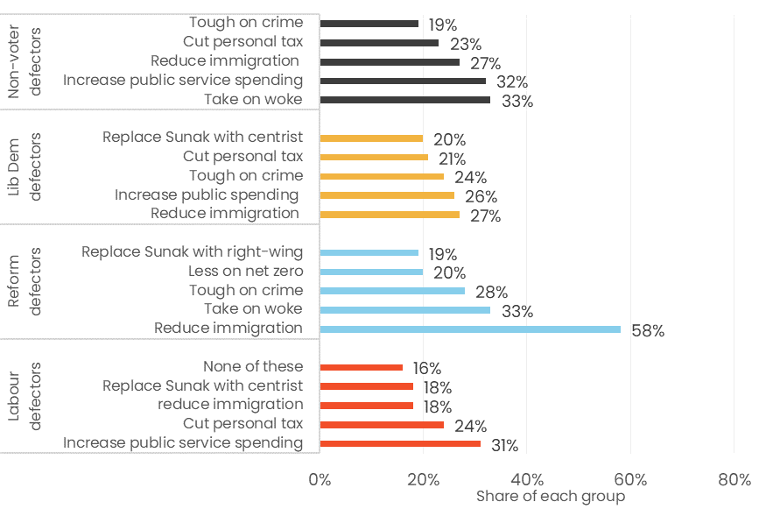 It’s therefore vital that the party does not make too many assumptions about the ideological histories of those who abandoned it at the last election. Immigration predominates regardless of which party voters switched to, but public services are important for all 2019 defectors. Just as Liberal Democrat defectors say the previous government failed on immigration, similarly defectors to Reform say it failed on the economy and cost of living, for example.
The party must target voters with “super-demographics”
One of the key findings of our report was the existence of a group of voters who are disproportionately significant in determining the outcome of elections. This is because they are efficiently distributed across constituencies (they aren’t clustered in one place), and because they are more likely to change their vote from one election to the next. They are therefore more strategically important to win and more likely to switch back to voting Conservative. The traits they have in common are “super-demographics”.
The traits are: older (55+), outright homeowner, C2 social grade, non-graduate, living in a less dense constituency, supported Leave in the EU referendum. The more super-demographics you have, the more likely you are to have voted Conservative in the past. The party haemorrhaged support with this type of voter in July, while Labour made disproportionate gains with them (above the national swing). This was a key part of Labour’s vote becoming so much more efficient and the Conservative vote collapsing.
Demographic groups under FPTP by vote volatility and efficiency
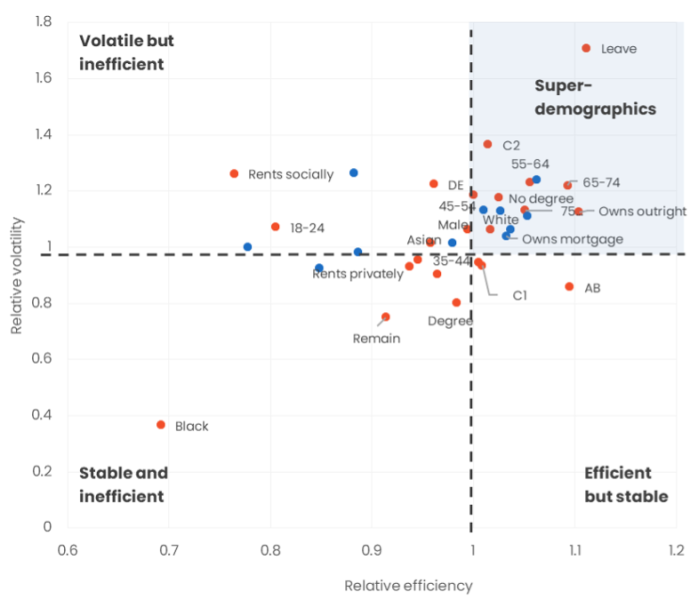
The picture we have, then, is one of voters who by rights should vote Conservative abandoning the party, especially for the Liberal Democrats and Reform, with the destination determined more by geography than by differences in underlying values. The party’s support plummeted with vital voters groups who should vote Tory, whose votes are volatile and who are crucial electorally because of where they live.
Finally, when we asked those who had voted Conservative in any of the general elections from 2015 onwards what their five most and least important priorities were for the Conservatives to focus on, they chose a pretty standard centre-right mix of issues. Again, we see that past Tory voters want immigration significantly cut, but do not want a deal with Nigel Farage.
Top five most and least important issues that would increase the likelihood of Conservative voters (those who voted Tory in at least one election between 2015 and 2024 ) to vote Conservative again
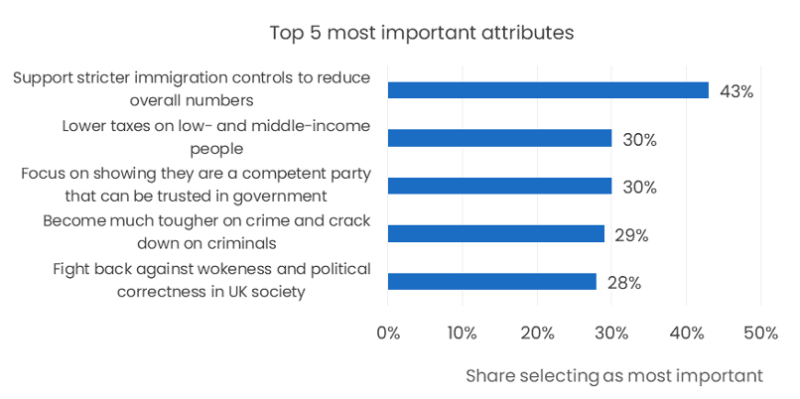
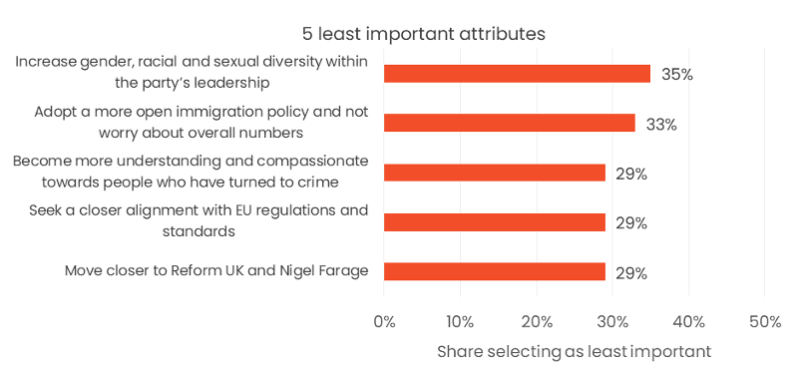 A lot of this may seem counter-intuitive. But it makes more sense when you realise that geography and historic voting patterns tend to matter more than ideology for many voters. The 2024 election was a vote against the Conservatives, and voters tended to vote in the most efficient way to get them out. This does mean that these lost voters don’t have centre-right political values. Overwhelmingly they do, but the Tories ceased to be seen as the party to deliver on those values.
Tomorrow in the final instalment I will examine the longer-term shape of the electorate, and address whether the long-term, post-Brexit Conservative coalition has become fundamentally unstable.
Gavin Rice is the Project Director of “Future of Conservatism” at the think tank Onward.
I have been laying out for ConservativeHome readers some of the key findings of Breaking Blue, Onward’s major post-election analysis.
In the first instalment of this three-part series for ConservativeHome, I explained how the 2019 vote splintered in multiple directions, with the party suffering its biggest losses with the groups with which it normally does best – older, white, Leave-voting homeowners. Labour carried all age groups under 64. There is no one silver bullet to reversing Labour’s loveless majority but multiple layers of support must be rebuilt.
In this post, part two, I’ll turn to the voters we need to win back: who are they, why did they abandon the Tories, and what are their priorities?
The next Leader of the Opposition will have to focus relentlessly on winning back these voters. “Uniting the right” will not be enough to win a majority. Yet at the same time the party cannot ignore the 23% of its support that went to Reform. It must fight on two fronts. The key things for the party to take away are:
The party must focus on both Liberal Democrat and Reform defectors
While it’s true that winning votes from Labour is more electorally efficient in Tory-Labour marginals — every vote won reduces Labour’s majority by two — Labour voters are presently much more reluctant to consider voting Conservative again. In contrast, Liberal Democrat and Reform defectors are most likely to give the Tories a second look.
How likely are you to consider voting for this party in the future? (scale of 0 – 10)
This seems like an impossible task.
After all, surely those who defected to Ed Davey and to Nigel Farage have fundamentally different political values? Actually, no. Defectors to these parties who voted Tory in 2019 are actually more similar than they are different. And they are more akin to voters who stayed Conservative in 2024 than they are to their destination parties. Importantly, a deal with Farage would be hugely divisive (see below). Rather the Conservatives should seek to tackle the issues Reform defectors care about, such as immigration and crime, rather than making a deal with the party.
Economic and cultural beliefs (Conservative defectors and all voters)
Barriers to voting Conservative again among all 2019 Conservative defectors
This makes more sense if you consider a constituency like Yeovil, which voted Leave in 2016 and Conservative in 2019 but has gone back to the Liberal Democrats this time – the historic challenger in this seat. These voters are actually especially liberal, but have nevertheless suffered from cost of living rises and exhaustion with the Tories. The Lib DEMS benefited significantly from the anti-incumbency dynamic in their marginals with Conservatives.
Preferred approach towards immigration (2019 Conservative voters by their 2024 vote)
Top five priorities of 2019 Conservative defectors by their 2024 vote
The party must target voters with “super-demographics”
One of the key findings of our report was the existence of a group of voters who are disproportionately significant in determining the outcome of elections. This is because they are efficiently distributed across constituencies (they aren’t clustered in one place), and because they are more likely to change their vote from one election to the next. They are therefore more strategically important to win and more likely to switch back to voting Conservative. The traits they have in common are “super-demographics”.
The traits are: older (55+), outright homeowner, C2 social grade, non-graduate, living in a less dense constituency, supported Leave in the EU referendum. The more super-demographics you have, the more likely you are to have voted Conservative in the past. The party haemorrhaged support with this type of voter in July, while Labour made disproportionate gains with them (above the national swing). This was a key part of Labour’s vote becoming so much more efficient and the Conservative vote collapsing.
Demographic groups under FPTP by vote volatility and efficiency
The picture we have, then, is one of voters who by rights should vote Conservative abandoning the party, especially for the Liberal Democrats and Reform, with the destination determined more by geography than by differences in underlying values. The party’s support plummeted with vital voters groups who should vote Tory, whose votes are volatile and who are crucial electorally because of where they live.
Finally, when we asked those who had voted Conservative in any of the general elections from 2015 onwards what their five most and least important priorities were for the Conservatives to focus on, they chose a pretty standard centre-right mix of issues. Again, we see that past Tory voters want immigration significantly cut, but do not want a deal with Nigel Farage.
Top five most and least important issues that would increase the likelihood of Conservative voters (those who voted Tory in at least one election between 2015 and 2024 ) to vote Conservative again
Tomorrow in the final instalment I will examine the longer-term shape of the electorate, and address whether the long-term, post-Brexit Conservative coalition has become fundamentally unstable.