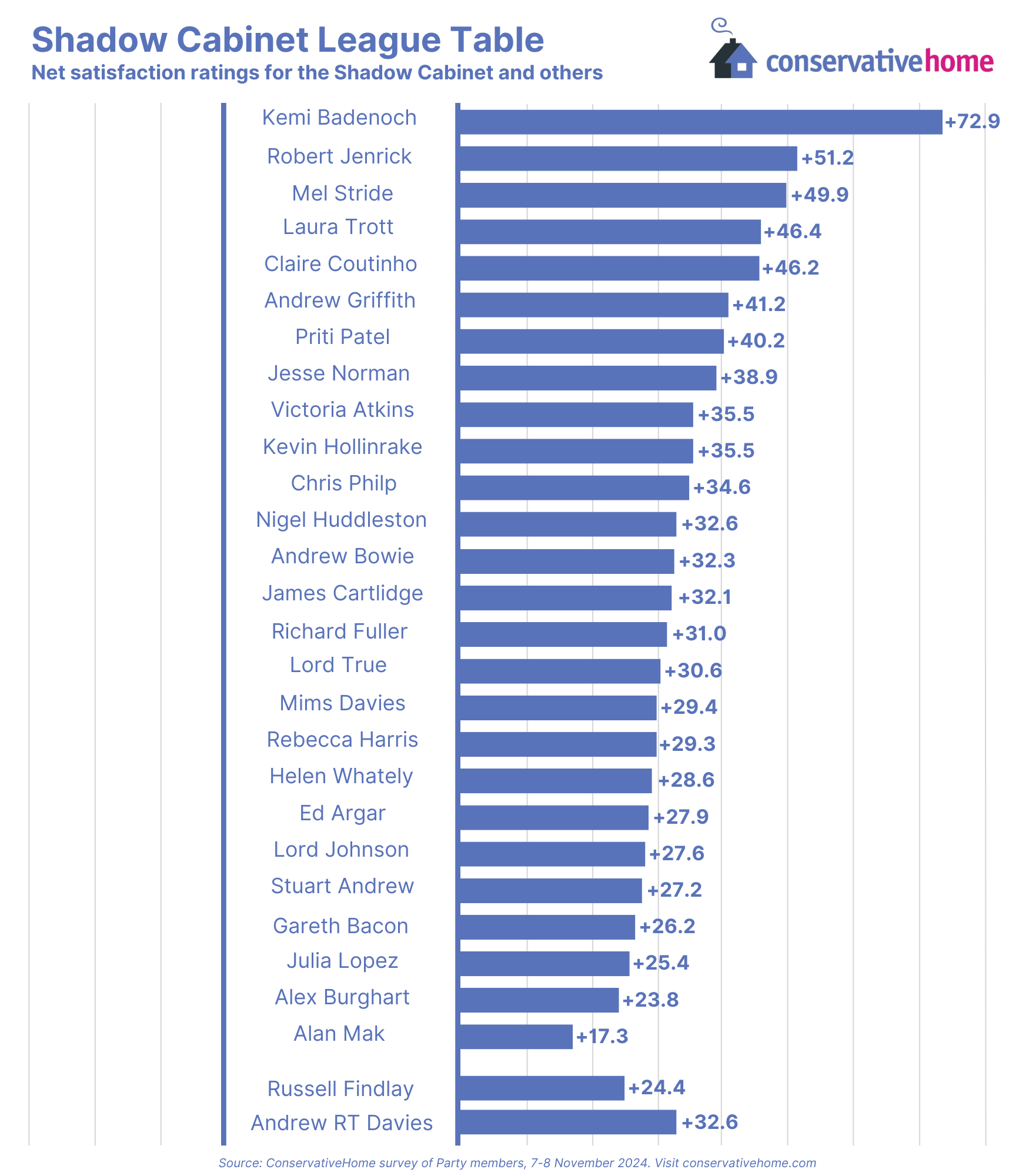
There’s nothing like a fresh start, is there? After a long period of anaemic ratings in our Shadow Cabinet League Table, the Badenoch Era kicks off with every member boasting a relatively healthy score.
Most impressive is that of the Leader herself, who has gained more than 20 points since we last checked in. Mel Stride, the new Shadow Chancellor, has done even better, picking up 23 points to take the bronze-medal position on the podium.
Taking second is Robert Jenrick, who enters the rankings from the back benches with a very healthy score of +51. Having the two finalists for the leadership is a fun dynamic, so we’ll have to see how that plays out.
Overall scores are much better too. There are no shadow ministers in negative ratings, and where last survey there were only eight with scores of +20 or more, now only one (Alan Mak, Shadow Science) is below that threshold.
The bulk scores are a good indicator of how the membership feels about the party in parliament (although both Russell Findlay and Andrew RT Davies have also benefited from the improved mood) – and as we’ve seen, members are currently very optimistic about Conservative prospects at the next election. If that hope starts to fade, the air can start to come out of these mid-table scores.
Looking ahead, the interesting thing will be what drives changes in the scores. In government, ministers could rise or fall depending on their own policy interventions, or members’ views about the government’s record on a particular issue such as immigration. In opposition, on the other hand, there’s no reason for most shadow ministers to so much as appear in the papers from one month to the next.
Take Claire Coutinho, the Shadow Energy Secretary. On the one hand, she’s gained 19 points – is that because she has been energetic in taking the fight to Labour on nuclear policy? On the other, she’s still in fifth place, so how much of that increase is simply the overall improvement in members’ assessment of the frontbench team?
Finally, we asked members about whether or not they felt Badenoch’s picks would fulfil her stated aim of bringing the party together. By two to one, they do (see below graphic). The question here is whether it will provide a foundation for long-term unity: it’s one thing to put people with different views in the shadow cabinet, but quite another to keep them there once you start having to clarify your positions on the questions that divide them.
