On Sunday I shared the results of our monthly poll tracking our survey panel’s expectations for the outcome of the next general election. This month our panel was the least confident of an outright Conservative majority that they had been since August. This was a belief I attributed to the recent polling and by-election success of Reform UK, something backed up by today’s results.
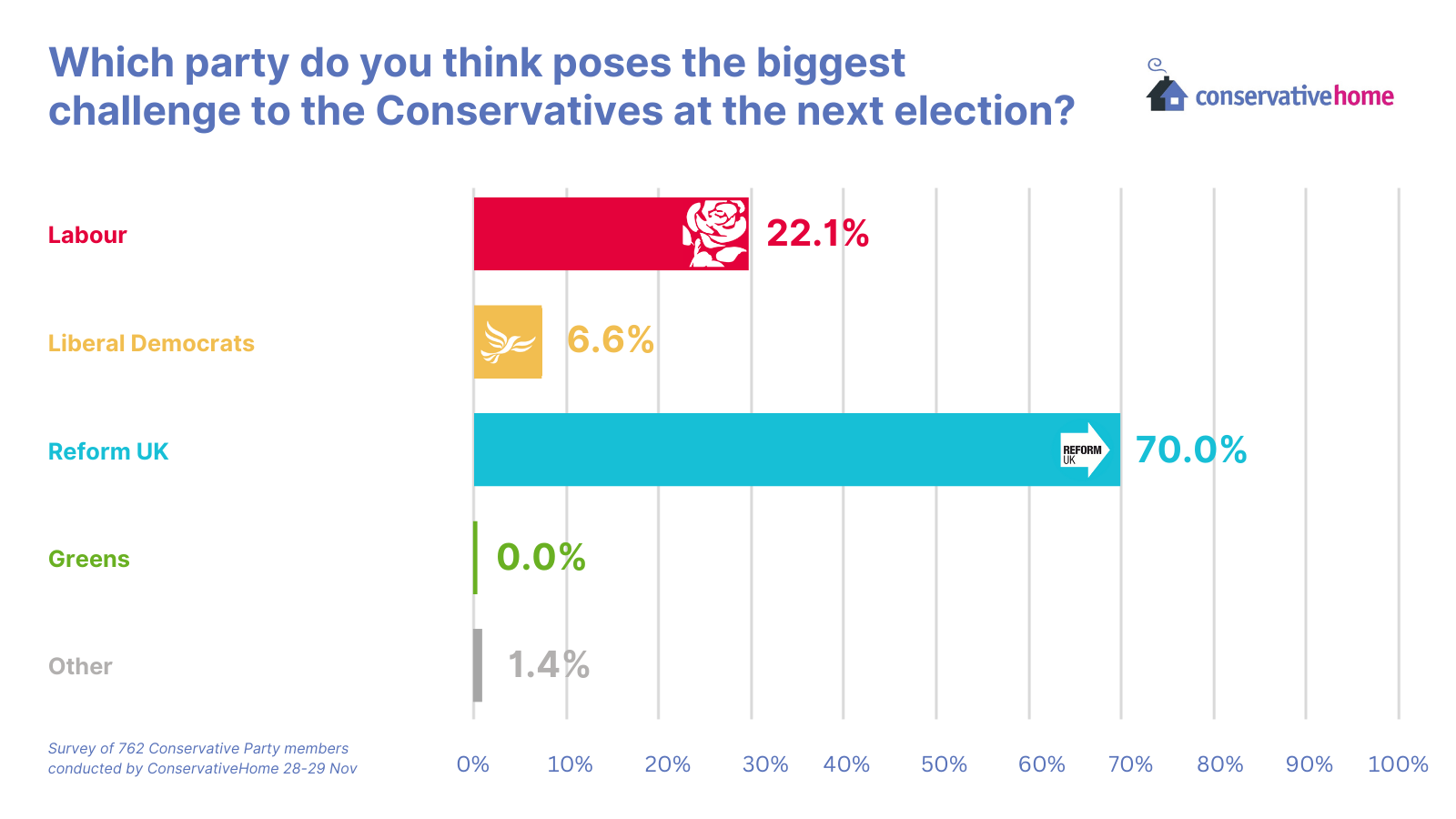
We asked our panel of party members who they thought posed the greatest threat to the Tories at the next election. Seven in ten have pointed their digital fingers at Nigel Farage’s party. 22.1 per cent named Labour, 6.6 per cent named the Liberal Democrats, no member answered the Greens (commiserations to Peter Franklin), and 1.4 suggested another, such as the SNP.
As I highlighted on Sunday, it is obvious that Reform are best-placed to sweep up the votes of Conservatives angry about immigration, Labour voters disillusioned by Keir Starmer but unwilling to trust the Tories, and the vast majority fed up with uni-party politics as usual. There is every chance Reform would be doing even better, if Farage didn’t elicit such strong passions .
As Gavin Rice has written for us, the Conservatives cannot win by simply “uniting the right”. Combining the Tory and Reform shares from the last election would give us 302 seats – short of a majority. But whilst we lost 7 per cent of our 2019 vote to the Liberal Democrats and 13 per cent to Labour, we lost 23 per cent of it to Reform. Killing Reform is not sufficient, but necessary.
Also following Rice’s research, it is clear that the primary reason why voters abandoned us was our failure on immigration, and this proved particularly toxic with the ‘super-demographic’ – “older (55+), outright homeowner, C2 social grade, non-graduate, living in a less dense constituency, supported Leave” – that are disproportionately important. They are prime targets for Farage.
Regaining credibility on migration – including giving the mother of all apologies for our record in government – is essential to winning back these voters. Badenoch cannot rely on Labour voters feeling buyer’s remorse, or Lib Dems being spooked. Our panel is right to perceive Reform as the primary threat, not only for the voters they have already taken, but for those they might in future.
With five months to go until the local elections, Kemi Badenoch and Keir Starmer will both be keen to stall Farage’s rapid progress. Starmer’s attempts to condemn a Tory experiment in open borders always seem a tad forced. But, unlike Badenoch, he at least can claim not to have been in government for the Boriswave and small boat explosion. That clip will get a lot of airing.
Having been to Washington to pick the brains of the incoming administration, Badenoch will hopefully be inspired to take a stronger line on the existential immigration question than she managed in her milquestoast mea culpa for the Centre for Policy Studies. Bemoaning the short-sightedness of her Year 12 teacher will cut little ice with voters against Farage’s finger-pointing.
Indeed, the more immediate question is not the challenge Reform pose to the Tories in four and a half years, but the threat they pose to Badenoch’s leadership within the next eighteen months. In the last ten opinion polls, her party were, on average, on 27 per cent, up 3 per cent from the election. But Reform were on an average of 20 per cent, up 6 per cent from the election.
Labour were also on 27 per cent, down 7 points from the election. Badenoch will hope that she can pick up voters from Labour with sufficient alacrity that the gap with Reform – down 3 points from the election – will not continue to narrow. But if it does, and Reform wrack up an increasing number of second places, alarm bells start ringing. We might be going from Germany to Austria.
Robert Jenrick supporters will start muttering “We told you so” more loudly, openly, and purposefully. If the locals are rough, and the turquoise tide continues to rise, a lot of Badenoch’s colleagues will become nervous. Already, it is a subject of conversation whether her leadership is disappointing. Early days. But this is how the rot starts. Round and round and round we go.
Badenoch does not seem like a leader who panics easily. As MPs begin to fret, one imagines she will continue steadily reviewing party policy in her own way. Let Reform have their fun. Allow their success in Scotland and Wales to seem inevitable, even necessary. What are the loss of a few councils, MSPs, or MSs, against the noble ambition of telling voters the truth?
Labour can feel the heat from Reform. Badenoch can profit from their discomfort. As Starmer loses voters to Farage and to the Left, the path to a Tory majority becomes smoother, as we benefit from the same disproportionality that proved so helpful to him. Tensions cool, and the Conservatives enter office in 2029 with a healthy majority, a hobbled Labour, and The Right Approach 2.0.
One wishes her all the best. Our readers have identified her challenge; it is up to her to prove she can match it. If she doesn’t, this might not just be her first Christmas as Tory leader, but her last.