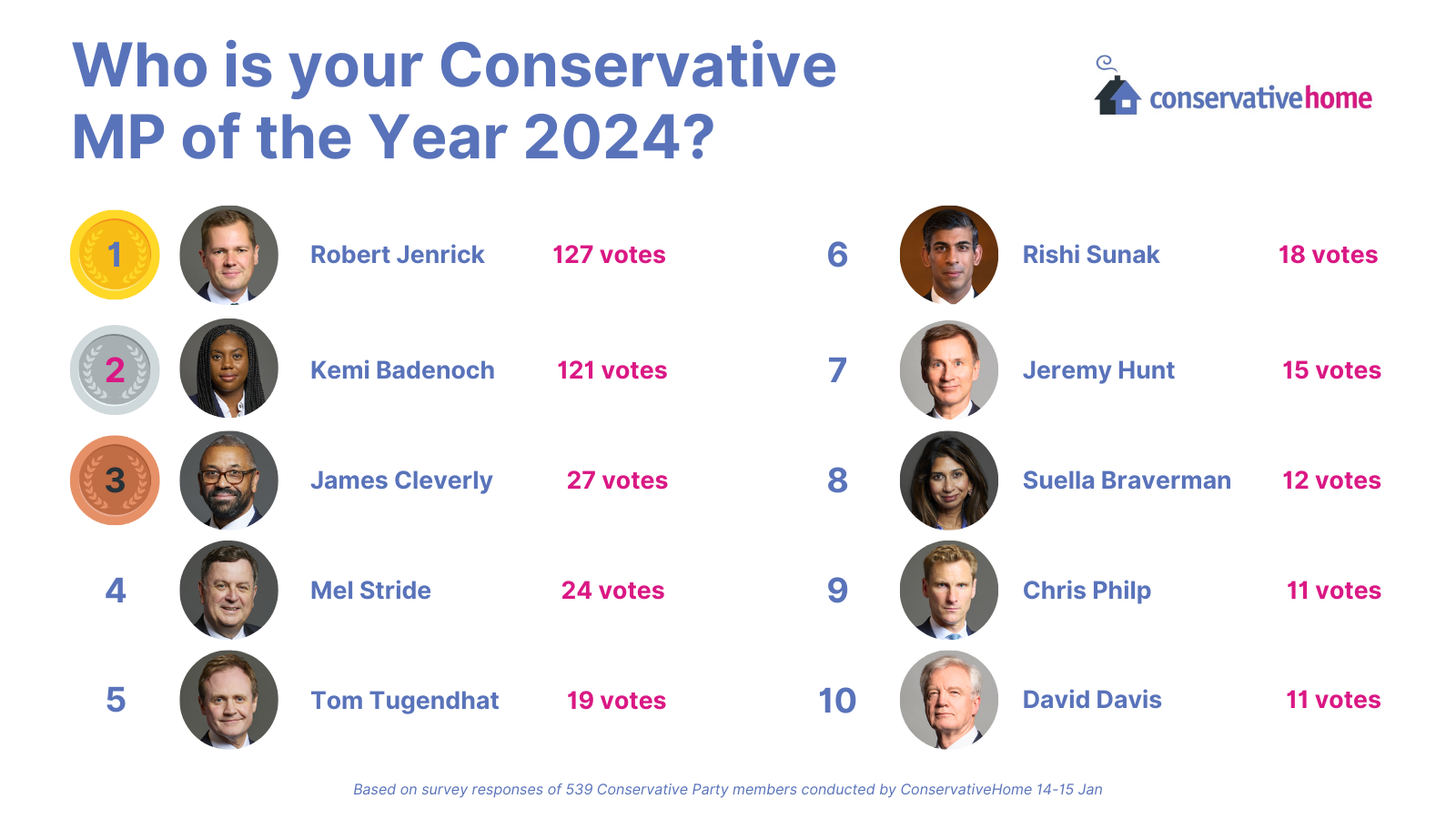
This year, we decided to provide a completely open field to our panellists for choosing their MP of the Year for 2024. The main finding? It seems to really help a nominee’s chances to have recently stood for the leadership.
Of the six MPs who threw their hat into the ring this summer, five secured the top positions in our unprompted question, with the three podium positions going to the three finalists.
The only one to miss out was Priti Patel, who secured just three votes. It isn’t obvious what might have caused the Shadow Foreign Secretary to fall behind like this except, perhaps, her decision to defend the ‘Boriswave’ of mass immigration (inevitable enough, as she served as Boris Johnson’s home secretary).
Otherwise it doesn’t seem to matter whether or not someone has continued on the front bench (Kemi Badenoch, Robert Jenrick, Mel Stride) or returned to the backbenches (James Cleverly, Tom Tugendhat).
The only real gulf is between the top two – no coincidence, surely, that they were the finalists in the leadership race – and everyone else.
Jenrick takes the top spot. Buyers’ remorse from the membership? Possibly, but the margin is only six votes so that possibility shouldn’t be overstated, however eye-catching. We should at least wait and see if he has also topped our Shadow Cabinet League Table, out next week, where Badenoch has for some time enjoyed a comfortable lead.
A more likely explanation is simply that he has been by far the most energetic and high-profile shadow minister over the past few months, especially on the grooming gangs scandal.
In other words, he has been the fastest to grasp the very different dynamics of opposition. In government, the press come to you and you are the news by default; a minister can build a relatively strong public profile on the basis of a relatively small number of well-judged interventions on favoured topics, as Badenoch did.
Outside government – and especially facing a government with such a huge majority – it is a very different proposition, and every scrap of media attention has to be fought for. Our panellists also have no actual policy achievements or stumbles in office on which to base their vote. Energetic shadow ministers can thus make their own weather to a much greater extent than actual ministers; it will be interesting to see if and when Jenrick’s colleagues start learning from his example.
Below the top five, it is interesting to see Rishi Sunak and Jeremy Hunt, the most senior members of the outgoing government, place sixth and seventh despite leading the party to such a catastrophic general election result. The presence of Suella Braverman and David Davis, two high-profile right-wing MPs, in the top ten is less surprising than that of Chris Philp, the new Shadow Home Secretary – although again, the grooming gangs scandal has given him an opportunity to take the spotlight in Parliament.
Below that, the numbers drop off quite quickly; Nick Timothy, Jacob Rees-Mogg, and Danny Kruger deserve honourable mentions for narrowly missing out on the leaderboard with ten, nine, and eight votes respectively, whilst Kevin Hollinrake took six. Below them, another 26 MPs took more than one vote:
Five:
- Andrew Griffith
- Iain Duncan Smith
Four:
- Alex Burghart
- Miriam Cates
- Esther McVey
- Robbie Moore
- Penny Mordaunt
Three:
- Claire Coutinho
- Caroline Dinenage
- Mark Francois
- Richard Fuller
- Craig Mackinlay
- Ben Obese-Jecty
- Priti Patel
- John Redwood
- Andrew Rosindell
- Grant Shapps
- Greg Smith
Two:
- Victoria Atkins
- Sarah Bool
- Damian Hinds
- Alicia Kearns
- Andrew Mitchell
- Bradley Thomas
- Laura Trott
- Matt Vickers
Another 42 current or former MPs (we allowed nominees who left parliament at the election) took one vote each; we’re delighted to see such close engagement with our survey from the green benches.