Alexander Bowen is an MPP-MIA student at SciencesPo Paris and St Gallen specialising in public health, and a policy fellow at a British think tank.
In biology there is the mantra that form follows function, that if something does not aid in survival it is likely not present. In our political biology that mantra is much the same – and yet far too few seem to realise it. Electoral function has at this election, and the one prior, entirely dictated the form both of the Commons and our governments..
You heard during the last term about Conservative efforts to ‘rig’ elections via such means as redrawing electoral boundaries, introducing voter ID, and repealing the alternative vote.
Labour too looks set to do its own equivalents: lowering the voting age, expanding the franchise to even more non-citizens, legislating for automatic voter registration, and expanding the role of the judiciary to limit policy-space. Collectively they all constitute changing the functioning of our political system in an effort to mould its compositional output, our legislature’s form.
But there is, and I suspect calls for it now the two-party vote share has reached its all-time low will only grow louder, another much larger form of procedural tinkering waiting in the wings and it is the arguably cynical aspiration of all minor parties.
What then of proportional representation? What then if we imagined not a tinkered, but an overhauled, process? The impacts of Voter ID or automatic voter registration are hard to measure, but in disaggregating outcome from process, you can see clearly the impact of said process – and nowhere is that clearer than with PR.
Consider then the static results of the last election in a different system, Nigel Farage’s favourite: German style mixed member proportional.
To do this 16 hypothetical regions must be constituted, forming the parallel to Germany’s 16 länder, necessary for allocating seats in the proportional system. Each region has been assigned seats based on the size of their electorate (35 of the 299 first-past-the-post seats for Greater London and two for Cumbria) coupled with the same number of regional proportional seats.
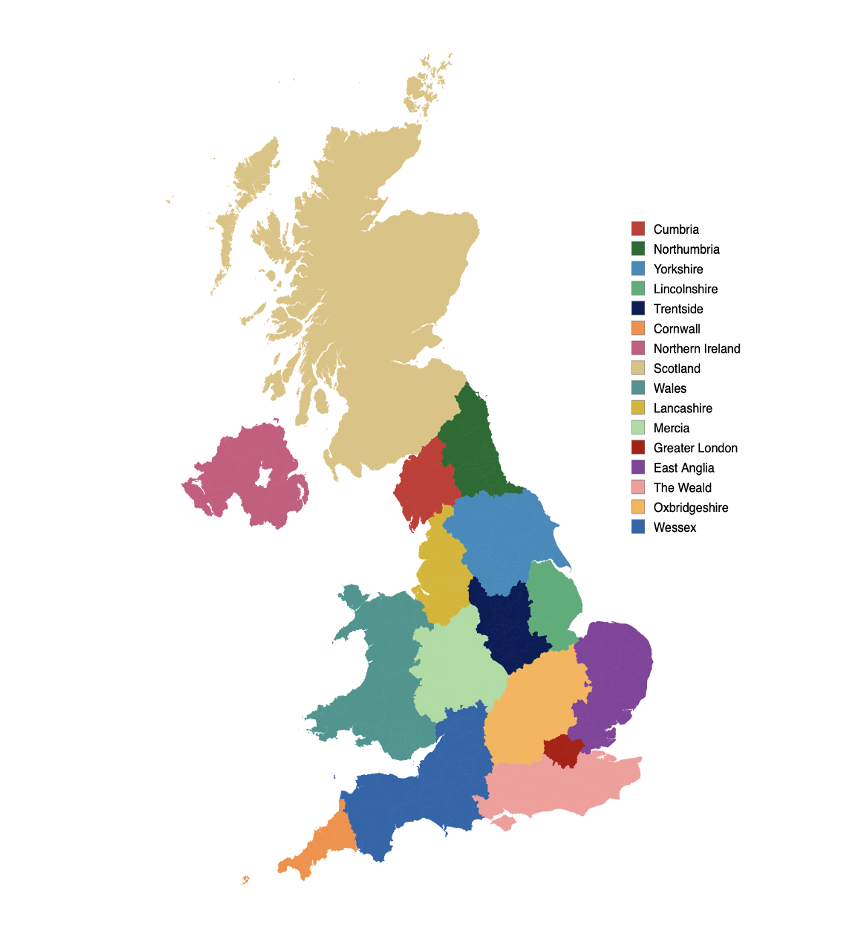 Of these 299 seats, using only the real data from the last election, 189 would go to Labour, 49 to the Conservatives and some 37 to the Liberal Democrats. That is to say they would be won in roughly similar proportions to at the last election, though with a greater skew to Labour and the Liberal Democrats by virtue of representing an area with 220 per cent more people.
(However, how boundaries were drawn would matter here but be corrected at later rounds.)
In Wales, Northumbria, Cumbria, and Cornwall, not a single Conservative would have been elected and in Lancashire and Greater London just two and three respectively would have held on.
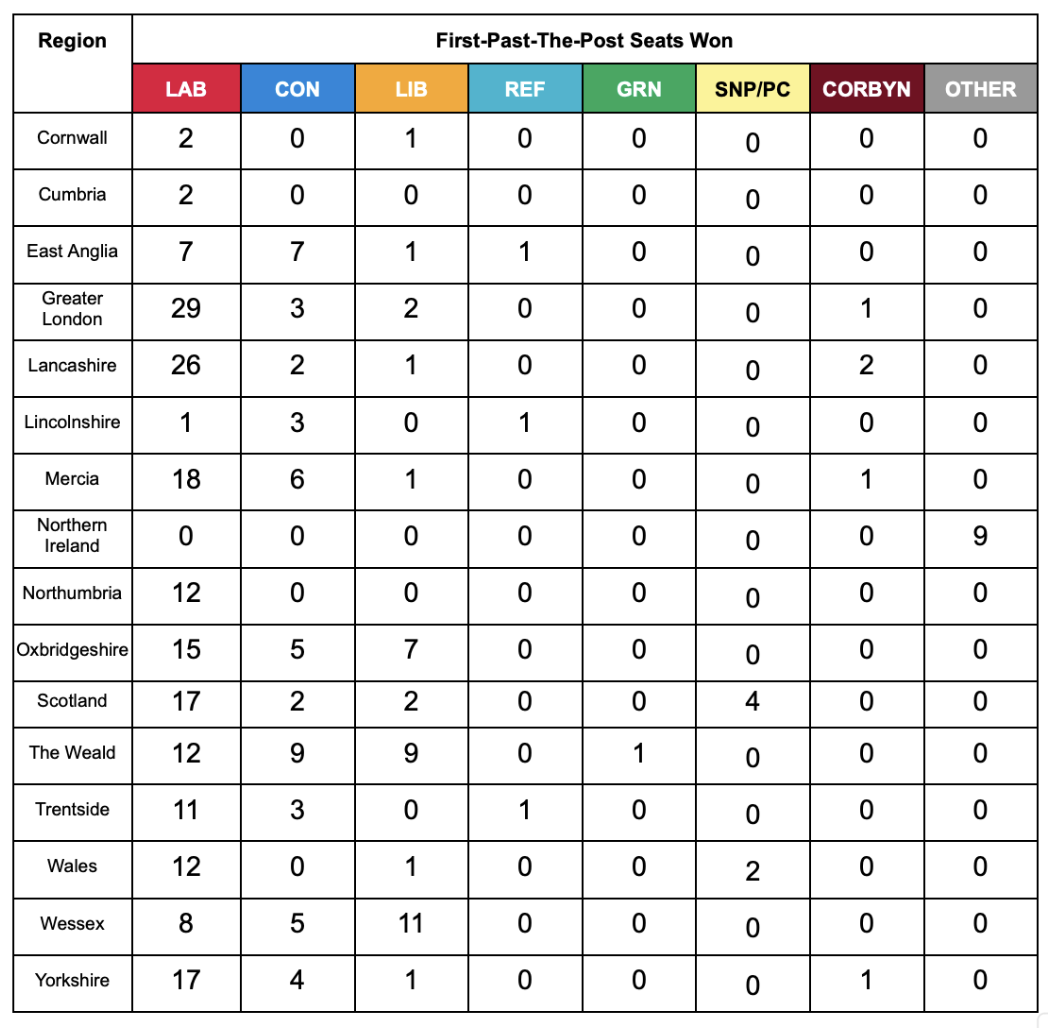 In calculating this table I’ve also grouped together Corbynite candidates, Islamist independent candidates, and the Workers’ Party of Great Britain, which fuses the two tendencies under George Galloway, to create a grouping in a sort of parallel to Germany’s Die Linke. (Appropriate, given Corbyn is currently spearheading his own effort at creating a grouping much along these lines.)
Winning 580,000 voters or two per cent (though of course they stood in fewer seats than they would have had proportional lists) the grouping would, much like Die Linke, not have passed the five percent electoral threshold if not for winning three of the first past the post seats that, under German electoral law, exempts them from the threshold.
Plaid and Northern Irish parties would have been similarly affected but, like Germany’s South Schleswig Voters’ Association (which exists to represent ethnic Danes), these parties would have been exempted from the threshold under the historic minority protection clause.
Seats in the regions then – allocated based on ensuring proportional representation in the region once given consideration of how the FPTP seats had already been allocated – would be a different picture, with the Conservatives and Reform winning 95 and 84 of these each.
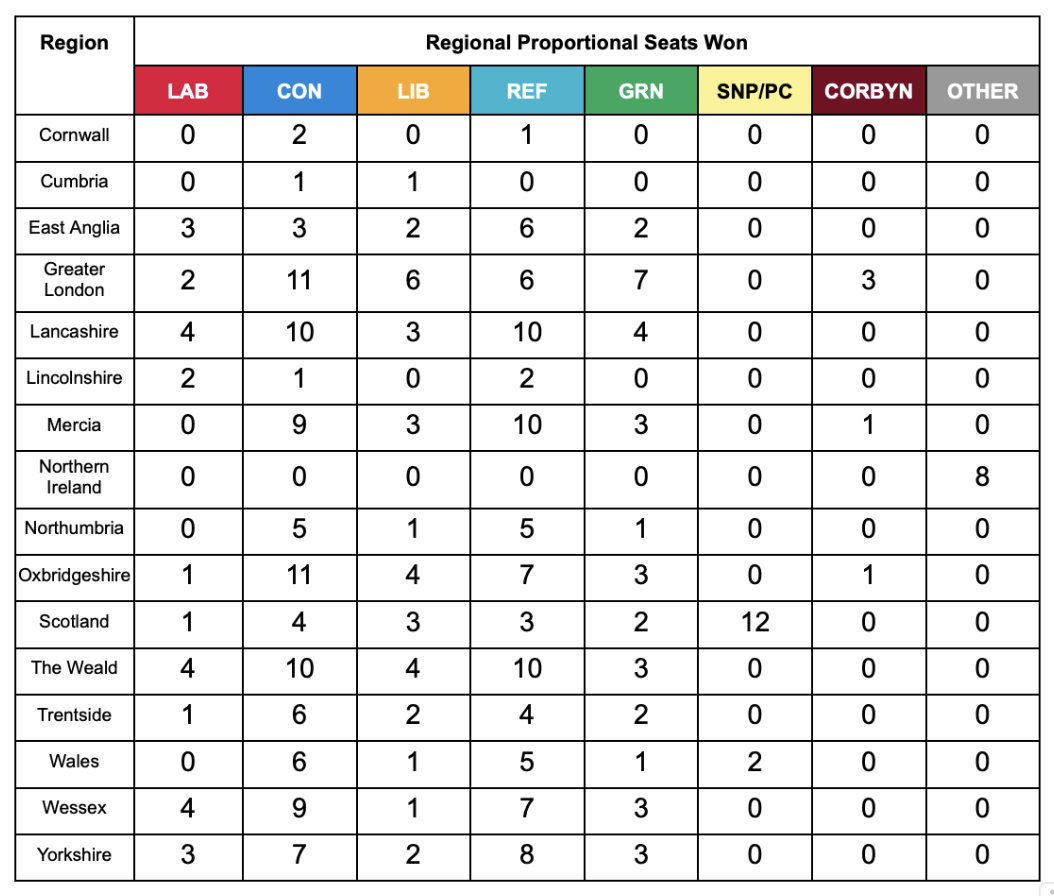 To prevent negative vote weight and ensure each vote counts equally regardless of where it is cast, levelling seats to compensate for the overhang seats created by relative levels of success in first-past-the-post would also need to be awarded.
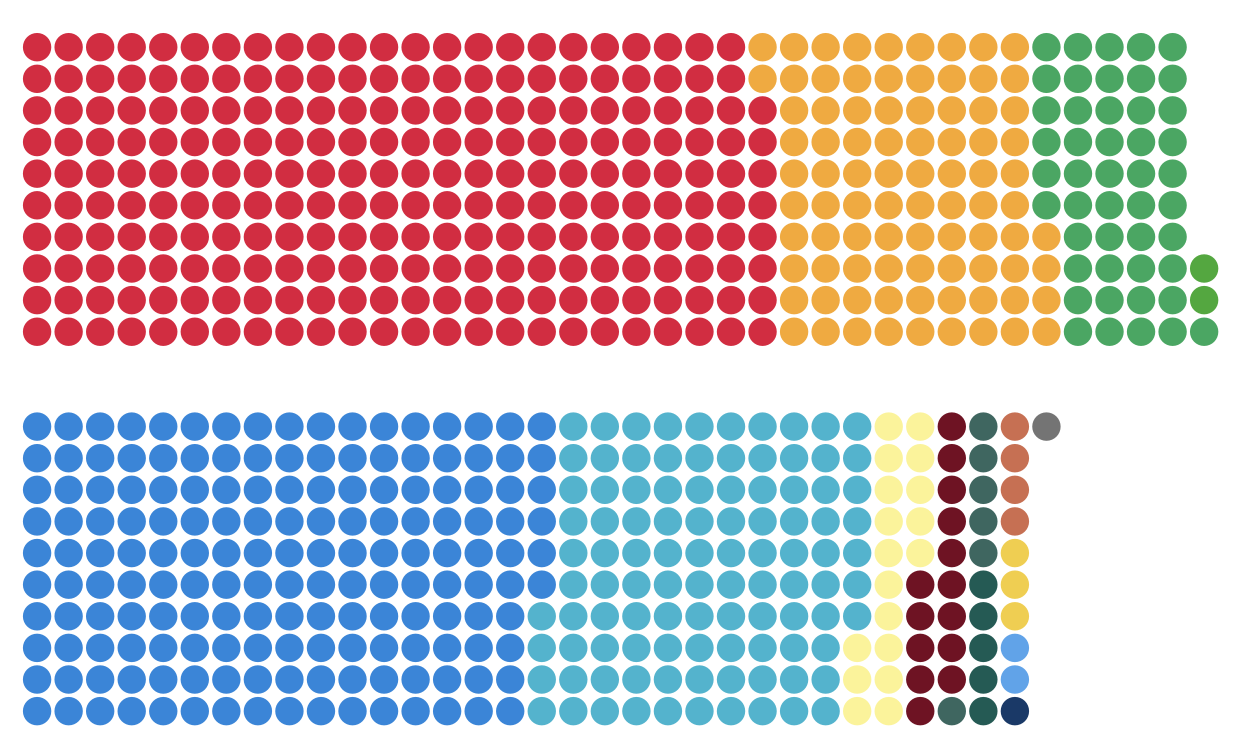
The Commons would thus swell to 694 seats – the largest number since Ireland departed the UK, but still 41 seats smaller than the Bundestag (and one hundred smaller than the House of Lords).
As would be expected given Labour won 33.8 per cent of the vote (a share that, whilst embarrassing in first-past-the-post, would frankly be deeply average in a reasonable proportional system given Olaf Scholz’s 25.7 per cent or Pedro Sanchez’s 31.7 per cent), a coalition would ensue.
Only two plausible options would exist, neither of which is led by the Conservatives given the implausibility of getting both the Liberal Democrats and Reform in a single government.
With the majority threshold at 348, reduced to 346 in the absence of Sinn Fein, a British version of Scholz’s Traffic Light Coalition combining Labour, the Liberal Democrats, and the Greens would pull in 371 seats. Alternatively something like what Gordon Brown attempted to cobble together in 2010 – combining Labour, the Liberal Democrats, the Scottish Nationalists, and either a Northern Irish cohort or Plaid – would also be able to create a majority.
 Such a coalition could see everyone’s favourite sixth former, Green Co-Leader Carla Denyer, take over a key portfolio like the Foreign Office whilst Adrian Ramsay, another member of the party, would likely take Energy Security and Net Zero. Ed Davey too would reprise a role in government, being in a position to demand and receive either Yvette Cooper’s Home Office job or Rachel Reeves’ role as Chancellor.
In short, a Starmer Government in a proportional system would be a mess, divided and incapable of responding to events. With Reeves’ much loved fiscal black-hole still around but with a high-income Lib Dem base needing its pound of flesh and a Green electorate that denies the existence of fiscal constraints altogether, the three-party circle would not be squared.
Whilst the German government keeps getting its budgets thrown out by the Federal Constitutional Court (a warning perhaps for Labour MPs rather too keen on informally-constitutionalising the OBR), a Starmer Government under PR would likely have its budget thrown out by its own coalition partners.
Contrast this to the Conservatives who, finding solace in the warm embrace of the regional list, would see some of their most talented MPs returned as part of a relative bumper crop of 166 seats. Capable of hoovering up the centre from this coalition without fearing vote-splitting to the right, its future position would also have been relatively improved.
All this is to say nothing about the potential for gridlock with a reformed upper house, a policy Labour seems rather keen on, which if composed like Germany’s Bundesrat would be in a near 24/7 state of campaigning flux.
Ultimately process isn’t sexy, but it is largely decisive in determining outcomes. Labour (or at least the senior PLP) gets that and Starmer did something particularly impressive – mastering the process but not the people.
When you do disaggregate process and people the two things that stick out are this. First, how the last election, far from a reset, was just, in international terms, quite average; second, how much graver the challenge of managing a coalition combining 238 generic Labour MPs, 86 petit-bourgeois Liberal Democrats, and 47 slacktivist Greens would be.
The large bulk of Labour members who, in the past, have hoped to alter function to dictate their preferred form would do well to remember that the results can always malform.