I don’t know if you’ve ever sat for six hours in the belly of a cargo plane in the middle of the night headed towards a war zone. 11th of October 2023 was my first time. It was a sobering experience.
I sat, in a spider web of sophisticated netting that was supposed to allow you to rest sat upright. They were the only seats, like a double row of cocoons the length of the fuselage. They were fascinatingly well designed and simultaneously utterly useless. Realising there was no way I was going to sleep, I had time to dwell on the three days before.
On this day last year Israel was targeted with a barrage of over four thousand rockets on the religious holiday of Simchat Torah. One thousand two hundred Israelis, Jews and non-Jews were murdered by Hamas terrorists coming from Gaza. They caught Israel almost completely off guard. Hamas and their affiliates killed indiscriminately, took 250 terrified hostages into captivity and as it turns out now, started a year of war.
I know. You know, what’s happened since. I’m not for a second dismissing the tens of thousands of dead in Gaza or how they died. I’m simply going back to October the 7th, and the few days after, to explain what happened to Israel as a society because I saw for myself that nothing, for better, or worse, would be the same again.
It wasn’t just the facts of the attack, it was the nature of it.
The sheer brutality of the killings, the complete surprise and shock, the targets, the scale, all were hard enough to take in, but Hamas wanted you to watch.
Within hours there were images around the globe of the body of a half-dressed young woman displayed on a pick-up truck, or another, alive, blood stained and brutalised, degraded and paraded in some vile show of euphoria and ‘strength’. Hamas wanted you to watch.
Then came the stories of women and children and the elderly butchered. I use that word literally, not for effect. Weeks later those who could face it, and some who’d try to downplay it, could see with their own eyes from head cam and phone footage the unimaginable blood lust on display. Hamas wanted you to see.
And if that catalogue of brutality wasn’t enough for anyone’s stomach, we got to hear the jubilant phone call of a young man calling his parents to boast about who he’d killed and how – with the pride you might imagine him announcing he was to be a father.
As I flew in the cargo bay, I was thinking about the events in the place I was headed but also about home. It is hard even today to understand how Israel, the victim of an attack that had it been scaled to the UK would have killed 9000 Brits, attracted a large crowd of people to their embassy in London the next day – not to lay flowers but to yell at them.
Hundreds of activists in a collective chorus of “look what you made them do to you”.
I can say it now: it was as sickening as it was baffling.
How do you justify that? The day after more Jews were murdered in a single day since the Holocaust – and people protested against them.
We landed in Tel Aviv and it all got very real, very fast. The security briefing was brief: if we were shot at in our convoy – get down, people on board will fire back. That’s hours before running to a bomb shelter and hearing the whoosh of a rocket and the “crump” overhead as it was shot down by Iron-Dome. This was not a game.
We headed at speed past military vehicles and trucks an hour down the highway to a war zone. We were headed to the borders of a fortress, or a prison, depending on which side is talking to you.
In easy rocket range from Gaza is the city of Ofakim. It was a textile centre for years, suffered when factories moved away, and has recently had a revival. On October the 7th it had new arrivals. 22 Hamas terrorists reached the city, and a battle was fought that claimed the lives of 27 residents and 6 policemen.
5 terrorists holed up in the home of Rachel and David Edry. A stand-off occurred and only by offering food and basic medical aid did the couple in their 60s stay alive. A police SWAT team eventually rescued them and killed the 5 gunmen.
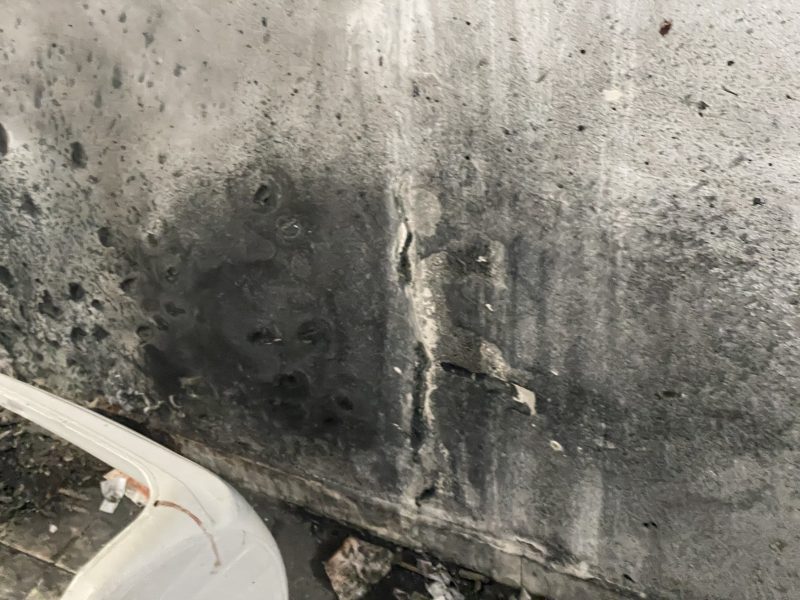
This is the home I was being driven to. It’s hard to describe until you see it. A perfectly normal domestic setting in which modern warfare has taken place. It jars you. On the 6th of Oct it was a family home, by the 8th it was uninhabitable. 
We met the parents of a young IDF soldier, at pains to make clear how less like a soldier he really was. His mother explained he’d been seen in a video inside Gaza. He was now a hostage. All she repeated was he had serious asthma and had no inhaler. It was so human it hurt. I still have no idea as to his fate.
An official confided in me that he had no figure for the total dead – they were still finding bodies, the morgues were full and some of the things the morticians were seeing were causing extreme mental stress.
The emotions were tangible everywhere.
It was a nation in deep, profound shock, and one that had been pushed over a line. Whoever we talked to, Minister, President, opposition politician, soldiers, citizens, people in the street, all said the same things:
We will never let this happen again.
We come from families that have fled persecution and murder before. It stops here.
We will not run, this is our home, we stand here, we defend our home.
It’s good of you to care, but we are doing this for us, and you won’t stop us until we are safe.
We talked of getting hostages and foreign nationals out of Gaza, we talked diplomatic efforts around humanitarian aid which would be needed – but we were talking to people in shock. Mainly we listened. In the past Israeli-Palestinian conflicts ended in two ways. Israel stopped or the US told them to stop. On day three after the attacks, it was clear that formula was over.
Benjamin Netanyahu’s reputation for playing the Palestinian factions off each other without accepting the two-state solution was regarded as cynically successful right up to the point it was a catastrophic failure. His political reputation was severely damaged in Israel on the 7th of October and today, he remains a highly controversial figure – many Israelis accusing him of being far more focused on himself, than the situation they are all in.
What is far less controversial in Israel, is the war.
Those lines in the sand from a year ago are still there. Israelis can firmly hold to them, and still be critical of their government.
It was also clear a year ago, and perhaps understandable, that Israel did not on the 11th October have a ‘what next’ plan. A year on and that lack of an publicly explained end game, or any evidence one exists, is worrying. Israel switches between renewed military action in Gaza and taking on Hezbollah in the north, but never lays out what happens if it ‘wins’.
A year ago, Labour were brave. I genuinely respected that they joined the then Conservative Government in standing shoulder to shoulder with Israel. Their position now in Government is more porous and political. The partial arms embargo was not necessary and didn’t satisfy those it was supposed to. And they never will be satisfied.
Israel is, and will remain, our ally. There are people in the UK who are unaware of the fact that they are alive today, because of that friendship. Besides, witnessing a country in deep trauma you can start to understand how you might respond, and thus understand them better.
In all the attempts to rightly focus attention on the plight of innocent Gazan citizens we have also seen sustained attempts to gloss over Israel’s emotional wounds and downplay the scale and severity of the 7th October.
How early on we saw people in Europe and America take down posters of hostages, question every detail of what happened, even denying it was anything much at all. It’s got steadily worse this year.
Some of these voices exist in our Parliament.
People can try to brush out what happened a year ago but deep in Israeli society it won’t wash. It really was a national trauma, and it really was as bad as Hamas terrorists wanted it to look.
We’d be wise to understand that, in order to better understand how this really ends.