Api Dawson is a former senior New Zealand political staffer and campaign manager, and currently works in Public Affairs.
As the New Zealand general election looms, it is increasingly looking like it is all over red rover for the Labour Party. Just three years after achieving the hitherto impossible feat of winning a majority under MMP, Labour looks set to lose the treasury benches come October.
On election night in 2020, Jacinda Ardern stated:
“New Zealand has shown the Labour Party its greatest support in at least 50 years. We have seen that support in both urban areas and in rural areas and seats we may have hoped for, but in those equally we may not have expected. And for that, I only have two simple words. Thank you.”
Once all the votes were counted it was Labour’s best result since 1946.
The scale of Labour’s victory cannot be overstated. Even the most optimistic in the Labour camp couldn’t have dreamt at the beginning of the campaign that its victory would be so resounding; the tsunami of public support for their handling of the early months of the Covid pandemic flooded polling stations up and down the country.
Not since the halcyon days of Helen Clark in 2002 had Labour looked popular enough to be rewarded with the rarest of political gifts: an absolute majority.

Constituencies across the country turned red. In the seat of Ilam, which includes affluent Christchurch suburbs such as Upper Ricarton and Fendalton, Gerry Brownlee, a former Cabinet Minister, saw his eight-election winning streak came to an end; Ilam, and it’s predecessor seat of Fendalton, had been held by National since the seat was re-established in 1978.
In National’s provincial heartland, seats such as the East Coast, Otaki, and the Wairarapa turned red for the first times in 15 years, 15 years, and 18 years respectively. The seat of Rangitata, which had never previously been held by Labour, was won with the Labour candidate securing an outright majority.
In the cities too Labour was dominant: in Hamilton West, Labour flipped the seat with 51 per cent of the vote; Nelson was won for the first from National since 1996.
For the National Party, it was their greatest ever net loss of seats. Once all was said and done, twenty three MPs departed the caucus. Only the landslide defeat of the 2002 election, where National secured just 21 pet cent of the vote, almost half of what Labour won, surpasses it.
But the dominance of 2020 is now a world away from the dire electoral position in which Labour now find themselves. Poll after poll has seen their support slip away: throughout 2021 they polled consistently in the 40s; in 2022, consistently in the 30s; now, four of the last five public polls has them polling in the 20s.
If these numbers were to be borne out on election night, it would be one of the greatest reversals of fortune in New Zealand political history.
But what would it mean for the Parliamentary Labour party? On current numbers, nearly half of those who party voted for Labour in 2020 are telling pollsters they will vote for another party. If this came to pass, Labour would likely lose nearly half their caucus – 30 of the 64 seats they won in 2020.

Naturally, after such a large election victory, the swing back the other way at the following election can be expected to be substantial.
But the problem for Labour is that they haven’t just returned to pre-2020 levels. The current polling has them at around 27 per cent ten per cent less than what Ardern won at the 2017 general election, where she failed to outpoll National and was only provided the keys to Prime Minister’s office by the New Zealand First Party.
That means it is not just the Covid converts, those otherwise loyal National voters who for the first time committed electoral adultery, that have abandoned Labour. It is the voters that Jacinda Ardern won in 2017 too. Labour is now looking at numbers they had regularly in the nine long years they endured in the wilderness of opposition.
But it is not all good news for National either; they have not been the sole beneficiary of the erosion to Labour’s support base. Both ACT (a smaller right-liberal party, originally the Association of Consumers and Taxpayers) and more recently, NZ First, have been gaining support. ACT are currently poised to win 17 seats according to the One News poll, their best ever result, while New Zealand First are looking likely to cross the five per cent threshold and come back in from the cold after being booted from Parliament in 2020.
Add in the Green Party consistently polling around ten per cent, and it is looking like 2023 is a rejection of the two major parties. Indeed, with a combined 38 per cent in the polls, the minor parties are out performing both Labour and National.
This is important in New Zealand’s multiparty, mixed member proportional (MMP) system. While electorate (constituency) races are important, the electoral system means that the party vote is crucial to secure victory.
Under MMP, voters cast two votes: one for the local candidate, and one for the party. New Zealand’s 120-seat house of representatives consists of 78 members elected by constituencies and 48 from political party lists, with list seats distributed to ensure proportionality.
This means that while the ACT Party may only win one constituency (their usual stronghold of Epsom), they will have that one seat topped up with list seats until it reflects their share of the party vote.
Under MMP minor parties are important, and National may well have to work with the largest minor party since Jim Bolger had to work with NZ First and their 17 MPs in 1996.
Even the Guardian, who have recently started polling in New Zealand, are not painting a pretty picture. In an article for their inaugural poll, the author opined that:
“It seemed at that time to be a safe bet that New Zealand would continue a recent history of giving governments of both persuasions nine years at the top before the political metronome swung back like clockwork, set to a uniquely Kiwi beat.”
Faith in such alleged truisms as the three-term-turn, and the scale of Labour’s 2020 victory, mean many on the left are bewildered at Labour’s current predicament.
But the problem with restricting your analysis to recent history is it can often be misleading. True, excluding the current government, the last three governments, the fourth National (1990-1999), the fifth Labour (1999-2008), and the fifth National (2008-2017), have all been three-term affairs.
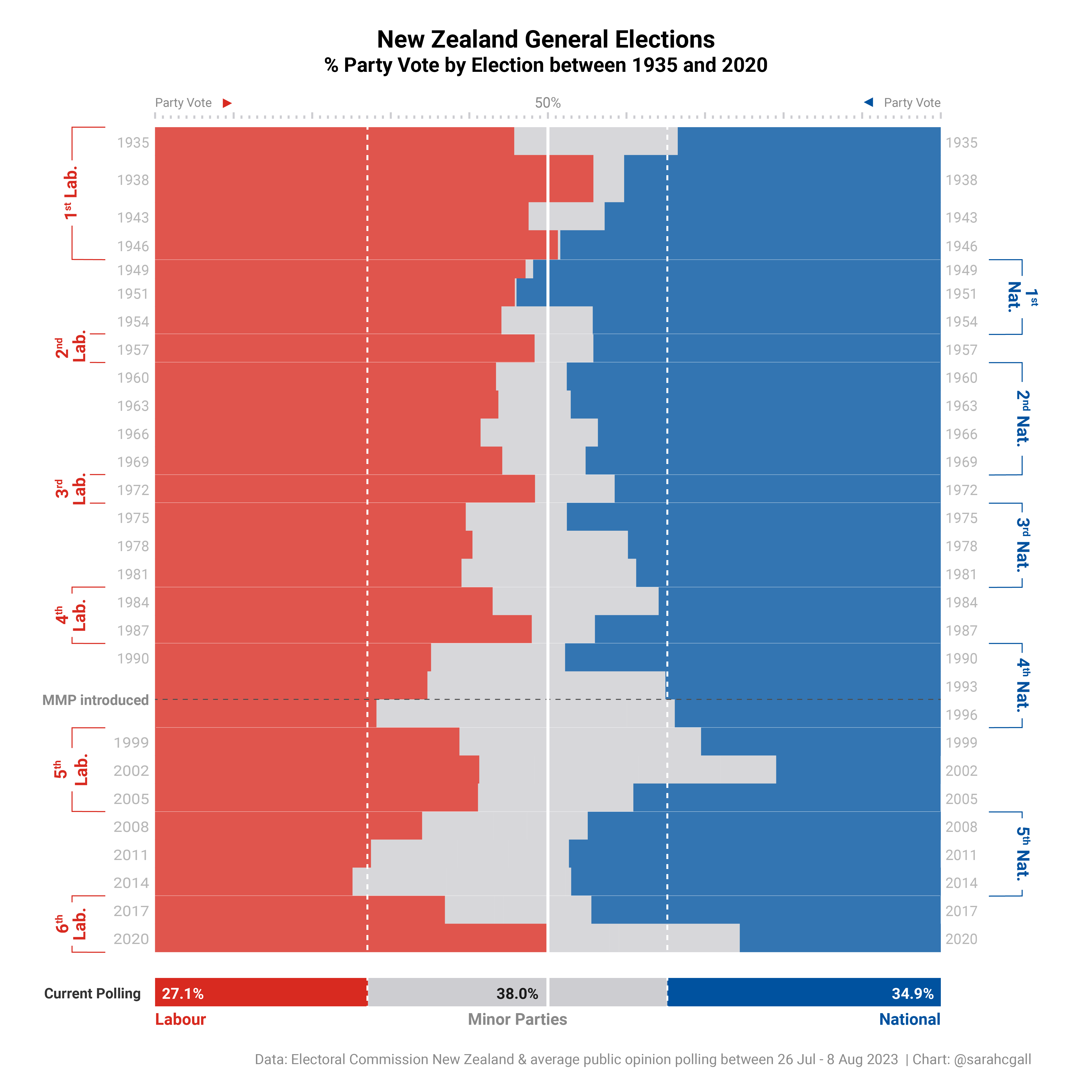
But if one looks at the full record then the numbers tell a very different story. National has never had a single-term government; Labour has had two.
Indeed, if you were to exclude the first Labour government, which included the war years, Labour has only had one three term government. Meanwhile every National government has governed for three terms other than the second National government, who were firmly ensconced on the treasury benches for four.
This election could thus well spell a return to the historical norm of short term Labour governments. On election night in 2020 Judith Collins, then National Party leader, proclaimed: “Even though tonight has been a very tough night for us all… three years will be gone in the blink of the eye. I say to everybody, we will be back.”
Her words could well be prophetic.
Olivia O’Malley is away.