6:45 AM
Capping off the hundreds of Tory losses today, Liz Truss, the former Prime Minister, has lost her seat in South West Norfolk. The final update to the BBC forecast has revised down the Conservative figures, and revised up the Labour and Liberal Democrat figures. Labour have also gained Uxbridge and South Ruislip, Maidenhead, and Witney – the former seats of Boris Johnson, Theresa May, and David Cameron. A fitting end to 14 years?
5:45 AM
The run of declarations has continued. The Conservatives have been wiped out in Wales. Tom Tugendhat has clung on, but Douglas Ross has lost in Aberdeenshire North. John Curtice says the Labour vote has barely risen in England and fell in Wales. Labour’s win is thanks to Reform and the SNP collapse. This election has the highest percentage of third-party votes for 100 years. Michael Gove’s former seat has been lost to the Lib Dems.
5:00 AM
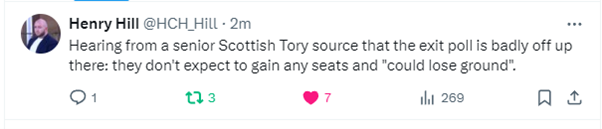
Our Acting Editor suggests the Scottish Conservatives are pessimistic about their prospects compared to the exit poll and BBC forecast.
Meanwhile, Labour has passed 326 seats. They will form the next government. The question of the rest of this morning is how large will their landslide be, and how many Tories will survive to oppose them. Labour have also lost a growing number of seats to pro-Gaza independents, including Blackburn and Dewsbury and Batley. Jacob Rees-Mogg has also lost in North East Somerset, as the sun rises on the 5th of July. A new dawn, and all that.
4:45 AM
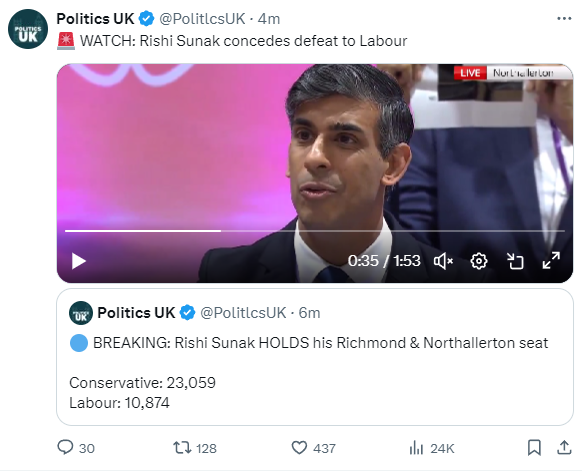
A record number of Cabinet Ministers have lost their seats, and Michelle Donelan has lost in Melkham and Devizes to the Liberal Democrats. But Jeremy Hunt has clung on in Godalming and Ash. So has Rishi Sunak in Richmond, who confirms Labour “have won the election”, that he has called Keir Starmer, and that he takes responsibility for the party’s loss. He says he will cease to be the Prime Minister today, and say more later.
4:30 AM
The BBC have again updated their forecast. Labour are now predicted to reach 410, the Conservatives 144, the Lib Dems 58, Reform 4, and the SNP 8. The Lib Dems have gained Wimbledon, Dorking and Horley, Wells and Mendip Hills, and Paddy Ashdown’s old seat of Yeovil. Labour gained Margaret Thatcher’s old seat of Finchley, despite the efforts of Alex Deane, our columnist. The Tories are down 26 per cent in seats they previously held.
4:15 AM
Penny Mordaunt, Leader of the House of Commons and two-time leadership candidate, has lost her seat to Labour on an 18 per cent swing. Her vote fellow by 28 per cent, as Reform UK’s vote increased by 20 per cent, giving Labour a majority of 780. Lucy Frazer has also lost in Ely and East Cambridgeshire to the Lib Dems. A joint seven Cabinet ministers have lost their seats so far.
4:00 AM
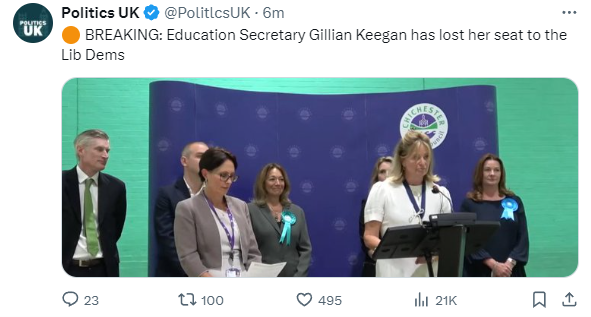
Gillian Keegan has lost in Chichester. But Suella Braverman has held on in Fareham, apologising for the Conservative Party for failing to listen to voters, and letting “the Great British people” down. And Richard Holden has won in Basildon and Billericay, in a three-way split, which has won by 20 votes.
Meanwhile, Richard Tice has won in Boston and Skegness, and the Greens have won in Bristol Central. The Conservatives, in the words of Iain Duncan Smith, have “taken a battering”, including being turfed out by the clearly disgusted people of Tunbridge Wells. Our columnist Miriam Cates has also lost.
3:45 AM
The BBC has updated their forecast. Labour are predicted to win 405, the Conservatives 154, the Liberal Democrats 56, the SNP 6, the Greens 2, and Reform 4. The Lib Dems are suspected to under-perform earlier predictions of gains from the Conservatives, whilst Reform has failed to meet earlier predictions. He describes it as an election the Conservatives “lost” much more than Labour winning, according to the numbers. Reform UK have also picked up Great Yarmouth, the former seat of Brandon Lewis, with the Tories pushed into third.
3:30 AM
In a news surprising precisely no-one, Nigel Farage has won for Reform UK in Clacton, entering Parliament on his eighth attempt. He predicts Labour will be in trouble “very quickly” and that he is “coming for Labour votes”. He plans to “stun” politics. Meanwhile, Jeremy Corbyn has won similarly emphatically in Islington North.
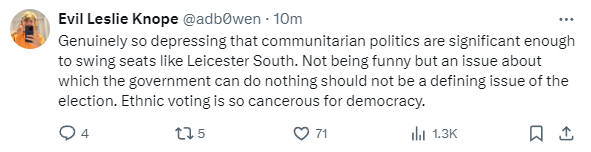
With Conservatives falling across the country, Kemi Badenoch has held on in North West Essex. Labour’s Jonathan Ashworth has also lost in Leicester South, the second Leicester seat to unexpectedly change hands tonight. Is this a sign of a depressing descent into sectarian voting spotted at May’s local election?
3:15 AM
Grant Shapps has become the second Cabinet minister to lose his seat, blaming his loss on an interminable “Tory soap opera” and the division of the Conservatives. We have also lost Hexham, West Bromwich, Newten Acycliffe, Ynys Mon, Sutton and Cheam, and Harlow, the former seat of Robert Halfon.
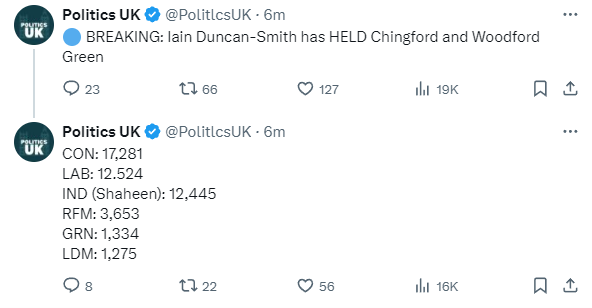
But we have also had two unexpected victories: Iain Duncan Smith in Chingford and Woodford Green, where Labour’s vote was split with an independent who had previously been a candidate, and Leicester East, which is a wholly unexpected gain from Labour. More as we get it.
3:15 AM
Alex Chalk has become the first Cabinet minister to lose his seat. Hardly a surprise, since his majority was only 981. He is one of several Liberal Democrat gains, including Hazel Grove, Torbay, Carshalton and Wallington.
3:00 AM
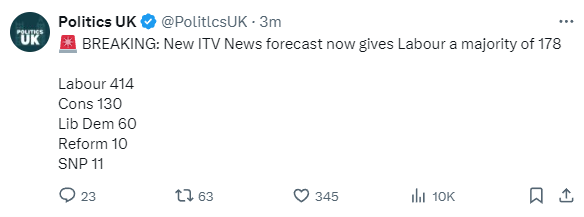
A suite of Labour gains, as the results start to flood in: Scunthorpe, Broxtowe, Southport, Stevenage, and Tipton and Wednesbury. But we have held on in Huntingdon, Cambridge North East, Bishop Auckland, Hinckley, and West Suffolk, which Nick Timothy has won. Rupert Harrison has been tipped to lose to the Liberal Democrats in Bicester. ITV have also updated their forecast, with an increase for Labour and a fall for Reform UK.
2: 35 AM
Henry Hill reporting.
On our new and oh-so-fun theme of underperforming the exit poll, an early straw in the wind was Monmouthshire. At 10pm we were forecast to hold on here, maintaining a toehold in Wales. Yet David TC Davies, the incumbent (and current Welsh Secretary) was apparently fast out of the gates saying he’d lost.
Verification there is now complete and counting is underway; local sources report that it is “very close”. But we have got our first confirmed casualty: Alun Cairns, another former Secretary of State for Wales, is out in Vale of Glamorgan, where he was defending a majority of just over 3,500.
An interesting theme in the Welsh results will be the Reform share. Whilst Vale of Glamorgan isn’t on their radar, the exit poll forecast them coming second in 11 constituencies – none of them Tory-held. It was less than ten years ago that UKIP secured seven seats in the Welsh Assembly. Might the Faragists yet entrench themselves in Welsh politics? It did vote Leave…
In the meantime, Reform are still hurting the Conservatives in the handful of other Welsh seats where activists think there’s at least an outside chance; local sources report that “Clwyd South is still in play, but Reform have taken a lot of votes”. Clwyd East is also reportedly “tight”.
Sadly, it looks as though the Welsh Conservatives have not been able to harness discontent at Labour’s incumbency at Cardiff Bay the way their comrades in Scotland have public anger at the SNP. Perhaps that isn’t surprising – for all its recent tribulations over Vaughan Gething, Welsh Labour has not (yet) unravelled to anything like the extent that the Scottish Nationalists have.
2:30 AM
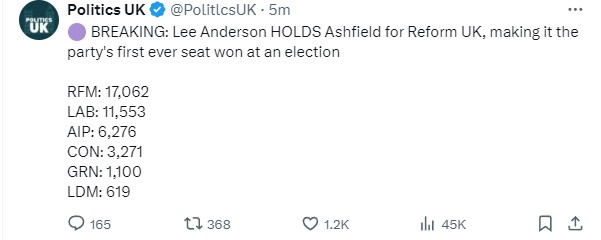
Lee Anderson – erstwhile ConservativeHome backbencher of the year turned Reform UK defector – has won in Ashfield. Four and a half years ago, the former Labour councillor turned the seat blue. He switched to Reform UK earlier this year after comments about Islamists saw him stripped of the Tory whip. His Conservative opponent came fourth, behind Labour and an independent candidate. A Tory humiliation – and a triumph for Reform.
Meanwhile, a sweep of Tory losses to Labour: Telford, Colchester, Vale of Glamorgan, Bridgend, Erewash, Rushcliffe, and Cannock Chase, the latter on an unprecedented swing, including a 40 per cent drop in the Conservative vote.
2:15 AM
A sweep of Tory losses: Eastleigh to the Lib Dems, and Leigh and Atherton, Swindon North, and Blackpool South, which was also lost at the by-election two months ago. On the bright side, we have held Castle Point.
Henry Hill reporting…
2:15 AM
Henry Hill reporting.
Of all the ways in which CCHQ’s mishandling of this campaign has provoked fury amongst Conservative candidates and activists, perhaps none has drawn greater ire than Richard Holden’s ‘chicken run’ to Basildon and Billericay.
Not only did he abandon not just his Durham constituency but his entire region for a berth in the East of England, but the Party used a novel procedure to impose him on the seat via a one-man shortlist.
This sort of tactic always carries risks. Local activists are volunteers, and selecting a candidate is one of the few privileges afforded them in return for giving up their evenings and weekends on the often-thankless work of canvassing, leafletting, and otherwise keeping the machinery of our democracy ticking over.
Reports from the campaign trail in 2017, when Theresa May used the snap election to impose all-female shortlists on seats in the expectation that her huge poll lead offered an opportunity to recast the parliamentary Conservative Party, were that in some seats local members simply stopped campaigning, helping her precipitous poll collapse sting that little bit more.
Has something similar played out in Basildon and Billericay? In 2019 (albeit on slightly different boundaries), John Baron secured 67.1 per cent of the vote and a majority of 20,412. Tonight, it has gone to a recount, with local sources suggesting there are only 20 points in it.
Even on a night where every individual seat matters more to the Party than at any election in modern history, plenty of Tories I’ve spoken to are waiting up for Holden – and not out of kindness.
Less Nelson at Trafalgar, or even Patten at Bath; more Varro at Cannae…
2:00 AM
Henry Hill reporting.
All right, it’s started, the bit we were dreading: what if the exit poll is wrong? According to some poll-watchers, the results so far suggest that the Conservatives are on track to under-perform the exit poll.
It’s just chatter for the moment, of course; the peril of having hours to fill between the close of polling and the actual flood of results is that there is plenty of time to analyse, and over analyse, everything. It also wouldn’t be the first time people have cast doubt on the exit poll, only for Sir John Curtice to come out the winner when the dust has settled.
But if it is the pattern, then the two crucial questions are these. First, how much worse do we do? Second, who picks up those extra seats?
On the first, there is some wriggle-room when it comes to the overall, psychological result for the Tories. Ending the night with only 120 or even 110 seats would be an abject performance (as indeed is 130), but it’s still in the range of being safely in triple figures. That, mercifully, seems to be the consensus. So far.
If it ends up being wildly wrong, and the Conservatives end up on double figures, then a full-blown Tory meltdown over the weekend is back on the table.
As for who’s picking up the extra seats, the consensus seems to be Labour – which again, from CCHQ’s perspective, isn’t the worst result. Labour will be in office, accruing the pain of difficult decisions; a close defeat to Labour is worse than a close win, but it gives the Party a clutch of obvious targets for 2028 or 2029.
That would not be the case, on the other hand, if they went to Reform…
1:55 AM
Results starting to come thick and fast now. Labour have (narrowly) gained Darlington, and not so narrowly gained Stroud. In Darlington, the Tory vote was down 16 per cent, the Reform UK vote up 13 per cent, and Labour’s vote almost unchanged. Meanwhile, the Lib Dems are claiming they have won Chichester – and Richard Holden is facing a full recount in Basildon and Billericay, with 20 votes apparently in it.

01:45 AM
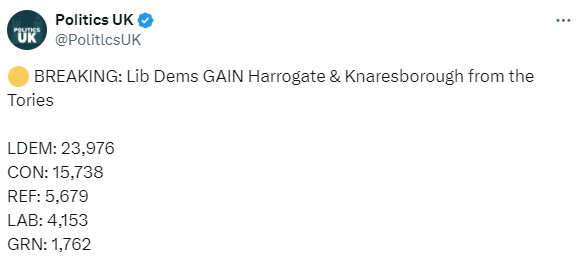
The Liberal Democrats have smashed their first hole in the Blue Wall, winning Harrogate and Knaresborough from the Conservatives on a 16 per cent swing. The Tories are down 22, Lib Dems up 10, and Reform UK are up 11. Andrew Jones had gained the seat from the Yellow Peril in 2010, and had held it at every election since.
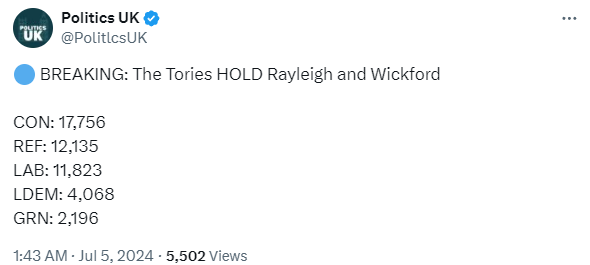
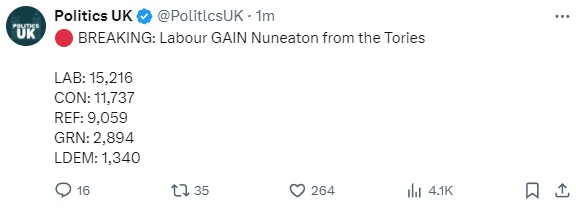
In happier news, Mark Francois has held on in Rayleigh and Wickford – the first Conservative hold of the night. Last time around, the Chairman of the ERG had a majority of over 30,000. Now he has a majority of just over 5,000 over Reform UK. Meanwhile, Labour have gained the traditional bellweather of Nuneaton on a 19 per cent swing.
01:30 AM
Henry Hill reporting.
At the time of writing, the forecast turnout is 54 per cent. The final number will obviously be higher – that figure is based on the results so far, which have all been in safe Labour seats where we might expect a lower share. But it ties into anecdotal reports from polling stations about a relatively sluggish day.
We must hope it’s higher, anyway, because otherwise it would be the lowest turnout since 1918, when it was 57.2 per cent. The modern nadir was 59.4 per cent, in 2001.
Unless it is significantly higher, however, the turnout will just add to the slightly strange aura around this election. When Tony Blair stormed into Downing Street in 1997, it was on 71.4 per cent of the vote. Sir Keir Starmer looks set to win a larger majority than ever he did, on both a lower vote share and lower overall turnout.
That may, in part, simply be a sign of changing times; 1997 was actually the lowest turnout since 1935. It may also simply be an artefact of the result being a forgone conclusion: close-run elections, such as February 1974, 1992, and 2017, tend understandably to have higher turnout than less exciting contests.
But we should not discount the role of sheer lack of enthusiasm on the part of the public. The voters want to turf the Tories out – and they have, and then some – but there’s little buzz around Labour, with its thin manifesto and relatively unpopular leader. And that’s before you count rumours that Yvette Cooper might have lost her seat to Reform…
If so, it would be yet more evidence that attempts to paint this result as a decisive turn of the page, and the advent of a new and more stable era of British politics, may be proven by history to be rather naïve.
If Labour can’t break this country’s two-decade economic stall, bring immigration down to sustainable levels, make progress on the housing crisis, and find a way to put our unsustainable public spending commitments on a surer footing, we may sooner or later get another of those exciting, high-turnout elections – and Heaven knows what the result might be.
01:15 AM
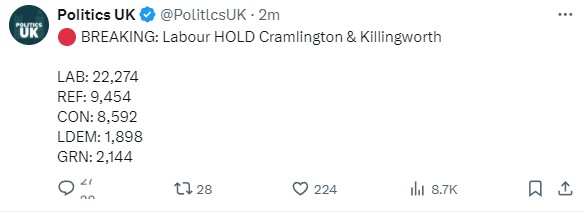
Ian Levy has lost in Cramlington. His unexpected victory in Blyth in 2019 was the first sign that the Red Wall was falling. He has now come third in the new constituency behind Reform UK. Based on boundary changes, this was already a Labour seat, and the Tories were expected to come third. But this will confirm the wipeout of Red Wall Conservative MPs that the exit polls suggested.
On a happier note:
01:00 AM
Henry Hill reporting.
Unfortunately, the BBC have taken the cautious (one might say cowardly…) approach to their map of the exit poll, with a swathe of seats listed as “too close to call”. But during Jeremy Vine’s death march down the wall of Conservative seats at the start of proceedings, there seemed to be relatively few losses to Reform UK – something in the region of four or five.
So where are the rest of the thirteen predicted gains supposed to come from? Well, the answer seems to be… Labour?
We have already seen Reform post some very impressive results in the safe Labour holds which traditionally kick off election night. But there is growing chatter about a breakthrough for Nigel Farage’s party in Barnsley. More extraordinary still, there is apparently concern at Labour HQ that Yvette Cooper, the New Labour veteran and Shadow Home Secretary, might be unseated.
We’ll have to see how that pans out. But the overall pattern raises an interesting prospect. To date, the assumption has been that the next Parliament would see the Conservatives and Reform fighting like rats in a sack over the rump right-wing vote. Yet what if Farage and co espy richer pickings in Labour areas?
Obviously they still still be fighting the Tories, and it is absolutely not good for the party to have a viable challenger to its right. But much as the above could simply be wishful thinking by battered Conservatives, it would make sense.
In Opposition, the Conservatives will have more flexibility to tack rightwards, at least rhetorically, to stem any mortal bleed to Reform. They will also simply no longer be in government. It will be Labour presiding over a difficult economic picture, making controversial decisions, and likely failing to deliver the results on either legal or illegal immigration that many voters expect.
In such circumstances, it might simply make strategic sense for Reform to focus on targeting incumbents in seats where they are well-positioned; some of those will be in seats where the Conservatives are competitive, but based on the results we’ve had so far, many of them won’t be.
Such an outcome would be a short-term boon for the Tories. But it might have a steep long-term cost: the final loss of the opportunity to capture the realignment within an hegemonic Conservative Party, as Boris Johnson might have done after 2019. If the Red Wall (and other areas) end up switching to Reform in a structural way, it could fundamentally change the electoral geography of the UK in a way that makes life difficult for both the major parties.
12:45 AM
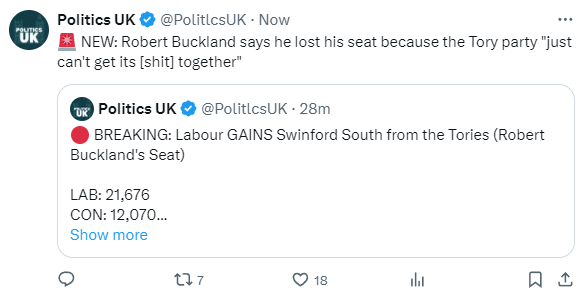
Robert Buckland is not a happy man.
Meanwhile, two green shoots of some of the other underlying stories of the night.

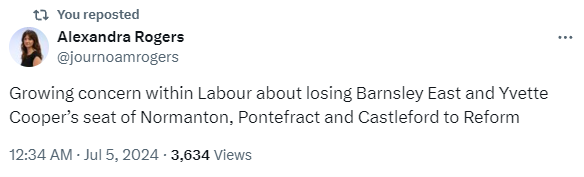
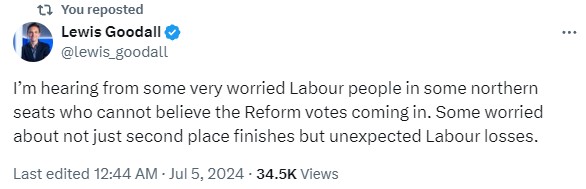
Will Reform take more seats off Labour than the Conservatives? How many dozens will they come second in? And how many will they lose in 2029?
12:30 AM
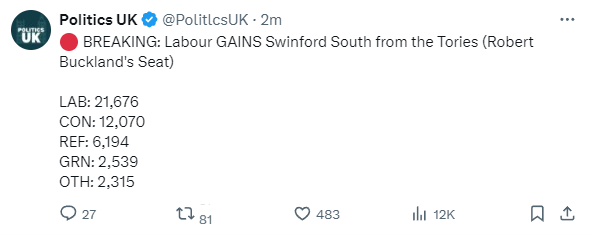
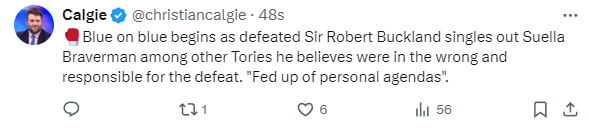
The first Tory loss of the night. Robert Buckland, the former Justice Secretary, has lost in Swindon South. He has held the seat since 2010. A majority of 6,625 has been turned into a majority of 9, 606 for Heidi Alexander, a former Labour MP returning to Parliament. The Labour vote is down 8 per cent, the Conservative vote down 25 per cent – a swing from 16 per cent from the Conservatives to Labour. Reform won 14 per cent of the vote.
The post-election mudslinging has begun:
Hat-tip to The Guardian, but we have a greater sense of Reform’s success in the northern seats declared so far. Houghton and Sunderland, a 16 per cent Brexit party vote in 2019 has become a 29 per cent Reform UK vote. In Blyth and Ashington, a 9 per cent Brexit party vote in 2019 has become a 27 per cent Reform UK vote. In Sunderland Central, a 12 per cent Brexit party vote has become a 27 per cent Reform UK vote.
12:15 AM
Henry Hill reporting.
The main focus of the night has been, understandably, the main parties. But if the exit poll is correct (and that is an if, see below), this election has produced a truly remarkable result in Scotland: the Scottish National Party, which in 2015 took all but three seats north of the border and was supposedly on the cusp of breaking up the United Kingdom, reduced to ten seats.
Ten seats.
Some forecasts are even worse; this screenshot is going around of the favoured (as opposed to probabilistic) and has the Nats on just seven…

Now we should be cautious about that precise result. The great sage, Sir John Curtice, has warned that the exit poll’s results in Scotland are based on fewer data points than the figures for the national parties. So there is plenty of scope for the results to be wrong. But presumably not so wrong that this isn’t going to prove a horrible night for the Nationalists.
Most of the credit for that goes to Labour, which looks set to recreate General Sherman’s march to the sea through those heartlands Nicola Sturgeon wrested from it after the referendum a decade ago. But the exit poll also suggests a very good night for the Conservatives, who have doubled their seat count. If those ‘favoured’ forecasts ban out, it looks like this:
Retained:
- >Berwickshire, Roxburgh and Selkirk (John Lamont)
- >Dumfries and Galloway (John Cooper)
- >Dumfriesshire, Clydesdale and Tweeddale (David Mundell)
- >Gordon and Buchan (Harriet Cross)
- >North Aberdeenshire and Moray East (Douglas Ross)
- >West Aberdeenshire and Kinkardine (Andrew Bowie)
Gained:
- >Aberdeen South (Douglas Lumsden)
- >Angus and Perthshire Glens (Stephen Kerr)
- >Argyll, Bute and South Lochaber (Amanda Hampsey)
- >Moray West, Nairn and Strathspey (Kathleen Robertson)
- >Perth and Kinross-shire (Luke Graham)
- >Stirling and Strathallan (Neil Benny)
If this bears out, that it will have a seismic impact on the already febrile situation inside the SNP goes without saying. But apart from the loss of Pete Wishart, who has served in the Commons since 2001, a Tory victory in Aberdeen South would mean the unseating of Stephen Flynn, the SNP’s Westminster leader who’s been touted as a potential leadership candidate. At least he’ll be free to seek a seat in the Scottish Parliament…
In fact, one veteran of the Better Together campaign put it to me that if these results are borne out, it would suggest that the only last impact of the 2014 referendum – which at one point looked as if it had turned Scotland into “Ireland without an Ulster”, according to one optimistic separatist in 2015 – has been to revive the Conservatives as the second party north of the border.
That feels a bit optimistic, and it is early in the night – another Tory source put it more prosaically as “basically the oil seats”. But if the SNP are on ten, that’s not much better than 2010, when on six seats they were a perennial but marginal force at Westminster.
But then, of course, they were entrenched in precisely the areas the Conservatives are now doing better in, having taken the ‘Tartan Tory’ vote after the collapse in 1997. Where would they be winning now?
- >Aberdeen North
- >Alloa and Grangemouth
- >Arbroath and Broughty Ferry
- >Dundee Central
- >Falkirk
- >Inverness, Skye and West Ross-shire
- >Kilmarnock and Loudoun
A smattering of seats across the Central Belt and the Highlands, but not the coherent heartland it had post-1997. Indeed, this would only play into the divisions playing out between the Sturgeonites, who want to cleave to the more progressive(-seeming) vision of the party cast by Sturgeon and aimed at Labour’s heartlands in Central Scotland, and the more centre-right version proffered by Kate Forbes, with a wary eye on the Tories in the party’s old rural fiefs.
12:00 AM
Three important results coming through in the next hour. Swindon South will declare at 12:15 AM, which had a Conservative majority in 6,000. Basildon and Billericay is expected to declare at the same time, where Richard Holden, the Conservative chairman, was parachuted in at the last minute. And Broxbourne – held by the Conservatives since 1983 – will declare at half past, which had a Tory majority of 19,000 in 2019.
The first and last are predicted to go to Labour. The middle is a toss-up, with a strong Reform vote expected. UKIP came third in 2015, but gained 16 per cent of the vote, and the seat voted to Leave. Reform have also come third in Sunderland Central, continuing their second-place finishes in the north-east. They were up 15 per cent, with a 7.7 per cent swing from Labour. Reform is also expected to win Hartlepool, to Peter Mandelson’s chagrin.
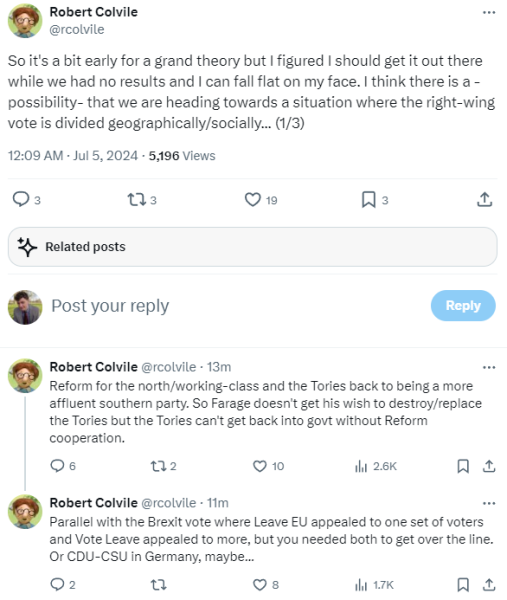
People might suggest Reform’s surge has come from nowhere. But these are all seats where UKIP and the Brexit Party previously did well, and which voted to Leave. The Conservatives united the Leave vote in 2019, in seats where the Brexit Party stood down. Now it has split. If it abandons these areas to Farage next time around and focuses on Labour and Liberal Democrat seats in the South, could a right-wing wave sweep to power in 2029?
Similar thoughts from Robert Colville of the Centre for Policy Studies:
11:30 PM
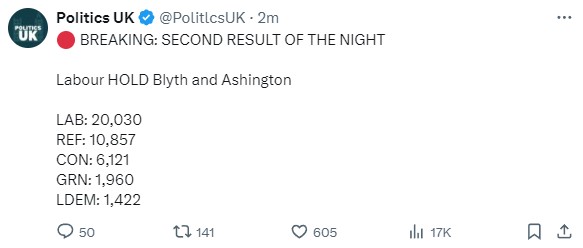
Another result – Blyth and Ashington – and another heavy swing to Reform pushed the Conservatives into third place. According to John Curtice, the Labour rise is as expected, but the Reform increase is less than expected, and the Conservative vote higher. A heavier Con-Reform vote has been expected based on their heavy Leave-voting nature. But the bread picture is the same: Labour slightly up, the Tories heavily down, and Reform surging.
The turnout for both is also consistent with the expected fall in turnout. Will it be as poor as 2001 – 59.4 per cent?
11:20 PM
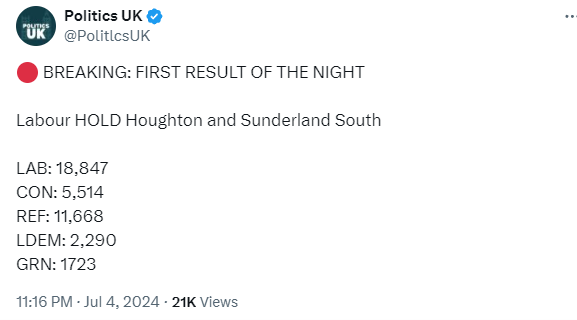
The first result of the night is in. Shadow Education Secretary Bridget Phillipson has held her constituency of Houghton and Sunderland South – with a huge swing to Reform. Will the first result of the 2029 general election involve Labour’s Education Secretary – or leader? – losing their seat to one of Nigel Farage’s crew?
11:15 PM
The first results we can expect are Blyth and Ashington and Houghton and Sunderland South, which are competing to be the first results.
According to the BBC, in 2019 Conservative seats, the Tory vote is down 28 per cent. The Labour vote is up 5 per cent, but the Reform vote is up 18 per cent. In 2019 Labour seats, the Tory vote is down 17 per cent, the Labour vote is down 1 per cent, the Reform vote is up 10 per cent, and the Green vote is up 4 per cent.
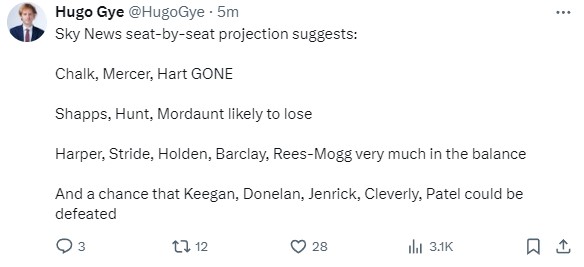
Meanwhile, Huge Gye – a friend of ConservativeHome – has a handy list of leading Tory figures likely to lose their seats. On the upside, George Galloway is predicted to lose in Rochdale. Every cloud…
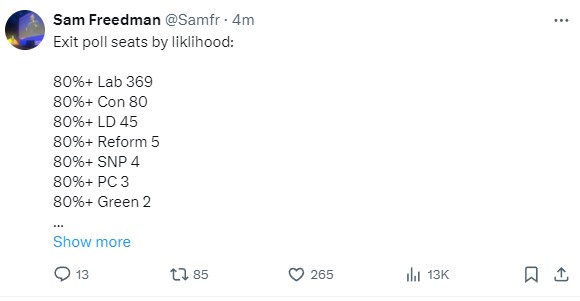
Sam Freedman also has a list of seats based on the likelihood of parties winning them. A Labour victory bigger than 2019’s Tory one looks very baked in.
11:00 PM
According to John Curtice, the Tory vote is falling heaviest in areas they already hold, due to the influence of Reform. Labour are doing particularly well against the SNP, whilst the Liberal Democrats are doing particularly well in many seats they lost in 2015 against the Conservatives. Curtice urges caution – the seat outcome could be different. But it does not follow that Labour have a landslide in terms of votes.
Electoral Calculus estimates published by GB News suggested Labour could secure 36.1 per cent – worse than Jeremy Corbyn in 2017 – with the Tories on 25.8 per cent, Reform on 17.2 per cent and the Lib Dems on 9.4 per cent. He also urges caution towards Reform winning 13 seats, and the SNP winning 10. There are fewer sampling points in Scotland – the exit poll over-estimated them in 2015 and 2019.
The truth is that Labour will have a substantial overall majority. But they will do it on a remarkably small share of the result. What if Reform gains more seats from them than the Conservatives?
10:45 PM
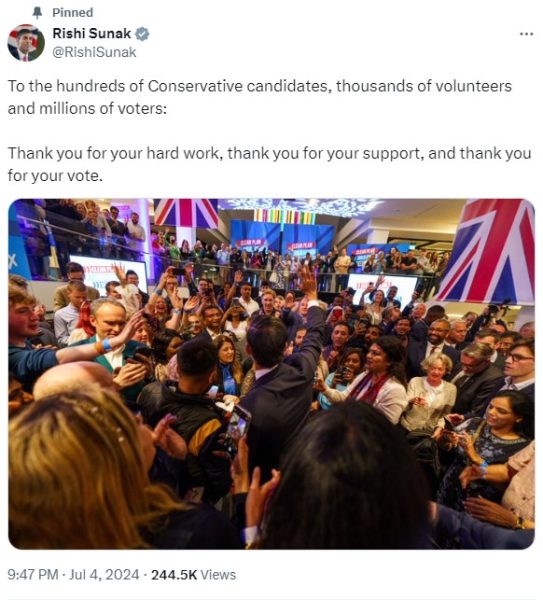
The Prime Minister’s response.
10:30 PM
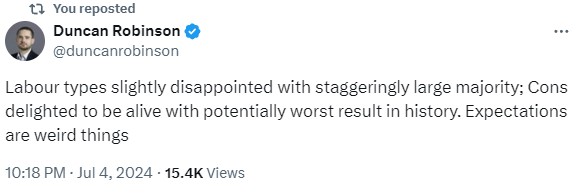
A simple summary of the current mood from Duncan Robinson of The Economist.
10:15 PM
It seems bizarre to cheer the Conservatives being reduced to 131 seats. But since that is a much better result than several final polls were suggesting, the party has crossed the barrier from terminal defeat, to survival.
131 seats is still, objectively, a disaster. It is worse than 1997. But it is recoverable. All that speculation about the party coming third, or the Prime Minister losing his seat, should now be for the birds. Starmer has not outperformed Tony Blair, even if we have done worse than John Major.
In terms of the smaller parties? Reform have performed at the high end of their expectations, the SNP at the low end of theirs. The SNP will be reduced to around the position they were in 2010. Labour’s vote is expected to rise by 18 per cent in Scotland, but fall in Wales and London. Experience of socialism in government?
Either way, as terrible as this is for Labour, and as absymal as a Starmer government will be – the Conservative Party has survived, and Labour have underperformed. The Tory vote has been efficient. The undecideds should have come home. We ride again.
Then again, it is an exit poll.
10:00 PM
BBC exit poll:
Conservative: 131
Labour: 410
Reform UK: 13
SNP: 10
Liberal Democrats: 61
Plaid Cymru: 4
Greens: 2
Labour majority of 170.
9:45 PM
William Atkinson reporting
Welcome to the ConservativeHome 2024 general election live blog. I wish the occasion were a cheerier one. But fifteen minutes from the close of voting and the exit poll, all the final polls point towards a record Conservative defeat and a Labour landslide.
The question the Conservative Party faces tonight is: who will cling on? Will it be 150 seats, or 50? Will enough leadership contenders survive that we can have a contest? Or will a generation of Tory talent be struck down in their prime? Will the Red Wall and the Blue Wall fall beneath a Labour-Lib Dem wave? Will the party be pushed out of London, Scotland, and Wales?
CCHQ has been e-mailing members to suggest turnout is higher than expected. Was this a last minute bluff to get reluctant voters into the polling booth? Or have more turned out for what has been one of the least-enthusing elections imaginable? What will that mean for results? A Tory over-performance? A Reform surge? Or a further addition to a Labour majority to make Tony Blair blush?
Is this the election that finally ends SNP hegemony in Scotland? That brings the Greens a second seat? And finally gets Nigel Farage into the House of Commons? How will George Galloway and his cronies fare? For a campaign that has often seemed unexciting, there is a surprising uncertainty about what tonight will bring, in broad parameters. Which pollster will look silliest?
Not long until we find out. I fear it will be a very long night. But ConservativeHome will be with you all the way. Welcome, to Election 24.