Lord Ashcroft KCMG PC is an international businessman, philanthropist, author, and pollster. For more information on his work, visit lordashcroft.com.
We have surveyed 16,677 people who voted in the general election to help understand how Britain voted and why. The results show who switched from 2019, the reasons for their decisions, when they made their minds up, what they expect from the new government and more.
Who voted for whom
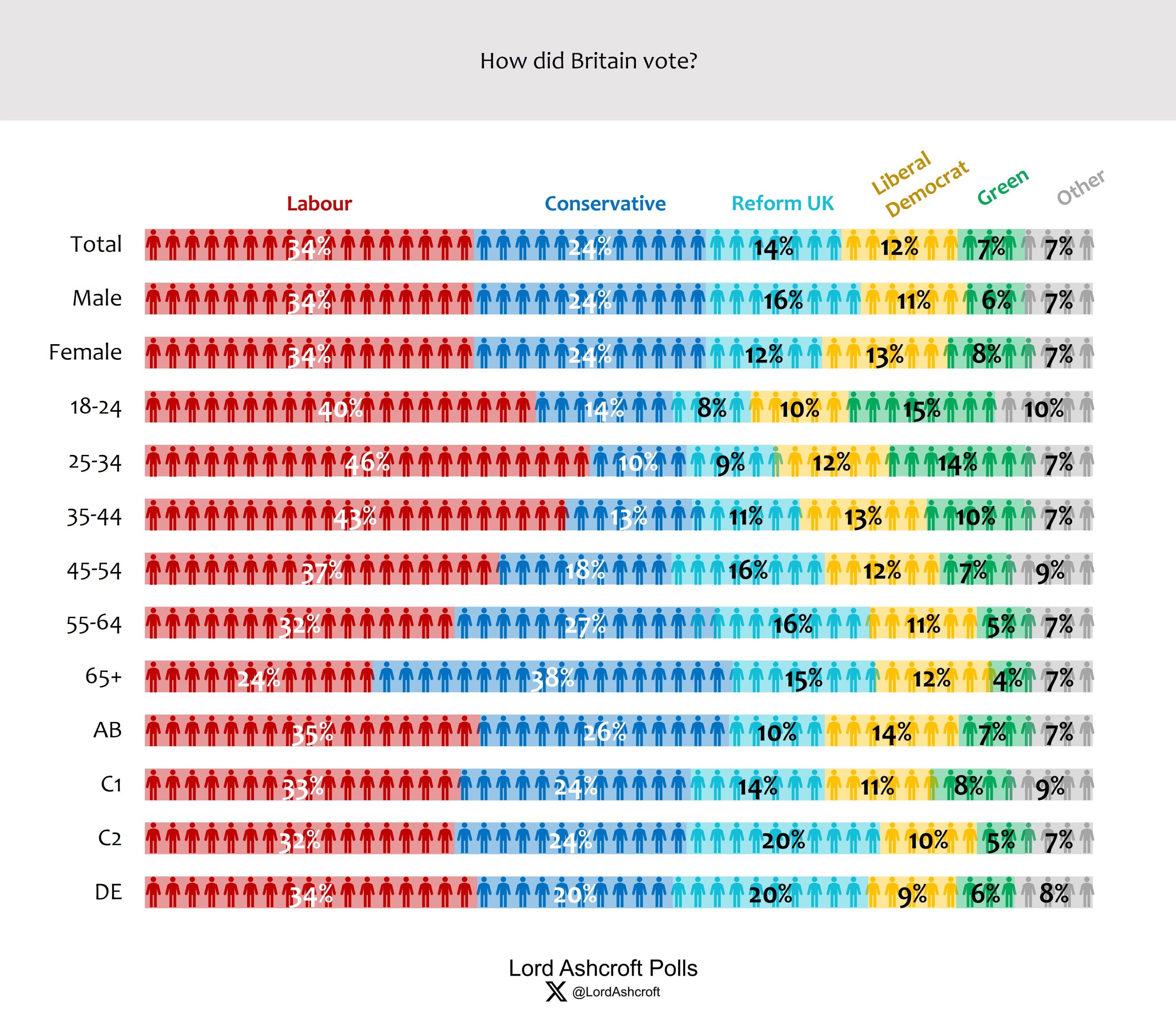
Labour beat the Conservatives by a 10-point margin among both men and women. Reform UK did slightly better among men (16 per cent) than women (12 per cent).
Labour won by a 25-point margin among 18-24s, with the Greens second on 15 per cent and the Conservatives third place on 14 per cent. The Conservatives were fourth among 25-34s and joint second among 35-44s. Labour won in every age group except those aged 65+, which the Conservatives won by 14 points.
Labour beat the Conservatives by nine points among voters in social groups AB and C1, eight points among C2, and 14 points among DEs.
Where did 2019 voters go?
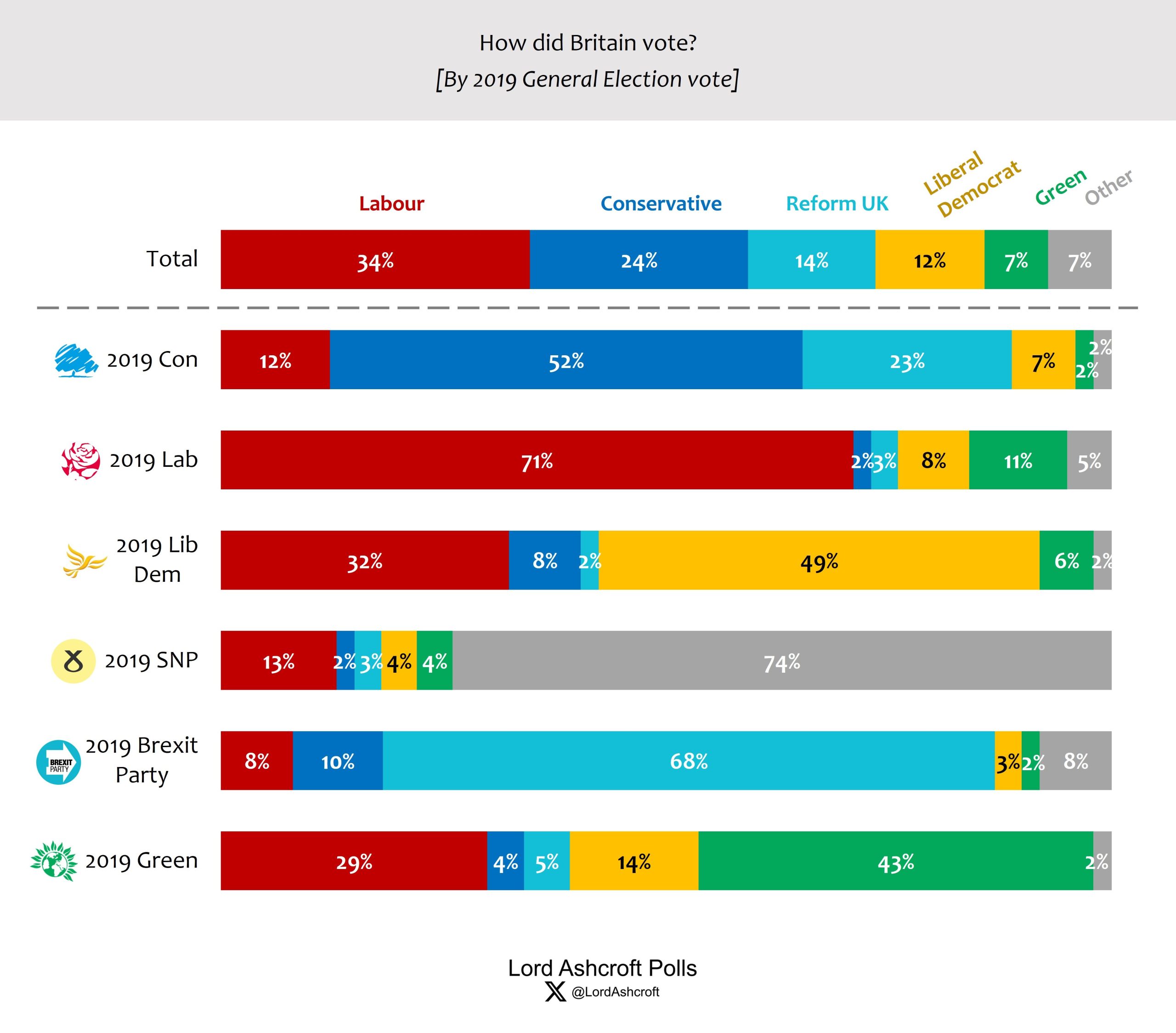
Just over half (52 per cent) of 2019 Conservatives who turned out at this election voted Tory again. Nearly a quarter (23 per cent) voted for Reform UK. 12 per cent switched to Labour and seven per cent to the Lib Dems.
Just over seven in ten 2019 Labour voters who turned out stayed with Labour (71 per cent), while 11 per cent went to the Greens and eight per cent to the Lib Dems. Just under half (49 per cent) of 2019 Lib Dems stayed with their former party, while nearly one in three (32 per cent) switched to Labour.
Just over seven in ten (71 per cent) 2019 SNP voters who turned out stayed with their former party, while 13 per cent switched to Labour; 15 per cent of those who voted Labour at this election said they had never voted Labour before.
When did people decide?

More than one in five voters (22 per cent) said they only decided which party to support on polling day, or on the day they filled in their postal vote. A further 14 per cent said they decided in the last few days. More than half (59 per cent) of voters said they decided at some point within the last month.
Three-quarters (75 per cent) of those who voted for Reform UK or the Liberal Democrats said they decided at some point within the last month, compared to 59 per cent of Tories and 41 per cent of Labour voters. Those who voted for the SNP were the most likely to say they always knew how they would end up voting (43 per cent).
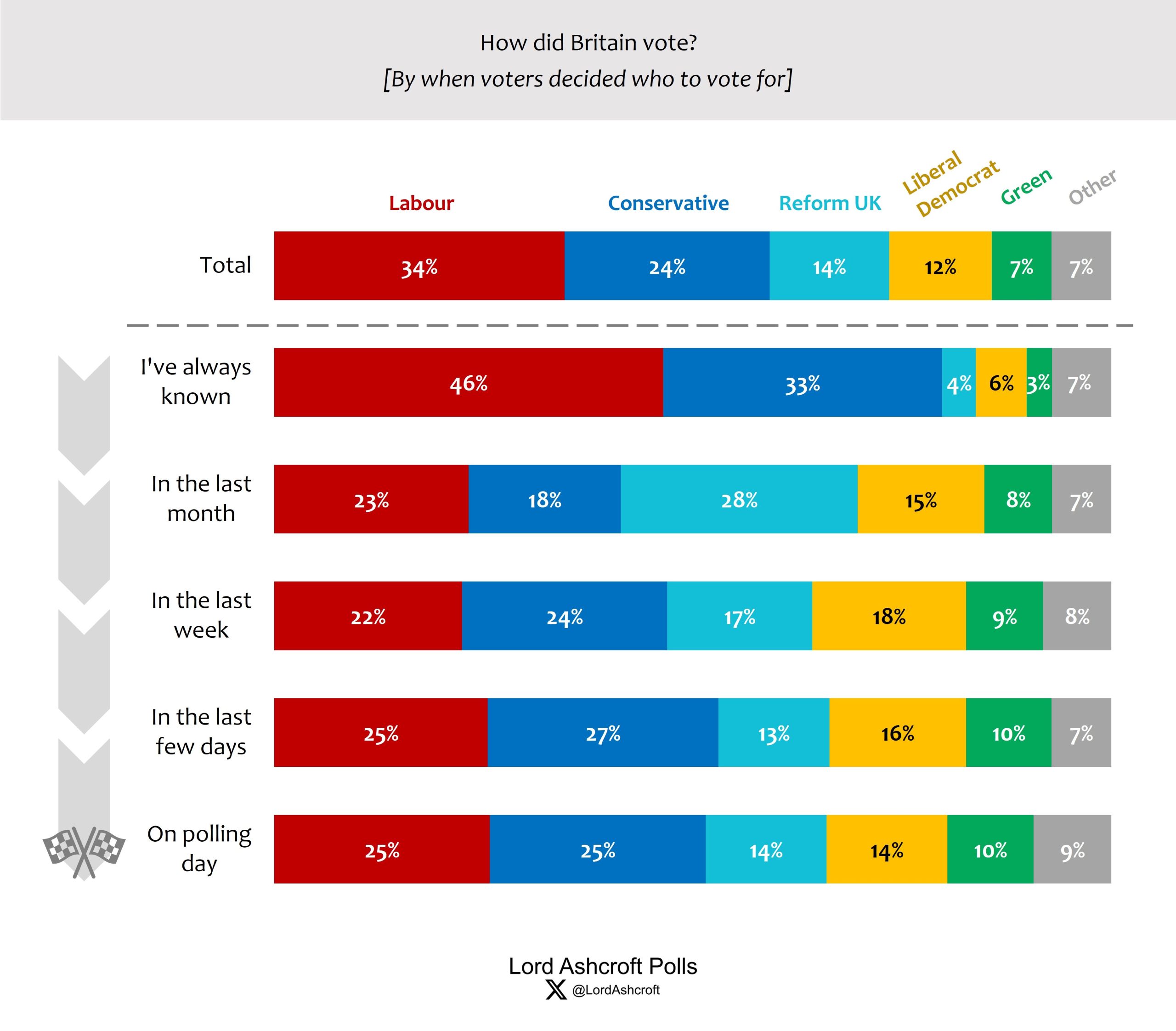
To look at the question from the other direction, those who decided on the day were evenly divided between Labour and the Conservatives (25 per cent each), with 14 per cent choosing the Lib Dems and a further 14 per cent Reform UK.
Among those who voted in person, Labour beat the Conservatives by a 12-point margin (35 per cent to 23 per cent). Among those who voted by post, the margin was five points (32 per cent to 27 per cent).
Was it hard to decide?

Four in ten of those who voted Labour said their voting decision was easier than usual, including 30 per cent saying it was much easier. More than half (51 per cent) of those who voted Conservative said their decision was harder than usual, including a quarter saying it was much harder.
Why did people vote as they did?
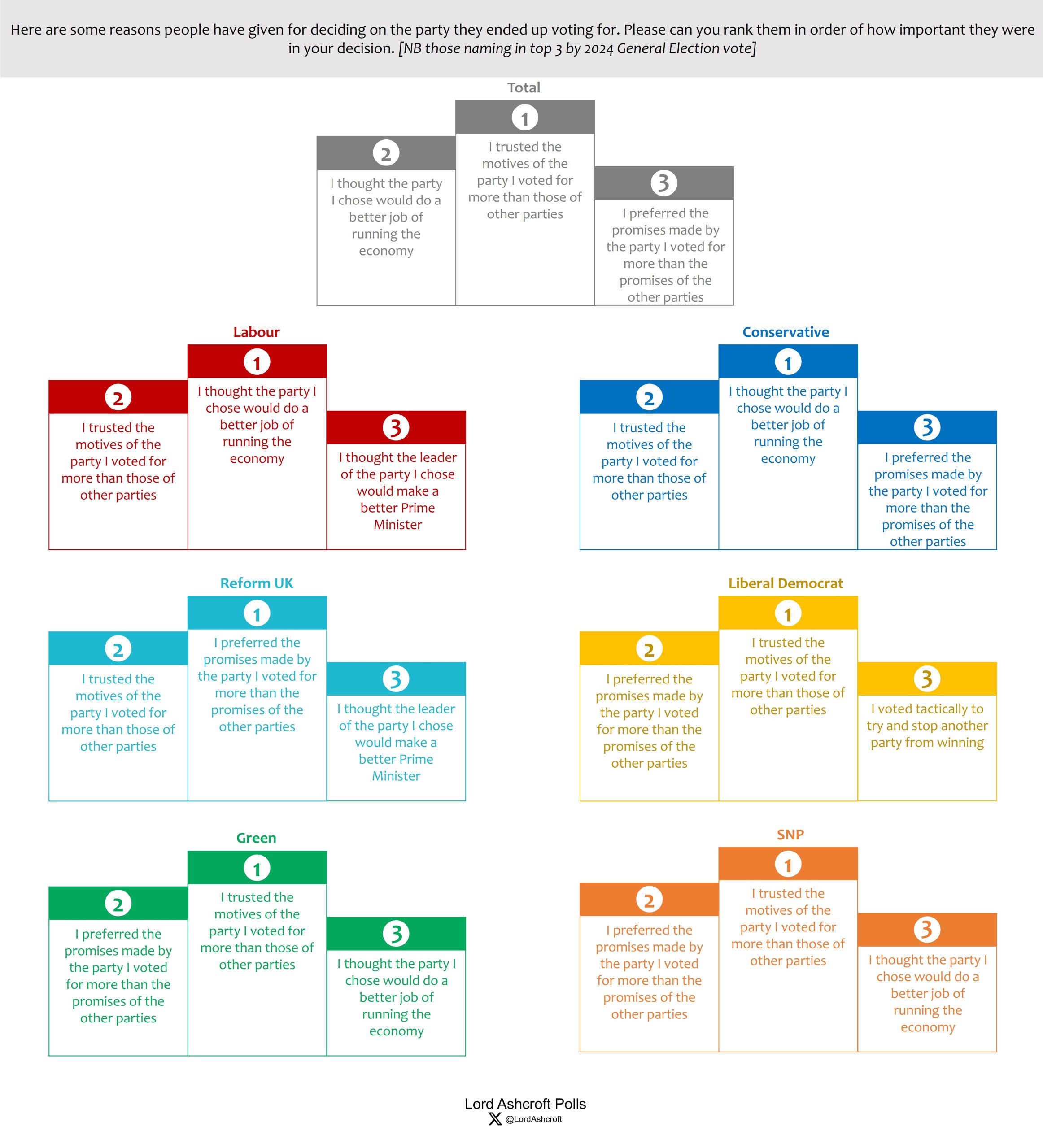
Just over six in ten (62 per cent) of those who voted Labour said one of their three main reasons was that they thought the Labour would do a better job of running the economy. Just over half (57 per cent) said they trusted the motives of Labour more than other parties, while 46 per cent thought Keir Starmer would make a better prime minister.
Among Conservative voters, 70 per cent said that thinking the Tories would do a better job on the economy was among their top three reasons, followed by trusting their motives more than those of other parties (51 per cent) and preferring their promises to those of other parties (45 per cent).
Just over three-quarters (76 per cent) of Reform UK voters said they preferred the parties’ promises to those of other parties. Nearly seven in ten (69 per cent) said they trusted the parties’ motives more than those of other parties, and more than half (59 per cent) thought their leader would make the best prime minister.
Those voting Lib Dem were the most likely to say they were voting tactically to stop another party from winning (51 per cent), but this was the third most important reason overall: trusting the party’s motives (65 per cent) and preferring its promises (57 per cent) were named more often.
Tactical voting
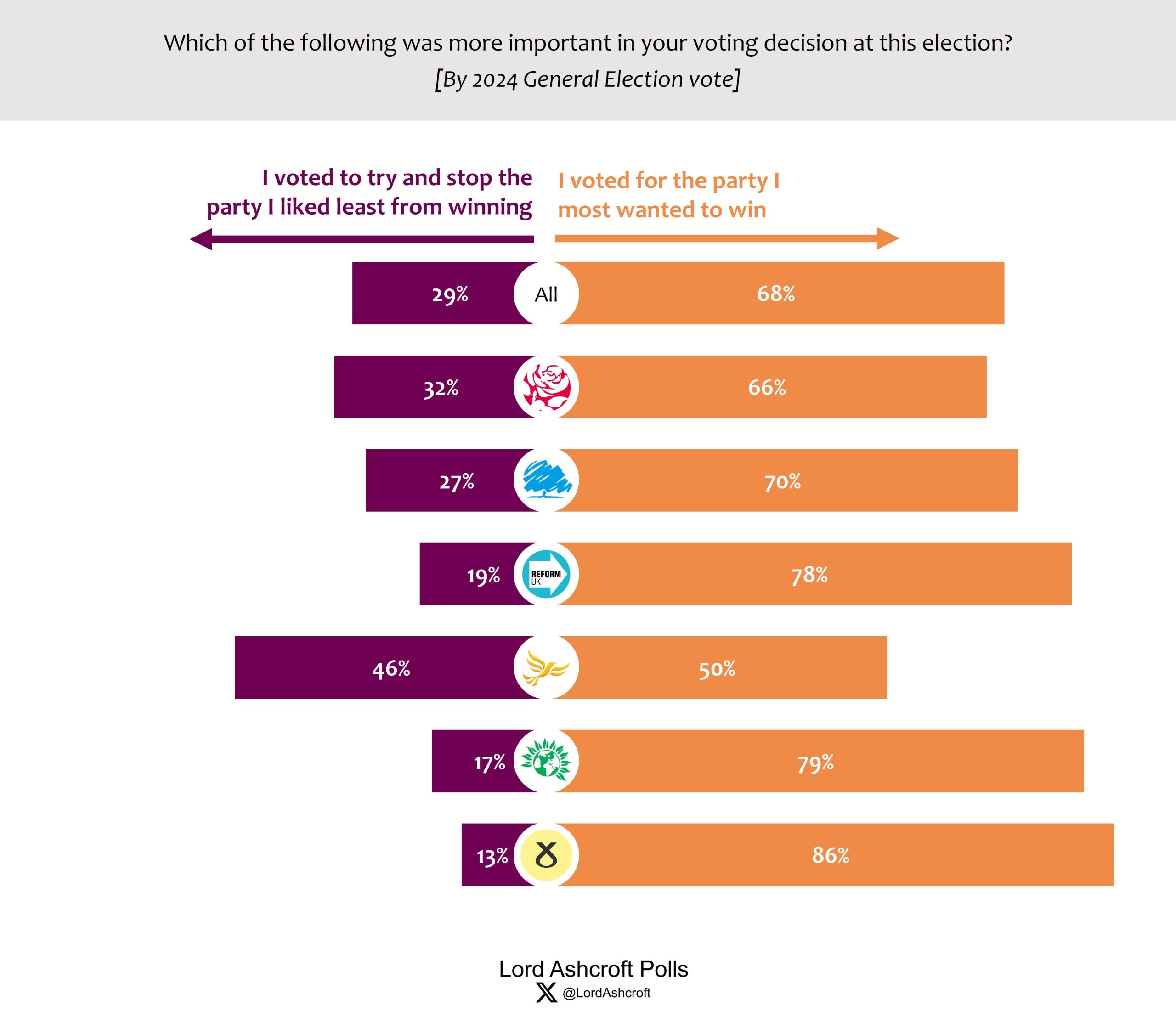
Two-thirds (66 per cent) of those who voted Labour said they were voting for the party they most wanted to win. One in three (32 per cent) said they were voting to try and stop the party they liked least from winning.
Those who voted Lib Dem were closely divided between voting for the party they most wanted to win (50 per cent) and voting to stop the party they liked least (46 per cent).
Those who voted SNP (86 per cent), Green, Plaid Cymru (both 79 per cent) and Reform (78 per cent) were the most likely to say they were backing the party they most wanted to win.
Most important issues
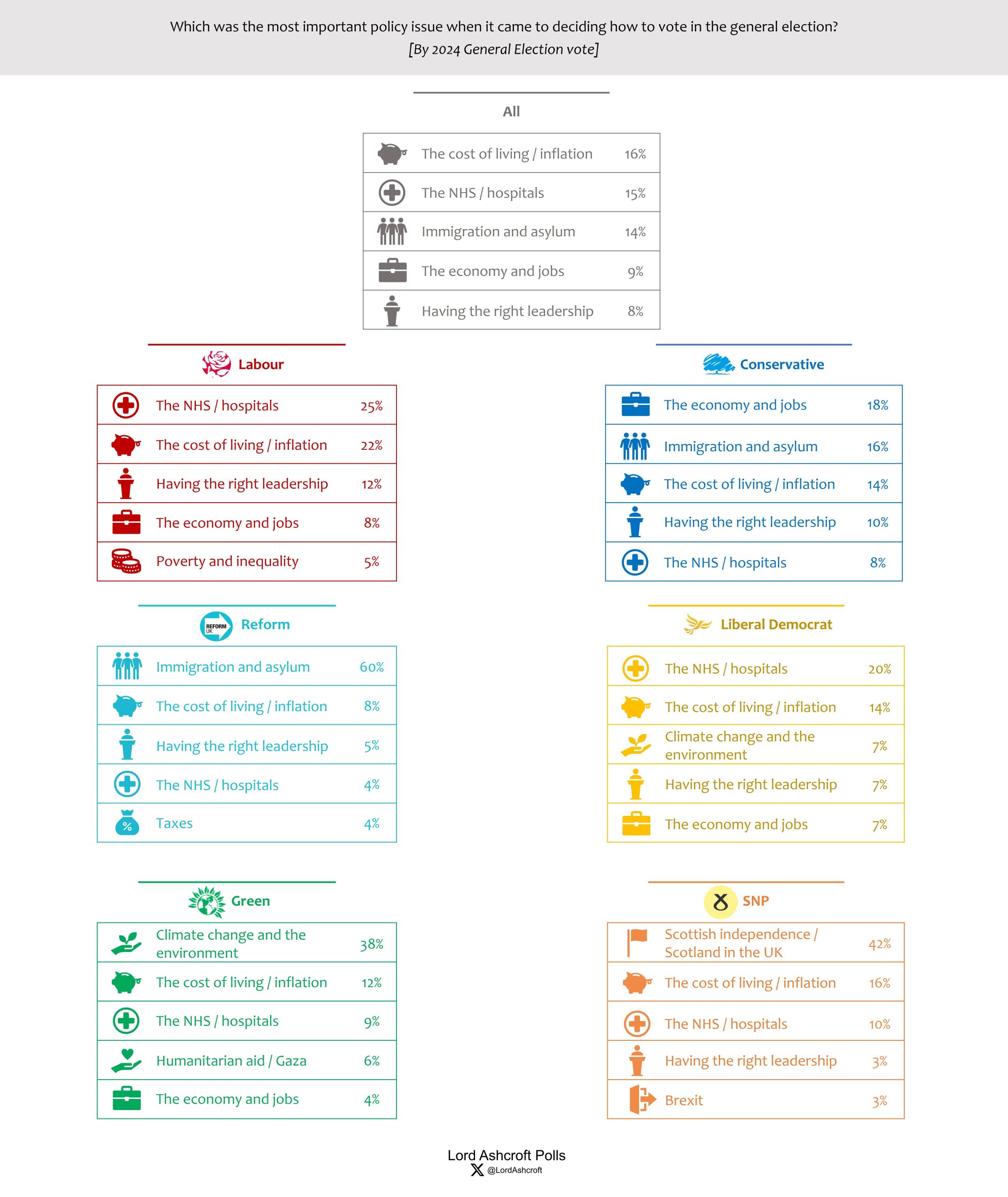
We asked people to state unprompted which was the most important policy issue when it came to deciding how to vote. Overall, the three issues most named issues were the cost of living, the NHS and immigration.
For Labour and Lib Dem voters, the most important issue was the NHS, followed closely by the cost of living. For Conservative voters it was the economy, followed closely by immigration. 60 per cent of Reform voters named immigration, with all other issues in single figures.
63 per cent of 2019 Conservatives switching to Reform named immigration as the most important issue. Conservative-Labour switchers were most likely to name the cost of living, followed closely by the NHS.
Why did 2019 Tories switch?
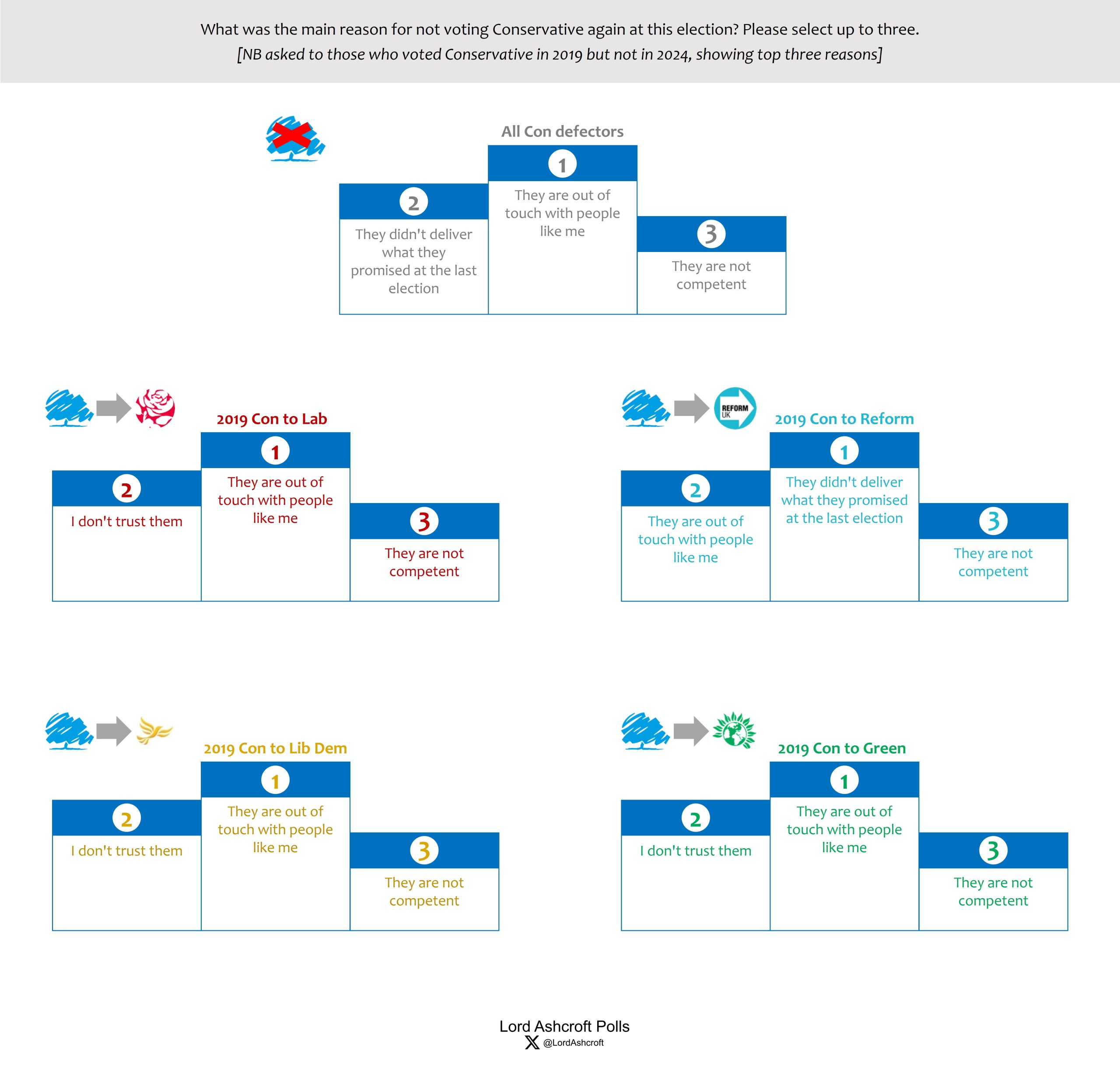
We asked those who voted Conservative in 2019 but not in 2024 why they moved away from the party. The most important reasons were that “they are out of touch with people like me” (36 per cent naming in the top three), that “they didn’t deliver what they promised” (35 per cent) and that “they’re not competent” (30 per cent), while 28 per cent said “I don’t trust them”. Just over one in five (21 per cent) chose “partygate and other scandals”.
For switchers to Reform UK, the most important reason was that “they didn’t deliver what they promised” (46 per cent), followed by “they are out of touch with people like me” (36 per cent).
Overall, 14 per cent of Conservative defectors said “they were not Conservative enough” and three per cent that “they had moved too far to the right”.
Only seven per cent said they were enthusiastic about the party they voted for instead (rising to 12 per cent among those switching to Reform UK).
Back to the Tories next time?
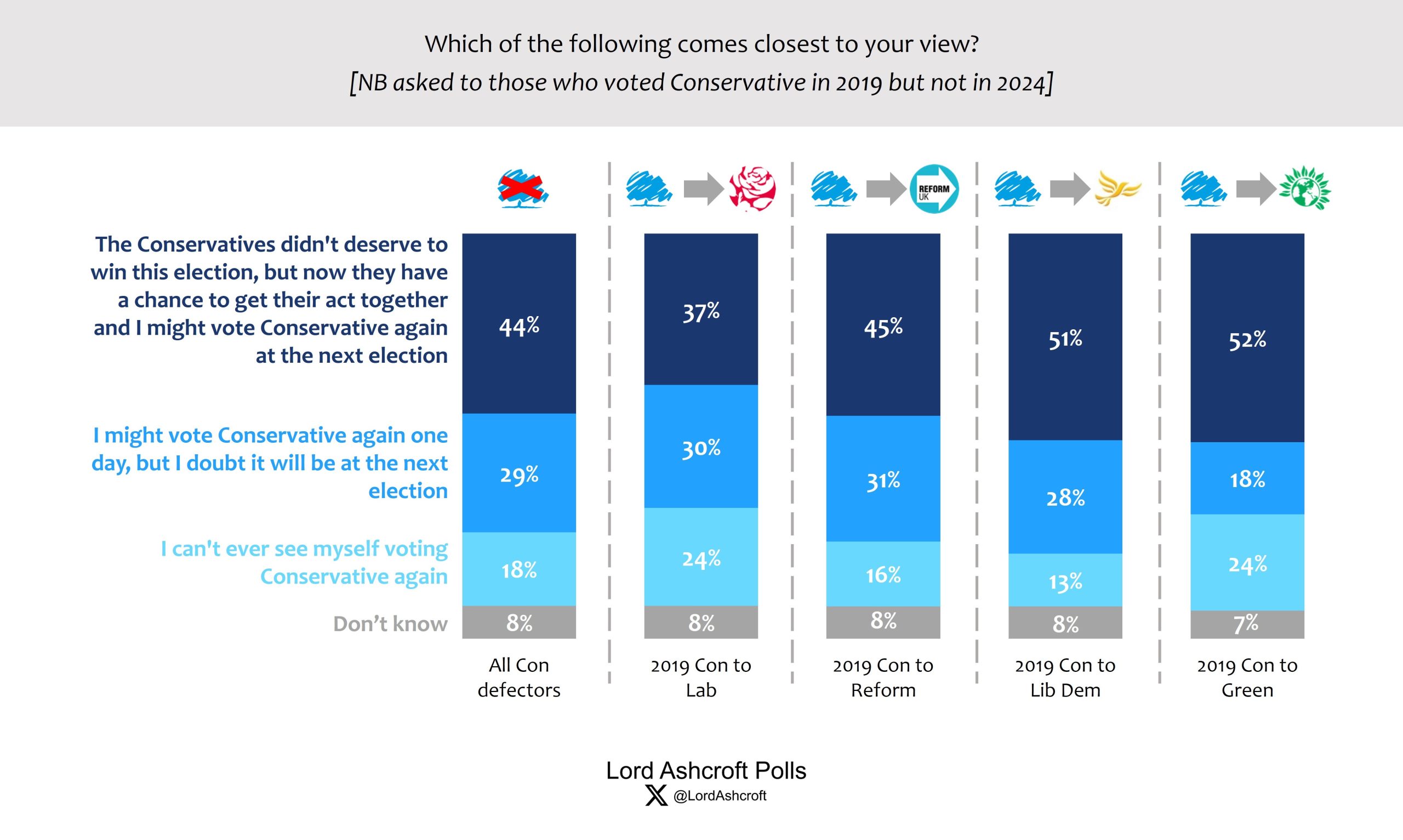
Just under half (44 per cent) of 2019 Tories switching to other parties said they could consider voting back to the Conservatives at the next election. Just under three in ten (29 per cent) said they might do so again one day, but doubted it would be at the next election. Just under one in five (18 per cent) said could never see themselves voting Conservative again – though those switching to Labour were more likely to say this (24 per cent) than those switching to Reform (16 per cent).
Expectations of Labour
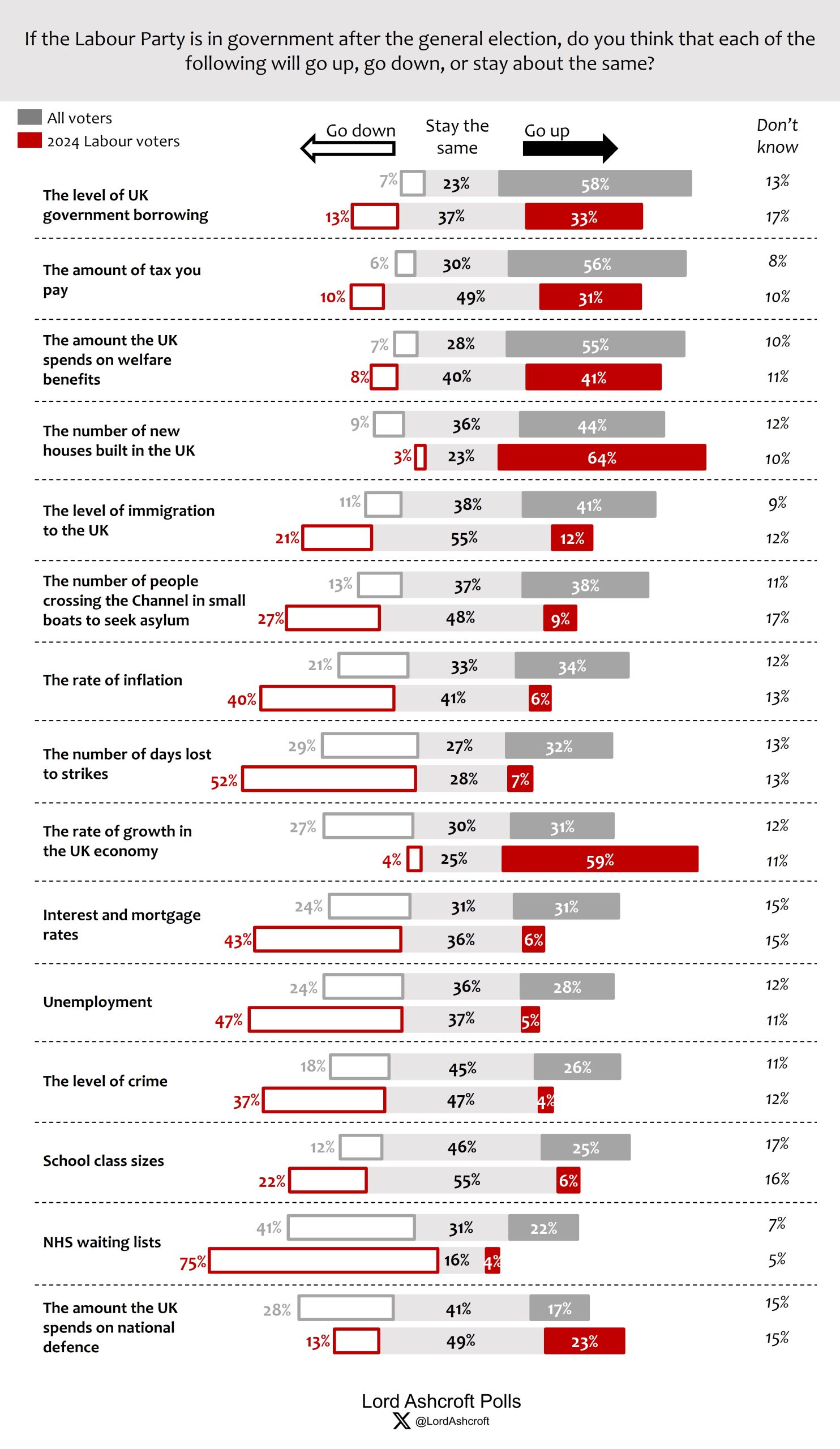
Voters as a whole were more likely to expect taxes, borrowing, welfare spending, immigration, small boat migration, inflation and crime to rise than to fall under the Labour government. They also expected house building to rise rather than fall, and NHS waiting lists to fall rather than rise.
Among Labour voters, expectations were highest for new home building (64 per cent expecting more), economic growth (59 per cent expecting an increase), days lost to strikes (52 per cent expecting a fall), unemployment (47 per cent expecting a fall), interest and mortgage rates (43 per cent expecting a fall), and – especially – NHS waiting lists (75 per cent expecting a reduction).
Leavers and Remainers
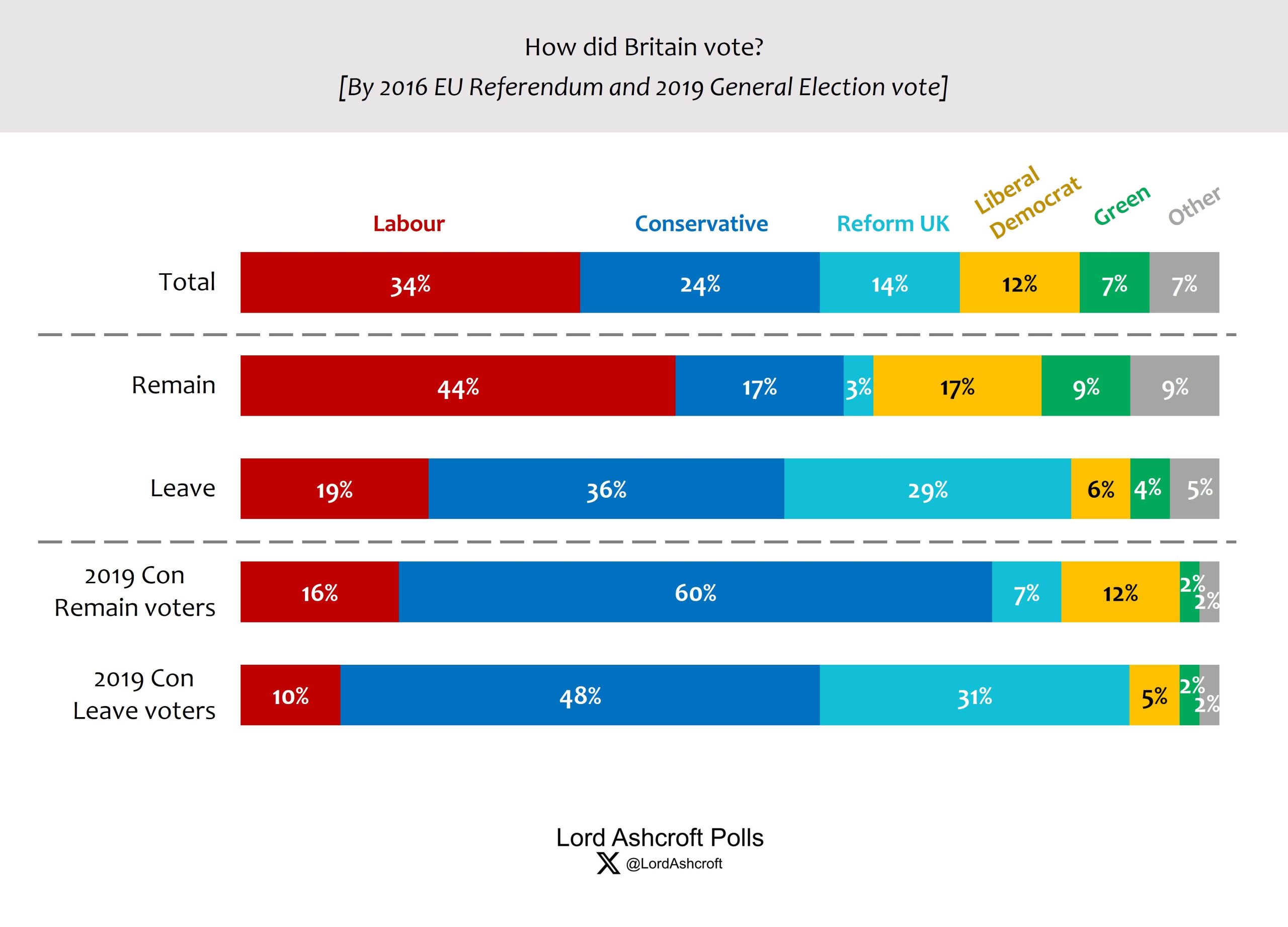
Just over one in three of those who voted Leave in the 2016 referendum (36 per cent) voted Conservative, while 29 per cent voted Reform UK. Just under one in five (19 per cent) voted Labour; 44 per cent of Remain voters backed Labour. 17 per cent voted Lib Dem and 17 per cent voted Conservative.
Six in ten 2019 Conservatives who voted Remain backed the Tories. Fewer than half (48 per cent) of 2019 Conservatives who voted Leave stayed with the Conservatives, while just over three in ten (31 per cent) switched to Reform UK.
Cultural attitudes
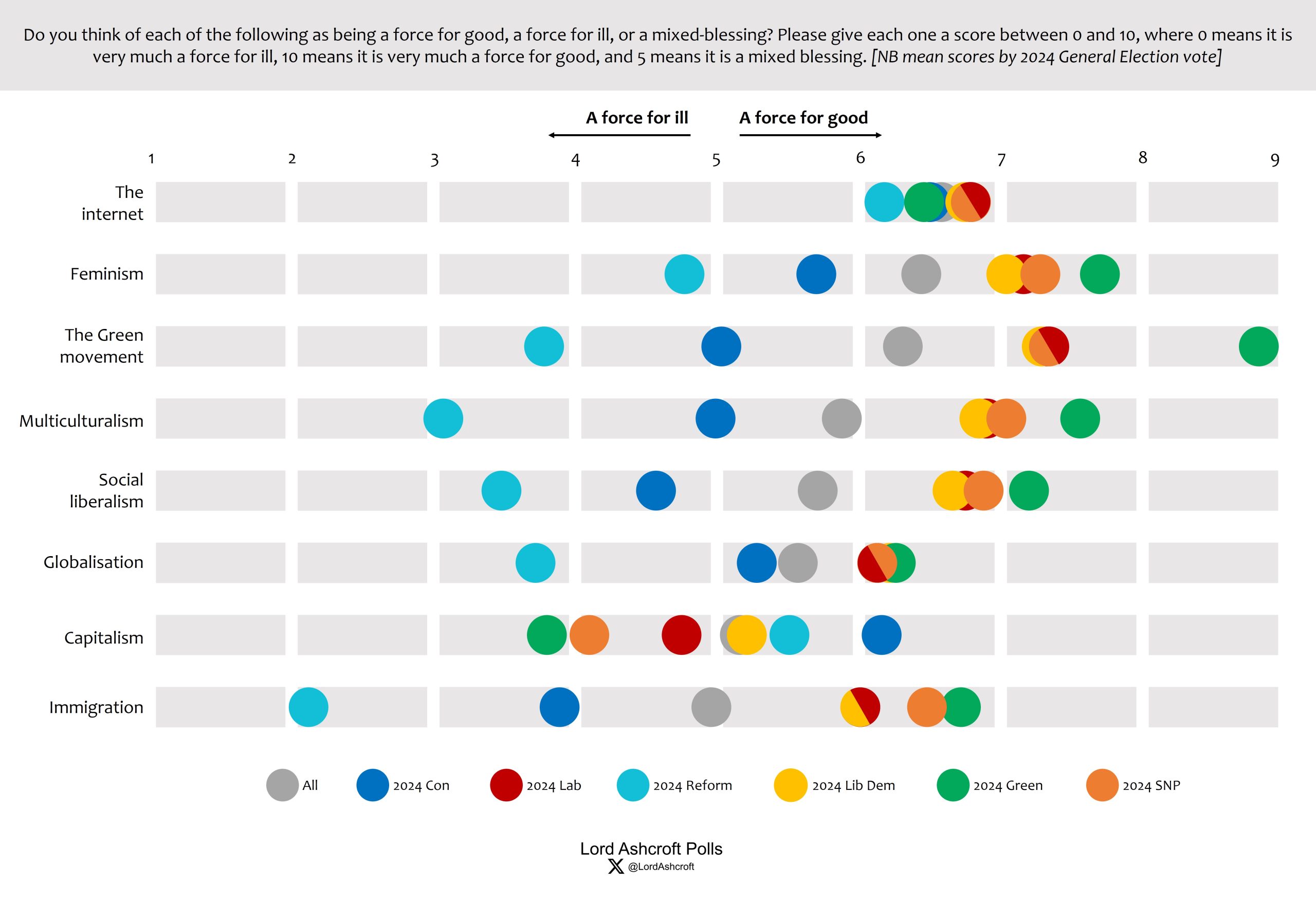
We asked voters whether they thought multiculturalism, social liberalism, feminism, the green movement, globalisation, the internet, capitalism and immigration were a force for good, a force for ill, or a mixed blessing.
Full data at LordAshcroftPolls.com
Lord Ashcroft KCMG PC is an international businessman, philanthropist, author, and pollster. For more information on his work, visit lordashcroft.com.
We have surveyed 16,677 people who voted in the general election to help understand how Britain voted and why. The results show who switched from 2019, the reasons for their decisions, when they made their minds up, what they expect from the new government and more.
Who voted for whom
Labour beat the Conservatives by a 10-point margin among both men and women. Reform UK did slightly better among men (16 per cent) than women (12 per cent).
Labour won by a 25-point margin among 18-24s, with the Greens second on 15 per cent and the Conservatives third place on 14 per cent. The Conservatives were fourth among 25-34s and joint second among 35-44s. Labour won in every age group except those aged 65+, which the Conservatives won by 14 points.
Labour beat the Conservatives by nine points among voters in social groups AB and C1, eight points among C2, and 14 points among DEs.
Where did 2019 voters go?
Just over half (52 per cent) of 2019 Conservatives who turned out at this election voted Tory again. Nearly a quarter (23 per cent) voted for Reform UK. 12 per cent switched to Labour and seven per cent to the Lib Dems.
Just over seven in ten 2019 Labour voters who turned out stayed with Labour (71 per cent), while 11 per cent went to the Greens and eight per cent to the Lib Dems. Just under half (49 per cent) of 2019 Lib Dems stayed with their former party, while nearly one in three (32 per cent) switched to Labour.
Just over seven in ten (71 per cent) 2019 SNP voters who turned out stayed with their former party, while 13 per cent switched to Labour; 15 per cent of those who voted Labour at this election said they had never voted Labour before.
When did people decide?
More than one in five voters (22 per cent) said they only decided which party to support on polling day, or on the day they filled in their postal vote. A further 14 per cent said they decided in the last few days. More than half (59 per cent) of voters said they decided at some point within the last month.
Three-quarters (75 per cent) of those who voted for Reform UK or the Liberal Democrats said they decided at some point within the last month, compared to 59 per cent of Tories and 41 per cent of Labour voters. Those who voted for the SNP were the most likely to say they always knew how they would end up voting (43 per cent).
To look at the question from the other direction, those who decided on the day were evenly divided between Labour and the Conservatives (25 per cent each), with 14 per cent choosing the Lib Dems and a further 14 per cent Reform UK.
Among those who voted in person, Labour beat the Conservatives by a 12-point margin (35 per cent to 23 per cent). Among those who voted by post, the margin was five points (32 per cent to 27 per cent).
Was it hard to decide?
Four in ten of those who voted Labour said their voting decision was easier than usual, including 30 per cent saying it was much easier. More than half (51 per cent) of those who voted Conservative said their decision was harder than usual, including a quarter saying it was much harder.
Why did people vote as they did?
Just over six in ten (62 per cent) of those who voted Labour said one of their three main reasons was that they thought the Labour would do a better job of running the economy. Just over half (57 per cent) said they trusted the motives of Labour more than other parties, while 46 per cent thought Keir Starmer would make a better prime minister.
Among Conservative voters, 70 per cent said that thinking the Tories would do a better job on the economy was among their top three reasons, followed by trusting their motives more than those of other parties (51 per cent) and preferring their promises to those of other parties (45 per cent).
Just over three-quarters (76 per cent) of Reform UK voters said they preferred the parties’ promises to those of other parties. Nearly seven in ten (69 per cent) said they trusted the parties’ motives more than those of other parties, and more than half (59 per cent) thought their leader would make the best prime minister.
Those voting Lib Dem were the most likely to say they were voting tactically to stop another party from winning (51 per cent), but this was the third most important reason overall: trusting the party’s motives (65 per cent) and preferring its promises (57 per cent) were named more often.
Tactical voting
Two-thirds (66 per cent) of those who voted Labour said they were voting for the party they most wanted to win. One in three (32 per cent) said they were voting to try and stop the party they liked least from winning.
Those who voted Lib Dem were closely divided between voting for the party they most wanted to win (50 per cent) and voting to stop the party they liked least (46 per cent).
Those who voted SNP (86 per cent), Green, Plaid Cymru (both 79 per cent) and Reform (78 per cent) were the most likely to say they were backing the party they most wanted to win.
Most important issues
We asked people to state unprompted which was the most important policy issue when it came to deciding how to vote. Overall, the three issues most named issues were the cost of living, the NHS and immigration.
For Labour and Lib Dem voters, the most important issue was the NHS, followed closely by the cost of living. For Conservative voters it was the economy, followed closely by immigration. 60 per cent of Reform voters named immigration, with all other issues in single figures.
63 per cent of 2019 Conservatives switching to Reform named immigration as the most important issue. Conservative-Labour switchers were most likely to name the cost of living, followed closely by the NHS.
Why did 2019 Tories switch?
We asked those who voted Conservative in 2019 but not in 2024 why they moved away from the party. The most important reasons were that “they are out of touch with people like me” (36 per cent naming in the top three), that “they didn’t deliver what they promised” (35 per cent) and that “they’re not competent” (30 per cent), while 28 per cent said “I don’t trust them”. Just over one in five (21 per cent) chose “partygate and other scandals”.
For switchers to Reform UK, the most important reason was that “they didn’t deliver what they promised” (46 per cent), followed by “they are out of touch with people like me” (36 per cent).
Overall, 14 per cent of Conservative defectors said “they were not Conservative enough” and three per cent that “they had moved too far to the right”.
Only seven per cent said they were enthusiastic about the party they voted for instead (rising to 12 per cent among those switching to Reform UK).
Back to the Tories next time?
Just under half (44 per cent) of 2019 Tories switching to other parties said they could consider voting back to the Conservatives at the next election. Just under three in ten (29 per cent) said they might do so again one day, but doubted it would be at the next election. Just under one in five (18 per cent) said could never see themselves voting Conservative again – though those switching to Labour were more likely to say this (24 per cent) than those switching to Reform (16 per cent).
Expectations of Labour
Voters as a whole were more likely to expect taxes, borrowing, welfare spending, immigration, small boat migration, inflation and crime to rise than to fall under the Labour government. They also expected house building to rise rather than fall, and NHS waiting lists to fall rather than rise.
Among Labour voters, expectations were highest for new home building (64 per cent expecting more), economic growth (59 per cent expecting an increase), days lost to strikes (52 per cent expecting a fall), unemployment (47 per cent expecting a fall), interest and mortgage rates (43 per cent expecting a fall), and – especially – NHS waiting lists (75 per cent expecting a reduction).
Leavers and Remainers
Just over one in three of those who voted Leave in the 2016 referendum (36 per cent) voted Conservative, while 29 per cent voted Reform UK. Just under one in five (19 per cent) voted Labour; 44 per cent of Remain voters backed Labour. 17 per cent voted Lib Dem and 17 per cent voted Conservative.
Six in ten 2019 Conservatives who voted Remain backed the Tories. Fewer than half (48 per cent) of 2019 Conservatives who voted Leave stayed with the Conservatives, while just over three in ten (31 per cent) switched to Reform UK.
Cultural attitudes
We asked voters whether they thought multiculturalism, social liberalism, feminism, the green movement, globalisation, the internet, capitalism and immigration were a force for good, a force for ill, or a mixed blessing.
Full data at LordAshcroftPolls.com