James Wright is a farmer, agri-tech entrepreneur and southwest chair of the Conservative Rural Forum. He stood as the parliamentary candidate in Bath in 2024.
The 2024 general election marked a shift in the political landscape. Not only did we lose our majority, to a party with fewer votes than they won in 2019, but we lost traditionally safe seats across the country. A total of 60 were lost to the Liberal Democrats and 2 of our safest to the Green Party.
We should be careful to conclude that this was entirely the doing of Reform. Polling by Lord Ashcroft shows that only 36 per cent of Reform voters, if they were unable to vote Reform, would have voted for the Conservatives. We’d have another hundred seats but still lost our majority.
We have to be brutally honest with ourselves. After 14 years of Government and stagnating standards of living, caused by issues both within and outside our control, the country wanted a party with a positive vision, a commitment to competence and a promise of change.
Whilst others will discuss what the party needs to look like, I believe we can also reflect in parallel on the path back to Government, how we view the newly acquired Liberal Democrats seats, and what that means for how we campaign.
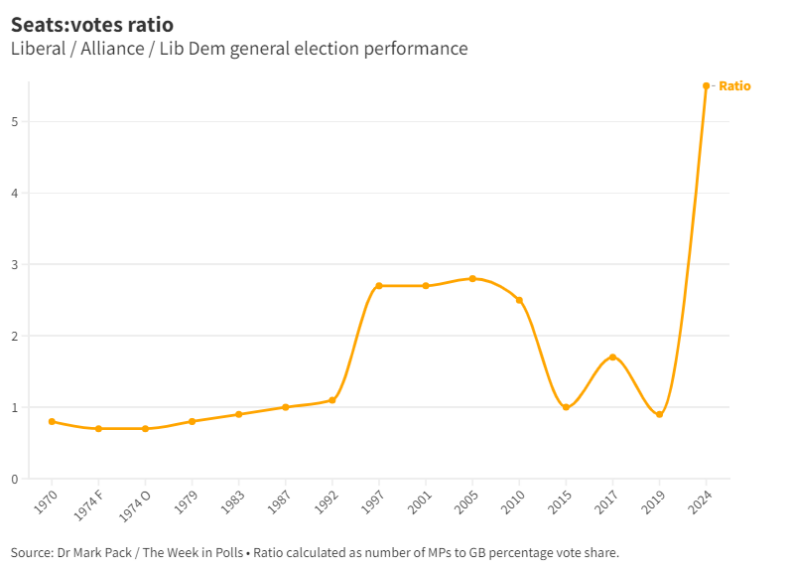
Dr Mark Pack, who runs a website and guide on all things Lib Dem, has written much on how they ruthlessly targeted their vote. We are now experts in the premise that under first past post, you need more votes than anyone else plus one. After losses in 2015 and 2019, the Liberal Democrats realised that they only had to target specific voters in specific constituencies to win. They understood how powerful each one of their voters was and their entire campaign centred around that.
The collapse in our support made this possible in even more seats than they had predicted – but there is no route back to government without fixing the bleed to the Liberal Democrats.
The results of the by-elections in Tiverton & Honiton, North Shropshire, and Frome & Somerton should have set alarm bells. These seats had large swings to the Liberal Democrats, but they also hid a fall in our vote. In the 2023 local elections, we lost councils like Horsham, which have traditionally been true-blue shires.
The assumption was these people would come back to us at the general election when more was at stake, but they did not. We have long held sway in rural constituencies, – losing their support would have been unthinkable so how might this have happened?
Environment: The awareness of biodiversity loss, and climate change has driven, what are largely affluent rural voters towards parties with strong environmental credentials. In Waveney, National Grid plans to build 100 miles of pylons was a main election issue and the Green’s opposition to any infrastructure gave them a wedge to exploit.
Sewage: The decision in 2010 to monitor sewage outflows and then not have a plan to combat them cost us dozens of seats in this election. In rural and coastal constituencies this was the most talked about issue amongst swing voters.
Agriculture: Whilst removing direct subsidies on farms has been the right thing to do, it left many farmers feeling uncertain about their future. The roll-out of new payment schemes has been slow and confusing, the Australia and New Zealand trade deals will allow beef and lamb produced at standards illegal in the UK to be imported. Simply, they don’t trust us.
Local Issues: Rural communities often face unique challenges such as access to healthcare, education, and infrastructure. Liberal and Green’s focus on localism and community-oriented solutions may have resonated more with voters feeling neglected by the broader national agendas of our campaigning.
How did they exploit these advantages?
Liberal Democrats national campaign: Whilst many mock Ed Davey for his stunts, they ensured that he was in the news every day and that the issues he wanted to talk about were, whilst we talked about that day’s faux pax. Whether that was the NHS, care in the community, farm subsidies, or sewage, Davey got his message out.
In the final days, his bungee jump whilst shouting ‘Do something you’ve never done before: Vote Liberal Democrat’ were perfectly timed to exploit those voters he needed to lend his vote.
Digital Advertising and a leaflet deluge: The Greens spent hundreds of thousands of pounds in their target constituencies on digital advertising, using national messaging to swing voters over to them. The Liberal Democrats selected candidates much earlier, in target seats delivered sometimes up to 10 leaflets in the short campaign, and on polling day they ran a proper knocking up operation. We were simply outcampaigned.
Tactical voting: Polling by More in Common found that 26 per cent of Liberal Democrat voters in this election voted tactically. In North Devon in the last weeks a website called ‘Taxi for Saxby’ was started, via a third-party campaign the Liberal Democrats spent thousands of pounds on digital adverts targeting voters aged 18-35 and encouraging voters to vote tactically. These campaigns happened across the country.
Liberal Democrats are ruthless at Parliamentary and local incumbency. They will exploit every opportunity to embed themselves. Indeed, some of our best results were delivered off the back of successful incumbency campaigns. As they are not a party of government, we will not be able to attack them on their record. There is hope though, many of their majorities are small, on lower turnouts, with a strong run into the next election we have a chance at regaining lost ground.
Our next leader will need to build a policy program and team that reflects the problems of the nation, one that will galvanise those disenfranchised Liberal Democrat voters, those Reform defectors, and the millions of people who did not feel they had the confidence to vote for anyone, let alone us – we must be credible and competent.
Our campaign will have to be better. David Cameron in 2010 had a ‘Lib Dems for Cameron’ website and campaign. The message was precisely targeted to wavering Liberal Democrats.
Our Tools both Labour and the Liberal Democrats have invested heavily in digital tools for volunteers. The Liberal Democrats app assigns walking routes to volunteers and gives them specific leaflets to deliver to each house, maximising the impact of their message.
Labour’s volunteer app is ruthless at sending volunteers to the place where they’ll have the most impact. Votesource is in desperate need of modernising. It needs to become the hub for every member to interact with the party and support its campaigns.
The candidates that we pick will need to better reflect the communities they are selected for. 24 per cent of Liberal Democrat voters say they choose to vote for their ‘local candidate’, and the campaigns that they run will have to be better funded and resourced – over many years.
Whilst losses to the Greens and Independents in urban seats will alarm Labour, the wins for the Liberal Democrats and Greens should concern us much more. Their success further underlines the challenge we face to regain the trust of rural voters.
I know I will be supporting the leader who can deliver the most comprehensive answer to how we take the fight to them at the next election. Without a Liberal-Democrat-defeating-Leader, we stand no hope of ever forming a government.
James Wright is a farmer, agri-tech entrepreneur and southwest chair of the Conservative Rural Forum. He stood as the parliamentary candidate in Bath in 2024.
The 2024 general election marked a shift in the political landscape. Not only did we lose our majority, to a party with fewer votes than they won in 2019, but we lost traditionally safe seats across the country. A total of 60 were lost to the Liberal Democrats and 2 of our safest to the Green Party.
We should be careful to conclude that this was entirely the doing of Reform. Polling by Lord Ashcroft shows that only 36 per cent of Reform voters, if they were unable to vote Reform, would have voted for the Conservatives. We’d have another hundred seats but still lost our majority.
We have to be brutally honest with ourselves. After 14 years of Government and stagnating standards of living, caused by issues both within and outside our control, the country wanted a party with a positive vision, a commitment to competence and a promise of change.
Whilst others will discuss what the party needs to look like, I believe we can also reflect in parallel on the path back to Government, how we view the newly acquired Liberal Democrats seats, and what that means for how we campaign.
Dr Mark Pack, who runs a website and guide on all things Lib Dem, has written much on how they ruthlessly targeted their vote. We are now experts in the premise that under first past post, you need more votes than anyone else plus one. After losses in 2015 and 2019, the Liberal Democrats realised that they only had to target specific voters in specific constituencies to win. They understood how powerful each one of their voters was and their entire campaign centred around that.
The collapse in our support made this possible in even more seats than they had predicted – but there is no route back to government without fixing the bleed to the Liberal Democrats.
The results of the by-elections in Tiverton & Honiton, North Shropshire, and Frome & Somerton should have set alarm bells. These seats had large swings to the Liberal Democrats, but they also hid a fall in our vote. In the 2023 local elections, we lost councils like Horsham, which have traditionally been true-blue shires.
The assumption was these people would come back to us at the general election when more was at stake, but they did not. We have long held sway in rural constituencies, – losing their support would have been unthinkable so how might this have happened?
Environment: The awareness of biodiversity loss, and climate change has driven, what are largely affluent rural voters towards parties with strong environmental credentials. In Waveney, National Grid plans to build 100 miles of pylons was a main election issue and the Green’s opposition to any infrastructure gave them a wedge to exploit.
Sewage: The decision in 2010 to monitor sewage outflows and then not have a plan to combat them cost us dozens of seats in this election. In rural and coastal constituencies this was the most talked about issue amongst swing voters.
Agriculture: Whilst removing direct subsidies on farms has been the right thing to do, it left many farmers feeling uncertain about their future. The roll-out of new payment schemes has been slow and confusing, the Australia and New Zealand trade deals will allow beef and lamb produced at standards illegal in the UK to be imported. Simply, they don’t trust us.
Local Issues: Rural communities often face unique challenges such as access to healthcare, education, and infrastructure. Liberal and Green’s focus on localism and community-oriented solutions may have resonated more with voters feeling neglected by the broader national agendas of our campaigning.
How did they exploit these advantages?
Liberal Democrats national campaign: Whilst many mock Ed Davey for his stunts, they ensured that he was in the news every day and that the issues he wanted to talk about were, whilst we talked about that day’s faux pax. Whether that was the NHS, care in the community, farm subsidies, or sewage, Davey got his message out.
In the final days, his bungee jump whilst shouting ‘Do something you’ve never done before: Vote Liberal Democrat’ were perfectly timed to exploit those voters he needed to lend his vote.
Digital Advertising and a leaflet deluge: The Greens spent hundreds of thousands of pounds in their target constituencies on digital advertising, using national messaging to swing voters over to them. The Liberal Democrats selected candidates much earlier, in target seats delivered sometimes up to 10 leaflets in the short campaign, and on polling day they ran a proper knocking up operation. We were simply outcampaigned.
Tactical voting: Polling by More in Common found that 26 per cent of Liberal Democrat voters in this election voted tactically. In North Devon in the last weeks a website called ‘Taxi for Saxby’ was started, via a third-party campaign the Liberal Democrats spent thousands of pounds on digital adverts targeting voters aged 18-35 and encouraging voters to vote tactically. These campaigns happened across the country.
Liberal Democrats are ruthless at Parliamentary and local incumbency. They will exploit every opportunity to embed themselves. Indeed, some of our best results were delivered off the back of successful incumbency campaigns. As they are not a party of government, we will not be able to attack them on their record. There is hope though, many of their majorities are small, on lower turnouts, with a strong run into the next election we have a chance at regaining lost ground.
Our next leader will need to build a policy program and team that reflects the problems of the nation, one that will galvanise those disenfranchised Liberal Democrat voters, those Reform defectors, and the millions of people who did not feel they had the confidence to vote for anyone, let alone us – we must be credible and competent.
Our campaign will have to be better. David Cameron in 2010 had a ‘Lib Dems for Cameron’ website and campaign. The message was precisely targeted to wavering Liberal Democrats.
Our Tools both Labour and the Liberal Democrats have invested heavily in digital tools for volunteers. The Liberal Democrats app assigns walking routes to volunteers and gives them specific leaflets to deliver to each house, maximising the impact of their message.
Labour’s volunteer app is ruthless at sending volunteers to the place where they’ll have the most impact. Votesource is in desperate need of modernising. It needs to become the hub for every member to interact with the party and support its campaigns.
The candidates that we pick will need to better reflect the communities they are selected for. 24 per cent of Liberal Democrat voters say they choose to vote for their ‘local candidate’, and the campaigns that they run will have to be better funded and resourced – over many years.
Whilst losses to the Greens and Independents in urban seats will alarm Labour, the wins for the Liberal Democrats and Greens should concern us much more. Their success further underlines the challenge we face to regain the trust of rural voters.
I know I will be supporting the leader who can deliver the most comprehensive answer to how we take the fight to them at the next election. Without a Liberal-Democrat-defeating-Leader, we stand no hope of ever forming a government.