Chris Hopkins is the Political Research Director at Savanta.
The smaller the gap between two sets of people, Sigmund Freud argued, the more likely their eventual conflict will be. He called this ‘the ‘narcissism of small differences’.
Freud was talking about small differences in the context of psychoanalysis, rather than party political disagreements. More learned readers can make the case for how much overlap these two fields have in 2024.
But I always think of his theory during party leader contests.
Truth be told, there is little to distinguish between the remaining Conservative leadership candidates, policy-wise. They are all anti-immigration and pro-Brexit. They’re all pro-lower taxes, but anti-winter fuel allowance cuts. Pro-increased defence spending, but also pro-smaller state. I could go on.
Each candidate and their campaign team has clearly made a calculation that there is a narrow path to victory. It runs through 120 MPs and 170,00 Conservative members. Those hoping for a fight for the soul of the party between right and centre may well be disappointed.
In some sense, I think they’ve all broadly made the right call. In my – and many other pollster’s – view, the Conservatives were defeated this summer because of perceived incompetence and lack of trust and not, unlike a lot of commentary, because they were seen as too ‘left’ or ‘right’ on some issues.
The challenge for all the candidates is that it’s actually very difficult to look competent from the opposition benches. But, with a bit of luck and some things falling your way, it is achievable – just ask Sir Keir Starmer.
What doesn’t build trust with the public is vicious off- (and on-) the-record briefing between leadership camps. These seem to be increasing in frequency and volume. The next leader of the Conservative Party will have to hope the tone of the contest doesn’t stick to them post-victory.
Whoever that is, they might get away with it. Savanta’s research suggests that the public aren’t taking much notice of the contest at all. In our latest Political Tracker, the public are more likely to say they ‘don’t know’, than that they have a favourable view of all four remaining candidates.
We also put the (then) five candidates in a series of head-to-heads against Starmer on the question of who would make the best prime minister, and even though James Cleverly narrowly performed the best, he was still 24-points behind the Labour leader.
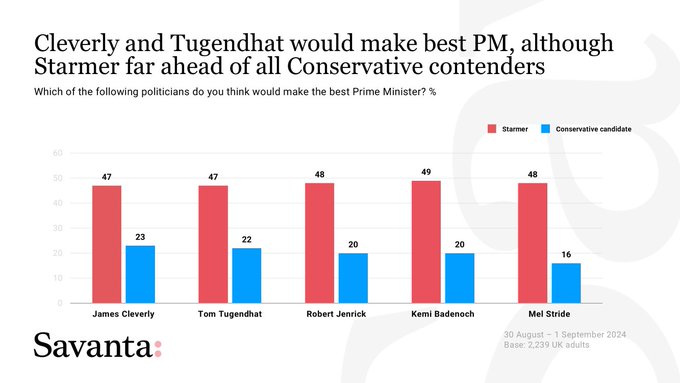
Cleverly intuitively feels like the sensible choice, and voters probably sense that. He has the most senior cabinet level experience, and is a strong media performer.
His challenge is that his loyalty to three Conservative prime ministers could make him guilty by association in the public’s eye. If I were Team Cleverly, I’d also be concerned about Steve McClaren syndrome: being a great assistant manager doesn’t mean you will ever be a lauded head coach.
Tom Tugendhat is probably the next candidate who polls the best (read: least bad) among the wider public. He is less known than Cleverly, but what the public do know of him (such as his military record), they like. He is also perceived to be the closest to the centre ground of all remaining candidates. This is currently a disadvantage, but could be an advantage at a general election.

But neither of these men are frontrunners. Indeed, depending on the reports you listen to, both are tipped to leave the contest before the member’s vote, just as Mel Stride did last night. (Stride was, perhaps like Cleverly, too heavily associated with the previous regime to have a realistic chance among Tory MPs, let alone party members.)
Robert Jenrick is probably the least known to the public after Stride. He has, however, managed to craft a strong narrative of himself of resigning from Rishi Sunak’s government over immigration. He is clearly pitching himself as the man to ‘unite the right’ and bring back Con-Reform switchers from the last election.
As many others have said, it’s worth noting this is a necessary but likely insufficient step towards the Conservatives getting back into government.
Kemi Badenoch was the original frontrunner. She has some of the same fallibilities as a candidate as Jenrick, but I think her combative style would mean she would find it easier to ‘cut through’ compared to most others on this list.
What could each of these mean for Starmer, and the next general election? Currently I think he has little to worry about. Notwithstanding the normal caveats, very few of these candidates currently look like they’re capable of turning the Conservatives into an effective governing force again any time soon.
That being said, Labour clearly is not infallible. The 2024 election results are still being pored over, but I think we can say that it wasn’t a mass endorsement of them. Any political party who can successfully take them to task will likely reap electoral benefits.
Who gets to do that will be up to Conservative MPs and members. The differences between these groups and the wider electorate are not small at all. There is a gulf between their perspective and priorities.
As such, the next Tory leader will be hoping their positions and actions over the course of this contest don’t harm them in the future. The path to leader may well be narrow, but the distance to travel to prime minister is much, much longer.
Chris Hopkins is the Political Research Director at Savanta.
The smaller the gap between two sets of people, Sigmund Freud argued, the more likely their eventual conflict will be. He called this ‘the ‘narcissism of small differences’.
Freud was talking about small differences in the context of psychoanalysis, rather than party political disagreements. More learned readers can make the case for how much overlap these two fields have in 2024.
But I always think of his theory during party leader contests.
Truth be told, there is little to distinguish between the remaining Conservative leadership candidates, policy-wise. They are all anti-immigration and pro-Brexit. They’re all pro-lower taxes, but anti-winter fuel allowance cuts. Pro-increased defence spending, but also pro-smaller state. I could go on.
Each candidate and their campaign team has clearly made a calculation that there is a narrow path to victory. It runs through 120 MPs and 170,00 Conservative members. Those hoping for a fight for the soul of the party between right and centre may well be disappointed.
In some sense, I think they’ve all broadly made the right call. In my – and many other pollster’s – view, the Conservatives were defeated this summer because of perceived incompetence and lack of trust and not, unlike a lot of commentary, because they were seen as too ‘left’ or ‘right’ on some issues.
The challenge for all the candidates is that it’s actually very difficult to look competent from the opposition benches. But, with a bit of luck and some things falling your way, it is achievable – just ask Sir Keir Starmer.
What doesn’t build trust with the public is vicious off- (and on-) the-record briefing between leadership camps. These seem to be increasing in frequency and volume. The next leader of the Conservative Party will have to hope the tone of the contest doesn’t stick to them post-victory.
Whoever that is, they might get away with it. Savanta’s research suggests that the public aren’t taking much notice of the contest at all. In our latest Political Tracker, the public are more likely to say they ‘don’t know’, than that they have a favourable view of all four remaining candidates.
We also put the (then) five candidates in a series of head-to-heads against Starmer on the question of who would make the best prime minister, and even though James Cleverly narrowly performed the best, he was still 24-points behind the Labour leader.
Cleverly intuitively feels like the sensible choice, and voters probably sense that. He has the most senior cabinet level experience, and is a strong media performer.
His challenge is that his loyalty to three Conservative prime ministers could make him guilty by association in the public’s eye. If I were Team Cleverly, I’d also be concerned about Steve McClaren syndrome: being a great assistant manager doesn’t mean you will ever be a lauded head coach.
Tom Tugendhat is probably the next candidate who polls the best (read: least bad) among the wider public. He is less known than Cleverly, but what the public do know of him (such as his military record), they like. He is also perceived to be the closest to the centre ground of all remaining candidates. This is currently a disadvantage, but could be an advantage at a general election.
But neither of these men are frontrunners. Indeed, depending on the reports you listen to, both are tipped to leave the contest before the member’s vote, just as Mel Stride did last night. (Stride was, perhaps like Cleverly, too heavily associated with the previous regime to have a realistic chance among Tory MPs, let alone party members.)
Robert Jenrick is probably the least known to the public after Stride. He has, however, managed to craft a strong narrative of himself of resigning from Rishi Sunak’s government over immigration. He is clearly pitching himself as the man to ‘unite the right’ and bring back Con-Reform switchers from the last election.
As many others have said, it’s worth noting this is a necessary but likely insufficient step towards the Conservatives getting back into government.
Kemi Badenoch was the original frontrunner. She has some of the same fallibilities as a candidate as Jenrick, but I think her combative style would mean she would find it easier to ‘cut through’ compared to most others on this list.
What could each of these mean for Starmer, and the next general election? Currently I think he has little to worry about. Notwithstanding the normal caveats, very few of these candidates currently look like they’re capable of turning the Conservatives into an effective governing force again any time soon.
That being said, Labour clearly is not infallible. The 2024 election results are still being pored over, but I think we can say that it wasn’t a mass endorsement of them. Any political party who can successfully take them to task will likely reap electoral benefits.
Who gets to do that will be up to Conservative MPs and members. The differences between these groups and the wider electorate are not small at all. There is a gulf between their perspective and priorities.
As such, the next Tory leader will be hoping their positions and actions over the course of this contest don’t harm them in the future. The path to leader may well be narrow, but the distance to travel to prime minister is much, much longer.