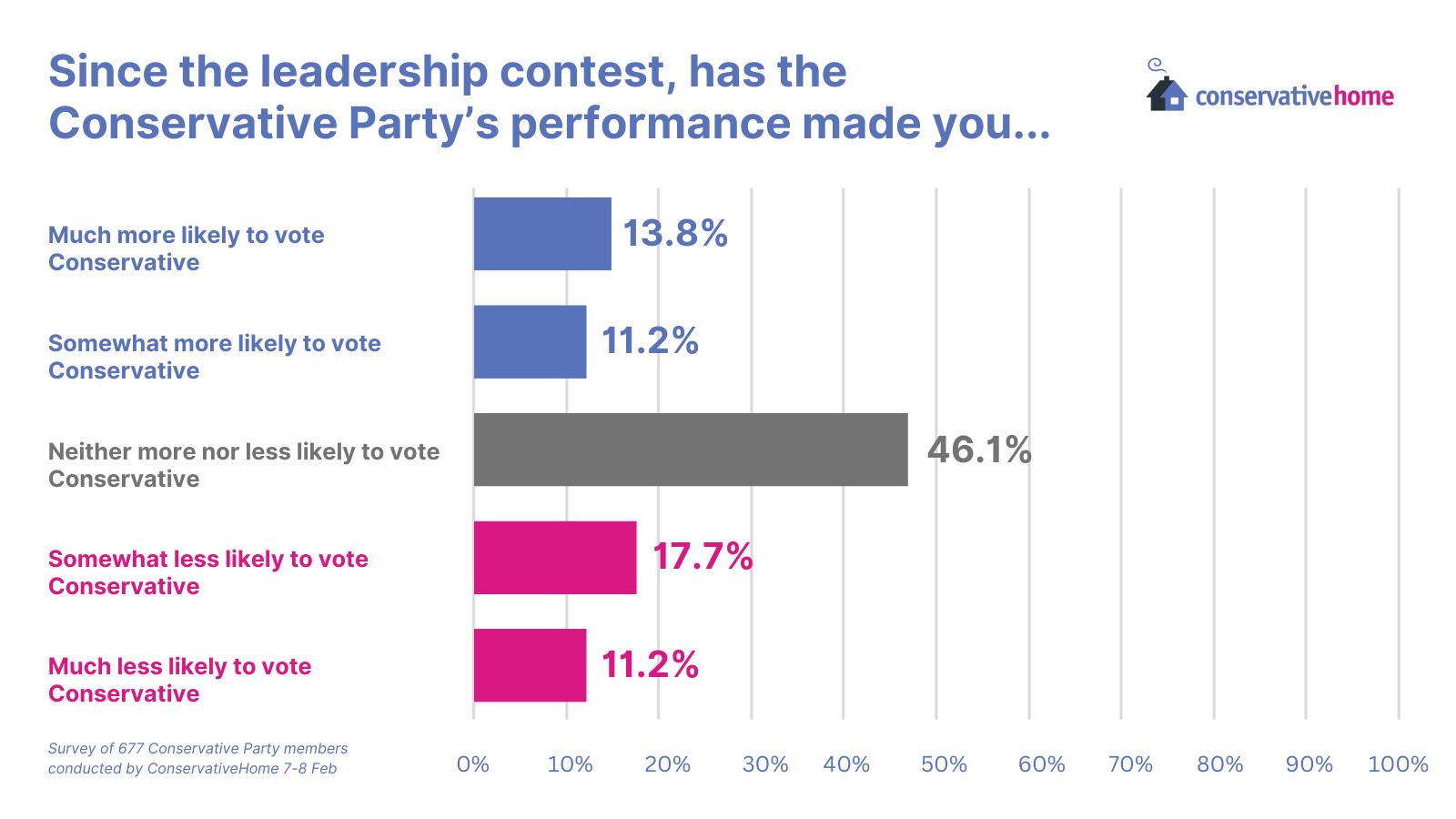
Earlier this week, Kemi Badenoch passed 100 days as Tory leader. Yesterday, we reported on our panel’s thoughts on her approach to policy (or lack thereof) and their confidence in her reaching the next election still in the role. Today, we can chart the evolving thoughts of our survey of members on the big, existential challenge to our party – and leader’s – future: Reform UK.
First, has Badenoch’s tenure made members more keen to vote Conservative? Has she sufficiently enthused them that they wouldn’t dream of making plans for Nigel? Erm. Not quite. Whilst we found almost half – 46.1 per cent – of the panel’s willingness to vote Tory was loyally unchanged, 25 per cent had become more likely to, but 28.9 per cent had become less likely.
Within these, the full figures were that 13.8 per cent declaring themselves as much more likely to vote Conservative, 11.2 per cent as somewhat more likely, 17.7 per cent as somewhat less likely, and 11.2 per cent as much less likely. Whilst Badenoch’s leadership has thus excited a quarter of our panel, it has left a larger section less willing to vote for the party of which they are members.
If we had sent out this survey after her performance at PMQs yesterday, one imagines that share would have been even larger. Hopefully Operation Slow Burn can engender some optimism for our chief soon, and expand that share of our panel which sees her leadership as attractive. Fewer boomer podcasts and more PMQs prep should be her ambition for the next month.
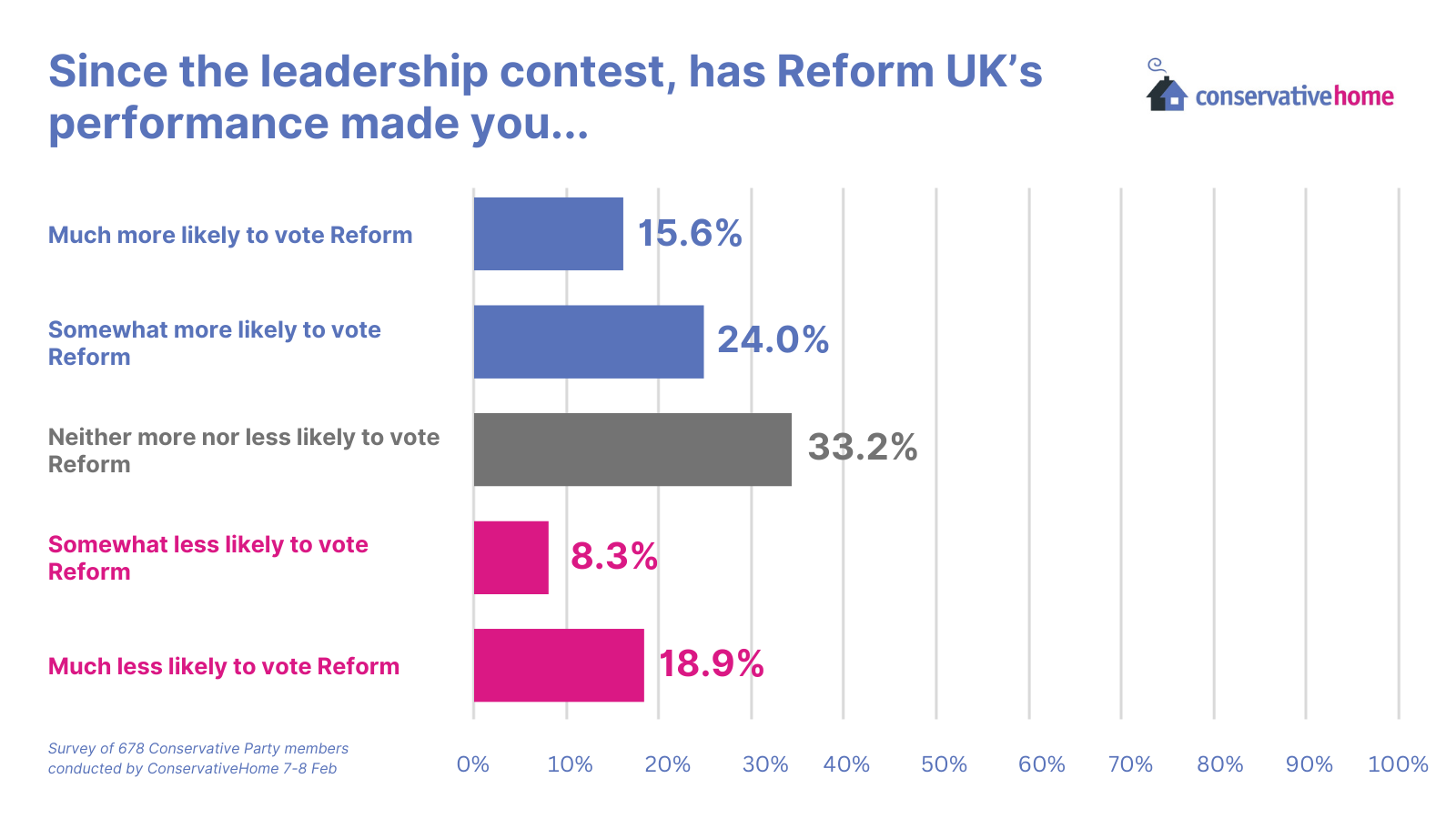
By contrast, members have become keener on Reform UK, based on their performance since Badenoch became Conservative leader. Whilst a third is neither more nor less likely to vote for the party, 39.6 per cent are much or somewhat more likely to vote for Farage’s party, whilst 27.2 per cent have become less likely to vote for them since Badenoch took over.
That the chunk of our panel that is unchanged in their views on Reform is so much smaller than that with unchanged views on the party of which they are a member reflects in our survey the same unavoidable impression provided by every opinion poll: that the momentum, interest, and arc of history increasingly seem on Farage’s side. Will the last Tory to leave, etc.
A substantial body of our panel has long been sympathetic to Farage. They wanted him admitted as a party member, they watch his GB News show, and their views on everything from membership of the ECHR to Net Zero are closer to his full-bodied opposition than Badenoch’s equivocation. His party must seem to fill a void that her underwhelming early leadership has so far left.

Nonetheless, just to confuse things, when asked for their monthly prediction of the outcome of the next election, our panel have presented a (slightly) more positive picture for Badenoch. Whilst the most likely outcome – unchanged on 33 per cent – remains a Conservative-led coalition, expectations of a Tory majority are no longer in freefall, and up two points to a lucky 13 per cent.
This surge in optimism takes that choice from the sixth most popular to the fourth, over-taking the confidence in a Labour majority and minority Conservative administration, but still behind those confident in a Labour-led coalition or minority Labour government. Whether we will soon need to include options for a Reform majority, coalition, or minority remains an open question.
In the meantime, expect talk of a Tory-Reform pact to only increase. But why would Farage be interested? He has his boot on our throats. If the polls continue trending the same way, the chances of a Tory wipeout and a Reform majority increase exponentially. Why would Farage waste this opportunity to destroy a party that he has been campaiging against for three decades?