As the leadership contest recedes into the past, Kemi Badenoch’s leadership is coming in for tougher questioning. The original case – that it is simply far too early to judge – continues to hold some merit, it’s a defence with a clock on it.
In light of that, and her serious slump in the last Shadow Cabinet League Table, we thought we’d test the waters with our panel.
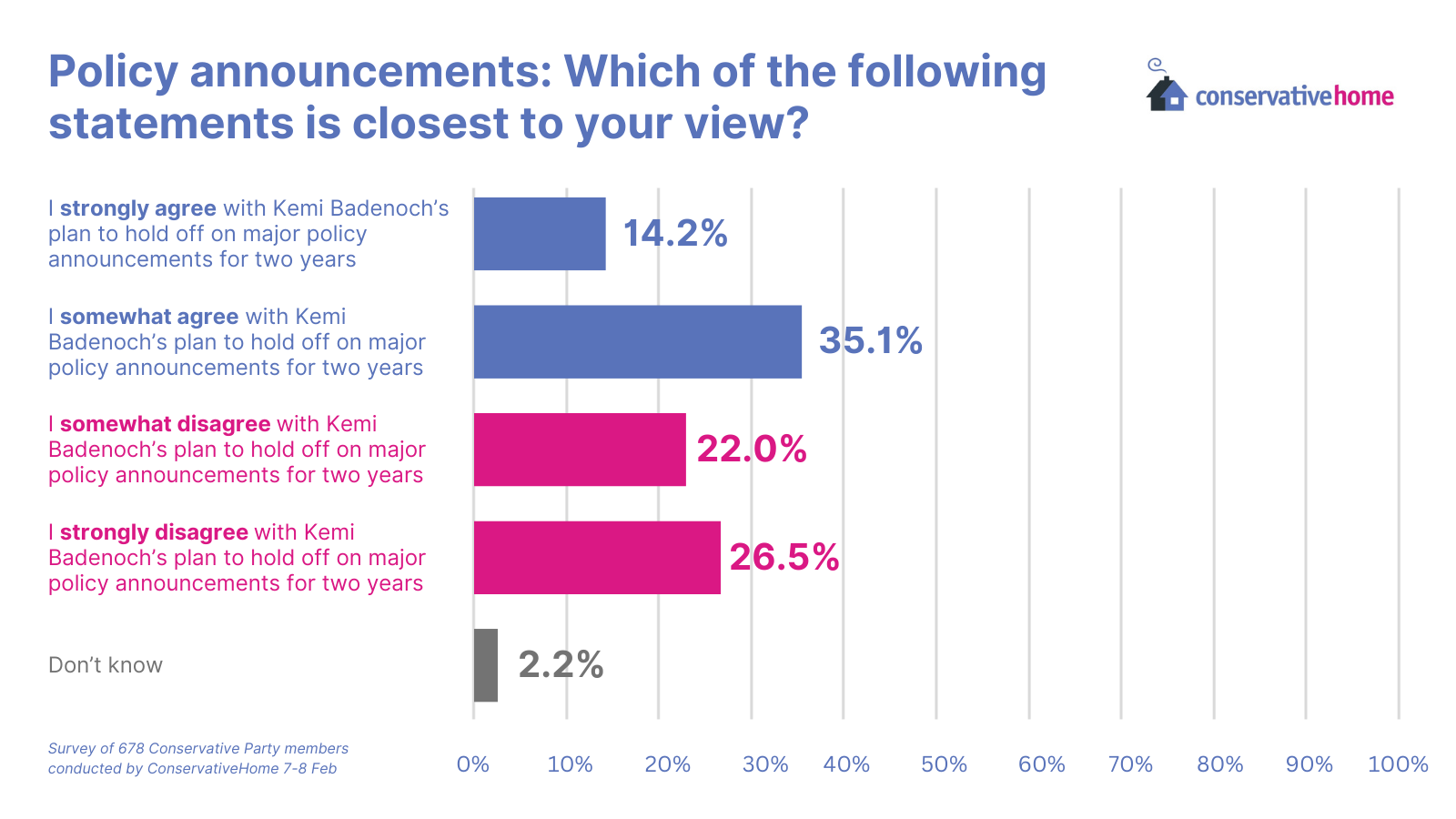
First off, we found an almost even split on the wisdom of not forming any policies for two years (about which we wrote on Sunday when the leader, er, made her first big policy announcement): 49.3 per cent in favour, 48.5 per cent against. It will be interesting to return to this question in a few months, assuming we haven’t by then had so many announcements as to make it redundant, to see if members’ patience with it endures the relentless week-to-week pressure to have something to say.
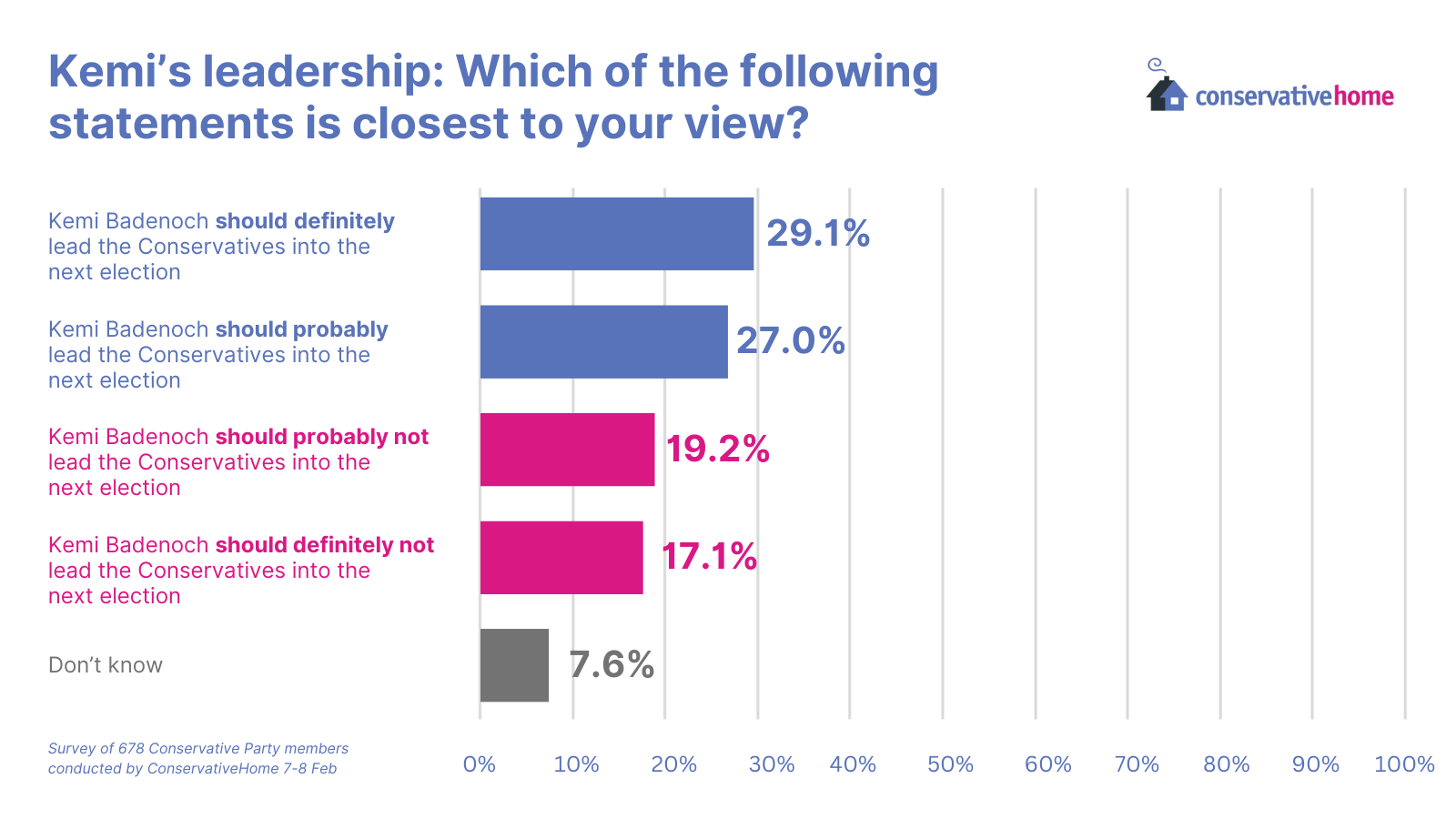
But what about Badenoch’s personal performance? The Shadow Cabinet League Table will be out in a few days, but we did ask our panel two direct questions: first, whether they thought she would lead the party into the next election; second, whether she should.

As you can see from the charts above and below, there’s an interesting split here. Overall, our panellists think both that our leader will lead us into the next election than not (56.6 per cent to 39.3 per cent) and that she should (56.1 per cent to 36.3 per cent). But there’s a big gap in confidence: whilst marginally more members think Badenoch ‘should definitely’ do so than ‘should probably’, those certain she will are outnumbered three-to-one by those who think it only probable.
This gap seems most likely to represent the share of the membership who are both staunch Kemi supporters and suspect that she may be undeservedly toppled.
There’s no sign yet that this element is either so numerous or so vocal as those which rallied behind Boris Johnson and (to a lesser extent) Liz Truss, but it is still something that Badenoch’s critics would do well to keep in mind – with the party at such a low ebb, the disenchantment engendered by ditching yet another elected leader could cost it foot soldiers it can ill-afford to lose.
On the other hand, this ought to be a sobering result for the leadership too: when less than a third of members are certain that they want you to lead the party into an existential election, there is an awful lot of confidence-winning to do.