Chico Khan-Gandapur is a managing partner at Metrica Consulting.
This light-hearted review looks ahead to the May 7 elections, exploring the hidden meanings in the names of Britain’s main political parties and their leaders, with uncannily prescient outcomes.
Across millennia, words have served not only as instruments of meaning, but also as tools for expression, puzzles for intellect, and instruments of concealment. Among the most intriguing stands the anagram: the art of rearranging the letters of a word or phrase to produce another.
The history of anagrams is fascinating, intertwining aspects of society whether, religion, literature, philosophy and politics. This fascination endures not only because they amuse, but because they embody humanity’s deep-seated belief that words may conceal truth, satire, or mysteries waiting to be revealed.
Consider the following medieval tradition from the trial of Jesus Christ. Pontius Pilate asks, “…Quid est veritas ?…” which translates as, “…What is Truth ?…” His famous anagrammatic response, “…Est vir qui adest…” profoundly answers, “…It is the man who is here…”. Pilate has unwittingly identified Jesus Christ as Truth Incarnate, echoing the Bible’s fundamental claim for him as the Son of Man. Profound indeed, but now for some more earthly examples.
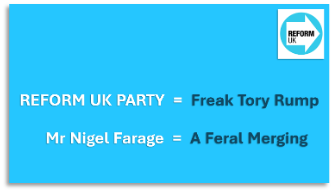
Current polling in the U.K. has the Reform UK Party and its leader, Mr Nigel Farage, ahead of a chasing pack. But unravelling and rearranging their letters perhaps reveals the party’s true essence, Freak Tory Rump, apposite since the arrival of Robert Jenrick and Suella Braverman, highlighting the prospect of, A Feral Merging – prophetic indeed.
The study of interpreting texts to uncover their hidden meanings is Hermeneutics. As classical knowledge filtered into medieval Europe, scholars began using anagrams as a means of interpreting scripture. St. Augustine saw letter play as evidence of divine order within language. The anagram of Roma transforming to Amor, that is, Rome to Love gained popularity during the Christianisation of the Roman Empire, symbolising the transformation of imperial power into divine love.
Parallels might be found today within the Green Party, especially after its sensational win in the Gorton and Denton by-election. Its leader Mr Zach Polanski wants to transform the global climate, eliminate nuclear weapons, repeal borders and decriminalise personal possession of drugs, all echoing the Summer of Love in 1967 San Francisco, when 100,000 young people flocked to a utopian experiment of free love, anti-war activism, a rejection of materialism, and acceptance of the use of drugs. Yet unravelling and rearranging their names reveals potentially challenging truths.
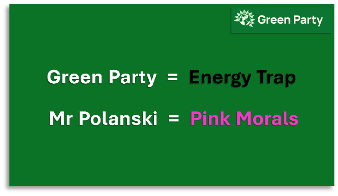
The party name becomes Energy Trap, and its leader, Pink Morals, reflecting concern about the costs of rushing to Net-Zero and the party’s ethics and policies being seen as overly superficial, or naive.
But returning to our historic review. By the twelfth and thirteenth centuries, anagrams had entered the realm of secret communication, or moral emblem. For example, the Society of Jesuits, SOCIETAS IESV (SOCIETAS JESU in modern script) became, VITIOSA SECES, or Cut-Off the Wicked Things, a very hostile polemical anagram.
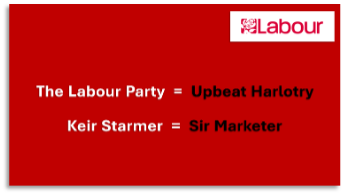
Modern analogies could include The Labour Party, which unravels to Upbeat Harlotry, warning of its appreciation of lavish freebies and handouts, while its leader, Keir Starmer, becomes Sir Marketer, highlighting his focus on words which lack deeper meaning, or resolve.
The Labour Party’s closest rival in policy terms is arguably the Liberal Democrat Party, led by, Sir Ed Davey.
Unravelling the party’s name gives, Tribal Replay, underscoring their policy similarity, while the leader’s name transforms to, Is Very Dead, wryly suggesting political ineffectiveness – splashing around in water just won’t cut it.
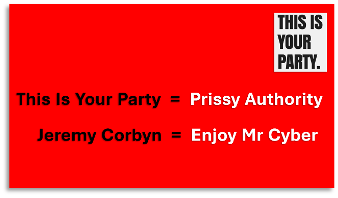
The newest party of the Left fares little better. This Is Your Party aptly unravels as Prissy Authority, underlining its recent lengthy struggles in choosing its leader from Jeremy Corbyn and Zarah Sultana. The former eventually prevailing, but who’s name rearranges to, Enjoy Mr Cyber.
Fans of the Time Lord, Dr Who, will remember the Cybermen who originated from Earth’s failing twin planet, Mondas. In order to survive, they were forced to replace failing body organs with cybernetic parts, in turn becoming emotionless conversion machines that erased individuality – perhaps an apt metaphor for Socialism !
The Renaissance exploded with curiosity about symbols, codes, and language’s hidden meanings. Monarchs were flattered as the anagram’s propagandistic potential was exploited. Queen Elizabeth I was celebrated in courtly verse, where Elizabeth became The Eliza B, and King James I, James Stuart unravelled to A Just Master.
By the nineteenth century, the anagram had seeped into the bloodstream of English literary experimentation. Lewis Carroll, renowned for his love of anagrams, rearranged his own name to Will’s Real Role – a reference to Shakespeare. And then changed Prime Minister’s William Ewart Gladstone to become, A Wild Man Will Go At Trees, satirising the PM’s passion for tree-felling. Eleven Plus Two became Twelve Plus One; Astronomer unravelled to Moon Starer; and The Eyes to They See.
In contrast, neither the Scots nor Welsh were major anagrammatic enthusiasts. Scottish literature favoured ballads and satire instead, and Welsh literary tradition emphasised, Cynghanedd, or sound harmony. Nevertheless the anagrams of their national parties hide some interesting meanings.
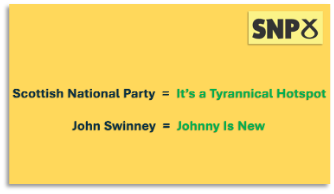
The Scottish Nationalist Party transforms to, It’s A Tyrannical Hotspot, with strong echoes of the independence challenge, and it’s leader, John Swinney, unravels to Johnny Is New emphasising the shift from his two predecessors, whose leaderships ended in relative turmoil.
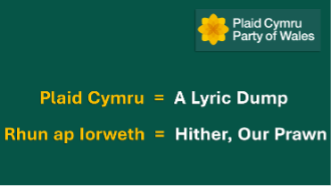
The ascent in the polls of Plaid Cymru and Wales’s literary heritage is combined as, A Lyric Dump, while its leader, Rhun Ap Iorweth unravels to, Hither Our Prawn, a food growing in prominence in Welsh food culture, but not yet at the status of lamb, or laverbread.
But what about the official opposition to the government, the Conservatives, and their leader, Kemi Badenoch.
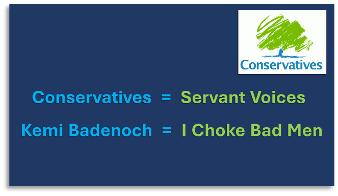
The former unravels to, Servant Voices, surely how the Party wishes itself to appear after fourteen turbulent years in government, while the latter rearranges to I Choke Bad Men, as Sir Marketer may rue during weekly PMQs.
This enduring fascination with anagrams stems partly from their metaphoric power, suggesting truth already lurks within them, dormant until rearranged. While the impulse to uncover latent meanings through transformation fuses analysis and creativity into a single cognitive act.
Ultimately, anagrams endure because they remind us of the pliability of meaning. Letters remain constant while words shift dramatically in sense. This tension mirrors the human experience of reinterpretation. Like history or identity, language is a system we can reorder to glimpse unseen possibilities, indeed, like politics itself.
Wishing all parties good Ale Collections!
(That’s ‘local elections’ of course)
Chico Khan-Gandapur is a managing partner at Metrica Consulting.
This light-hearted review looks ahead to the May 7 elections, exploring the hidden meanings in the names of Britain’s main political parties and their leaders, with uncannily prescient outcomes.
Across millennia, words have served not only as instruments of meaning, but also as tools for expression, puzzles for intellect, and instruments of concealment. Among the most intriguing stands the anagram: the art of rearranging the letters of a word or phrase to produce another.
The history of anagrams is fascinating, intertwining aspects of society whether, religion, literature, philosophy and politics. This fascination endures not only because they amuse, but because they embody humanity’s deep-seated belief that words may conceal truth, satire, or mysteries waiting to be revealed.
Consider the following medieval tradition from the trial of Jesus Christ. Pontius Pilate asks, “…Quid est veritas ?…” which translates as, “…What is Truth ?…” His famous anagrammatic response, “…Est vir qui adest…” profoundly answers, “…It is the man who is here…”. Pilate has unwittingly identified Jesus Christ as Truth Incarnate, echoing the Bible’s fundamental claim for him as the Son of Man. Profound indeed, but now for some more earthly examples.
Current polling in the U.K. has the Reform UK Party and its leader, Mr Nigel Farage, ahead of a chasing pack. But unravelling and rearranging their letters perhaps reveals the party’s true essence, Freak Tory Rump, apposite since the arrival of Robert Jenrick and Suella Braverman, highlighting the prospect of, A Feral Merging – prophetic indeed.
The study of interpreting texts to uncover their hidden meanings is Hermeneutics. As classical knowledge filtered into medieval Europe, scholars began using anagrams as a means of interpreting scripture. St. Augustine saw letter play as evidence of divine order within language. The anagram of Roma transforming to Amor, that is, Rome to Love gained popularity during the Christianisation of the Roman Empire, symbolising the transformation of imperial power into divine love.
Parallels might be found today within the Green Party, especially after its sensational win in the Gorton and Denton by-election. Its leader Mr Zach Polanski wants to transform the global climate, eliminate nuclear weapons, repeal borders and decriminalise personal possession of drugs, all echoing the Summer of Love in 1967 San Francisco, when 100,000 young people flocked to a utopian experiment of free love, anti-war activism, a rejection of materialism, and acceptance of the use of drugs. Yet unravelling and rearranging their names reveals potentially challenging truths.
The party name becomes Energy Trap, and its leader, Pink Morals, reflecting concern about the costs of rushing to Net-Zero and the party’s ethics and policies being seen as overly superficial, or naive.
But returning to our historic review. By the twelfth and thirteenth centuries, anagrams had entered the realm of secret communication, or moral emblem. For example, the Society of Jesuits, SOCIETAS IESV (SOCIETAS JESU in modern script) became, VITIOSA SECES, or Cut-Off the Wicked Things, a very hostile polemical anagram.
Modern analogies could include The Labour Party, which unravels to Upbeat Harlotry, warning of its appreciation of lavish freebies and handouts, while its leader, Keir Starmer, becomes Sir Marketer, highlighting his focus on words which lack deeper meaning, or resolve.
The Labour Party’s closest rival in policy terms is arguably the Liberal Democrat Party, led by, Sir Ed Davey.
Unravelling the party’s name gives, Tribal Replay, underscoring their policy similarity, while the leader’s name transforms to, Is Very Dead, wryly suggesting political ineffectiveness – splashing around in water just won’t cut it.
The newest party of the Left fares little better. This Is Your Party aptly unravels as Prissy Authority, underlining its recent lengthy struggles in choosing its leader from Jeremy Corbyn and Zarah Sultana. The former eventually prevailing, but who’s name rearranges to, Enjoy Mr Cyber.
Fans of the Time Lord, Dr Who, will remember the Cybermen who originated from Earth’s failing twin planet, Mondas. In order to survive, they were forced to replace failing body organs with cybernetic parts, in turn becoming emotionless conversion machines that erased individuality – perhaps an apt metaphor for Socialism !
The Renaissance exploded with curiosity about symbols, codes, and language’s hidden meanings. Monarchs were flattered as the anagram’s propagandistic potential was exploited. Queen Elizabeth I was celebrated in courtly verse, where Elizabeth became The Eliza B, and King James I, James Stuart unravelled to A Just Master.
By the nineteenth century, the anagram had seeped into the bloodstream of English literary experimentation. Lewis Carroll, renowned for his love of anagrams, rearranged his own name to Will’s Real Role – a reference to Shakespeare. And then changed Prime Minister’s William Ewart Gladstone to become, A Wild Man Will Go At Trees, satirising the PM’s passion for tree-felling. Eleven Plus Two became Twelve Plus One; Astronomer unravelled to Moon Starer; and The Eyes to They See.
In contrast, neither the Scots nor Welsh were major anagrammatic enthusiasts. Scottish literature favoured ballads and satire instead, and Welsh literary tradition emphasised, Cynghanedd, or sound harmony. Nevertheless the anagrams of their national parties hide some interesting meanings.
The Scottish Nationalist Party transforms to, It’s A Tyrannical Hotspot, with strong echoes of the independence challenge, and it’s leader, John Swinney, unravels to Johnny Is New emphasising the shift from his two predecessors, whose leaderships ended in relative turmoil.
The ascent in the polls of Plaid Cymru and Wales’s literary heritage is combined as, A Lyric Dump, while its leader, Rhun Ap Iorweth unravels to, Hither Our Prawn, a food growing in prominence in Welsh food culture, but not yet at the status of lamb, or laverbread.
But what about the official opposition to the government, the Conservatives, and their leader, Kemi Badenoch.
The former unravels to, Servant Voices, surely how the Party wishes itself to appear after fourteen turbulent years in government, while the latter rearranges to I Choke Bad Men, as Sir Marketer may rue during weekly PMQs.
This enduring fascination with anagrams stems partly from their metaphoric power, suggesting truth already lurks within them, dormant until rearranged. While the impulse to uncover latent meanings through transformation fuses analysis and creativity into a single cognitive act.
Ultimately, anagrams endure because they remind us of the pliability of meaning. Letters remain constant while words shift dramatically in sense. This tension mirrors the human experience of reinterpretation. Like history or identity, language is a system we can reorder to glimpse unseen possibilities, indeed, like politics itself.
Wishing all parties good Ale Collections!
(That’s ‘local elections’ of course)