With just 16 days to go until the Makerfield by-election, the nation’s focus is trained on the three-way fight between Reform, Restore, and Labour. The most recent poll carried out by Survation shows Labour on 43 per cent, Reform on 40 per cent, and Restore on 7 per cent – with Rupert Lowe’s party continuing to eat into Farage’s right flank.
Jump a few percentage points further down, however, and you will find the Conservative candidate sitting on a dizzyingly high of 2 per cent.
This is not, in itself, surprising.
Labour have held Makerfield at every election since the seat was conceived in 1983. The Tories losing their deposit here is not some ground-breaking phenomenon that reckons with time and space itself. What a Tory loss does do, however, is reinforce the narrative that Farage and his allies are so eager to peddle: That the turquoise troopers over at Reform are the real opposition, and that the Conservatives are, as they are fond of saying, ‘dead and buried.’
Yet, when a race is being decided by just 3 percentage points, 2 per cent could make a difference.
In ordinary circumstances, a margin of that size barely registers. When elections are decided across thousands of votes spread over hundreds of seats, a sliver of support here and there is fairly meaningless.
But Makerfield is not ordinary.
This is a contest where Andy Burnham’s personal vote is the only thing keeping Labour’s head above water. And the Conservative vote, as small as it is, is not nothing. If those voters chose to lend their support to Reform, they could tighten a race that is already too close to call. After all, Reform are already panicking about bleeding votes to Restore – surely the case might be made for Tory voters to shed their allegiance simply in a bid to stop Burnham?
The trouble, according to ConservativeHome survey data, is that they almost certainly won’t.
Following the local elections in May, we asked our readers whether they had voted tactically.
The results were of particular interest as Tali Fraser pointed out at the time and related to the upcoming Makerfield byelection
A reminder of those surveyed, just 6.4 per cent said they had voted tactically, against 56.7 per cent who had not. We can’t judge the remaining 36.9 per cent because simply put – they had no elections in their area at all.
The picture becomes even starker when those who did engage in tactical voting are examined more closely.
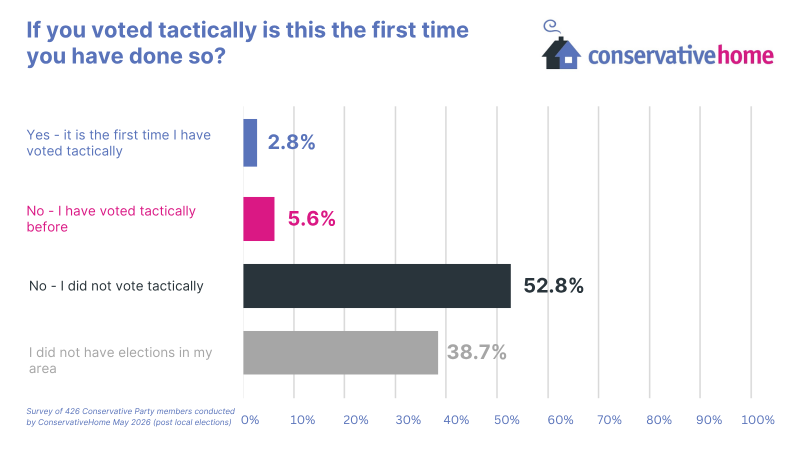
Only 2.8 per cent of all respondents said it was their first time voting tactically, while 5.6 per cent had done so before. Together, that still amounts to a rather small group, suggesting that tactical voting among Conservative members is not an exercise that is widely undertaken.
It would seem, then, that for a majority of Conservative members, tactical voting is not just unusual or odd, it mainly fails to register as an acceptable option.
This is against the mainstream narrative which focussed much attention on the possibility of widespread tactical voting in the run up to the 2026 local elections. There is no clear explanation for why so few Conservatives would choose to engage in any element of tactical voting. Perhaps it could be rooted in some tribalistic loyalty to the party, maybe they like what they see under ‘new management’ or perhaps it could be a reaction to the crass attitude of some senior Reform figures of late.
Taken alone, these figures cannot tell us motivation. But what they do tell us is that the consequences of this loyalty, however principled it may be, may not be confined to the parliamentary boundary of Makerfield. Unlike Vegas, what happens in Makerfield does not stay in Makerfield.
If Burnham seizes the constituency, a Labour leadership contest becomes practically inevitable, and the possibility of a coronation of the ‘King in the North’ comes closer.
Were the horror show of a Burnham premiership defined by fiscal irresponsibility not bad enough, the situation could get worse.
Those close to Burnham have reportedly suggested that, were he to succeed Starmer, he might seek a renewed mandate from the British public, with a snap general election as early as 2027. Bloomberg’s Alex Wickham has noted that Burnham’s team has refused to rule the possibility out, arguing that the poll bounce he might hope for, or get, might well be enough to secure him his own majority.
For Kemi Badenoch and the wider Conservative Party, that prospect should be deeply alarming.
Kemi’s strategy has been to play the long game. That, if the Tories are given just enough time, their economic arguments, policy platform (still incomplete) and space, difference and distance from the last government will cut through in time for 2029. Yet a snap election would render such a strategy obsolete – and force Badenoch to turn to the country at a time where after a poll of 29 per cent for the party from More in Common as she was elected leader in November 2024 she has since over seen a Party’s polling between 17-19 percent and stuck there. The 2 per cent in Makerfield and the inability to exceed those late teen percentages nationally are two symptoms of the same problem. Despite Kemi’s personal popularity, she has seemingly been unable, at least thus far, to bring the Tory brand up with her.
Indeed were the Conservatives to be caught so significantly off balance, they could find themselves not just relegated to third place, but – and it pains me to even float such a possibility – perhaps even fourth. Farage would have succeeded in replacing the Conservative Party as Britain’s main opposition, and the Tories who have long boasted being the most electorally successful party in democratic history, would be banished to the edges of electoral oblivion.
None of this is inevitable, however. There are several conditions that must fall into place. But the chain of events that begins with Tory voters refusing to vote tactically, and that ends with the another possible electoral wipe out of the party, is not necessarily far-fetched nor should it be casually waved aside.
To dismiss the Conservatives as being nothing more than observers in the Makerfield by-election would be incorrect. 2 per cent may mean nothing for the candidate in question, but it could very well determine the future direction of the country for years to come.