Dr Nick White is a healthcare leader with 25 years of experience in the NHS and independent sector.
Labour arrived in office with a clear promise: restore the NHS standard so that no patient waits longer than 18 weeks from referral for consultant-led treatment of non-urgent conditions. It was set to be achieved by March 2029.
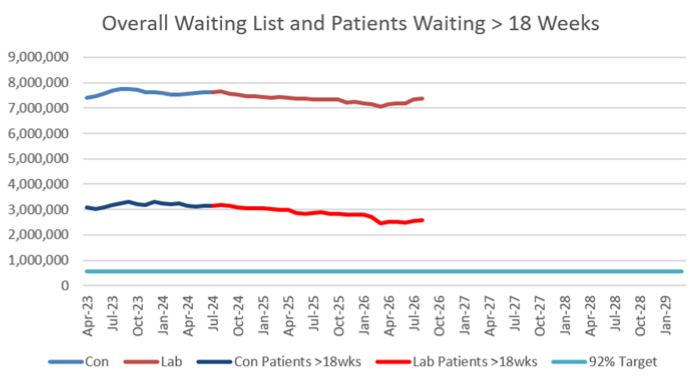
Two years on, that pledge is unravelling. The elective waiting list stood at 7.37 million pathways in August 2026 and the overall backlog is barely moving. The graph below suggests that the government is unlikely to meet its own target by the end of this parliamentary term. And indeed, it appears to be getting worse.
Each month hundreds of thousands of waiting list entries are removed through a process called ‘validation’. This is meant to “clean up” incorrect data from the waiting list. In the financial years 2023/24 and 2024/25 there were average monthly admin removals of 240,000. This has risen to a monthly average of 330,000 in 2026/27, with an all-time record figure of 477,486 for the latest month of August 2027. Were it not for this growth in admin removals, the overall waiting list would be at the same level it was when Labour were elected in July 2024.
Andy Burnham and Yvette Cooper passed through the recent Labour party conference without mentioning NHS waiting lists whatsoever. The Starmer-Streeting commitment is being allowed to fade. Speculation is rife that the Department of Health and Social Care (DHSC) and NHS England have sought yet more money from the Treasury to salvage the target, but have been rebuffed by John Healey.
The fiscal arithmetic makes such a refusal unsurprising. The DHSC budget is already roughly £214 billion and is set to reach roughly £246 billion by 2028/29. Including private care, healthcare spending sits near 11 per cent of GDP. The Office for Budget Responsibility (OBR) warns that, without substantial policy change, total public spending could climb from around 45 per cent of GDP in the mid-2020s to over 60 per cent by the 2070s – with government health spending alone heading toward 14.5 per cent. Real-terms NHS funding has risen by about 20 per cent since 2019, yet output has grown by only around 1 per cent a year, leaving a large productivity shortfall.
Pouring further money into an unreformed service will not close the gap. Lord Darzi’s 2024 report documented a £37 billion capital shortfall over the 2010s relative to comparable European systems, and repeated raids on capital budgets to cover day-to-day overspending have compounded this by at least £1 billion a year for a decade. The NHS allocates less than 6 per cent of its budget to capital.
Independent healthcare providers, however, who are free of such raids, invest closer to 8 per cent of revenue. Without new supply, additional cash simply competes for the same constrained labour and estate.
This has now been further confounded by the BMA calling a ‘consultants strike’ on the 25th and 26th of November. This will be two working days with no planned work being carried out, just emergency cover.
The doctors are striking for a number of reasons. They are: shorter hours to avoid burnout, more admin time for paperwork, improved financial recognition of emergency anti-social out of hours work, better access to pensions and, as always, higher pay.
With a below inflation offer for the next financial year of only 2.4 per cent, and the government arguing the reason is that additional money is better spent getting the waiting list down, Labour could be accused of goading the consultants into striking.
To reduce waiting lists a wider approach is required: reforms that expand capacity rather than merely pumping funds into existing bottlenecks. Three measures, outlined in the Prosperity Institute’s new healthcare policy platform, illustrate the direction required.
First, we must reform our tax system to unleash the latent potential of consultants who are ready and willing to do extra work but who face no financial incentive to do so. High marginal income tax rates deter the most productive clinicians from extra sessions. The tapered withdrawal of the income tax personal allowance between £100,000 and £125,140 creates an effective 60 per cent band that discourages precisely these senior hospital doctors whose additional work would most rapidly clear lists.
The £60,000 pension annual allowance and its taper also expose clinicians to complex, unpredictable tax charges that discourage additional work. The removal or reform of the pension annual allowance would eliminate or reduce these charges (currently totalling £350–466 million a year), that arrive 18 months after the work has been done, and prompt doctors to turn down overtime and extra sessions.
IR35 off-payroll-working rules, which capture an estimated £200–400 million a year from healthcare, further discourage clinicians from working through limited companies. Simplifying IR35 or excluding the relevant medical SIC codes would make additional activity attractive again.
These are not healthcare-specific giveaways; they are economy-wide measures that would also release substantial clinical capacity. The political case is straightforward: the reforms unlock NHS output rather than merely benefiting high earners.
Second, we should reintroduce tax relief on private medical insurance premiums. Roughly 8.4 million people already hold cover, and recent polling indicates that nearly 70 per cent of adults across party lines would consider private care if it were more affordable.
Relief existed for the over-60s from 1990 until Gordon Brown abolished it in 1997, and it has reappeared periodically in Conservative and Reform UK manifestos. The existing market generates several billion in tax revenue through employer National Insurance on company policies, income tax on benefits in kind, income tax on money used to purchase personal policies, and Insurance Premium Tax.
Full relief on the income-tax elements would cost the Exchequer roughly £2.73 billion immediately. If the affordability boost doubled coverage to around 16.8 million people – which is an achievable target given current trends – higher Insurance Premium Tax receipts would bring the net annual cost down toward £1.9 billion. In return, there would be a decrease in the number of patients using the NHS, reducing pressure on waiting lists.
Third, modest co-payments for GP appointments should be introduced. General practice is under severe strain: demand has outpaced real funding growth and practices report unsustainable workloads. Anyone who thinks this would represent a nefarious external attempt to privatise the NHS isn’t keeping up.
In May 2026 the BMA GP’s Committee conference voted strongly to explore a hybrid funding model akin to NHS dentistry, including means-tested options and subscription payments. A workable co-payment, say £5 per consultation, with exemptions modelled on prescription or dental charges for children, the elderly, low-income groups and the vulnerable, could target around 40 per cent of appointments as paid.
If all the additional funds raised went directly to individual GP practices then an average 10,000-patient practice might gain an additional 10 per cent of income, funding extended hours, staff, or facilities. Payment in advance of the appointment would also serve as a penalty for non-attendance, deterring unnecessary attendance.
Each measure above expands the supply of care. Workforce tax reform releases additional clinical sessions. Insurance relief channels private capital and activity into the wider healthcare system, whilst decreasing the number of new patients being added to NHS waiting lists. GP co-payments generate revenue for frontline practices, deter non-attendance and generate more capacity.
Together they start to address the workforce and capital shortfalls that pure spending increases have failed to close. They preserve the NHS’s universal access at the point of need while introducing market discipline, patient contribution, and voluntary private resources. The alternative—continued fiscal escalation without structural change—has only produced ever growing waiting lists.
Labour’s manifesto commitment is slipping because the government still treats the NHS primarily as a spending problem rather than a capacity problem. This is evidenced by the underlying reasons for the forthcoming consultants’ strike. Seeing the wood for the trees requires recognising that additional supply, not merely additional money or spurious admin removals, is what will finally bring waiting lists down.
Dr Nick White is a healthcare leader with 25 years of experience in the NHS and independent sector.
Labour arrived in office with a clear promise: restore the NHS standard so that no patient waits longer than 18 weeks from referral for consultant-led treatment of non-urgent conditions. It was set to be achieved by March 2029.
Two years on, that pledge is unravelling. The elective waiting list stood at 7.37 million pathways in August 2026 and the overall backlog is barely moving. The graph below suggests that the government is unlikely to meet its own target by the end of this parliamentary term. And indeed, it appears to be getting worse.
Each month hundreds of thousands of waiting list entries are removed through a process called ‘validation’. This is meant to “clean up” incorrect data from the waiting list. In the financial years 2023/24 and 2024/25 there were average monthly admin removals of 240,000. This has risen to a monthly average of 330,000 in 2026/27, with an all-time record figure of 477,486 for the latest month of August 2027. Were it not for this growth in admin removals, the overall waiting list would be at the same level it was when Labour were elected in July 2024.
Andy Burnham and Yvette Cooper passed through the recent Labour party conference without mentioning NHS waiting lists whatsoever. The Starmer-Streeting commitment is being allowed to fade. Speculation is rife that the Department of Health and Social Care (DHSC) and NHS England have sought yet more money from the Treasury to salvage the target, but have been rebuffed by John Healey.
The fiscal arithmetic makes such a refusal unsurprising. The DHSC budget is already roughly £214 billion and is set to reach roughly £246 billion by 2028/29. Including private care, healthcare spending sits near 11 per cent of GDP. The Office for Budget Responsibility (OBR) warns that, without substantial policy change, total public spending could climb from around 45 per cent of GDP in the mid-2020s to over 60 per cent by the 2070s – with government health spending alone heading toward 14.5 per cent. Real-terms NHS funding has risen by about 20 per cent since 2019, yet output has grown by only around 1 per cent a year, leaving a large productivity shortfall.
Pouring further money into an unreformed service will not close the gap. Lord Darzi’s 2024 report documented a £37 billion capital shortfall over the 2010s relative to comparable European systems, and repeated raids on capital budgets to cover day-to-day overspending have compounded this by at least £1 billion a year for a decade. The NHS allocates less than 6 per cent of its budget to capital.
Independent healthcare providers, however, who are free of such raids, invest closer to 8 per cent of revenue. Without new supply, additional cash simply competes for the same constrained labour and estate.
This has now been further confounded by the BMA calling a ‘consultants strike’ on the 25th and 26th of November. This will be two working days with no planned work being carried out, just emergency cover.
The doctors are striking for a number of reasons. They are: shorter hours to avoid burnout, more admin time for paperwork, improved financial recognition of emergency anti-social out of hours work, better access to pensions and, as always, higher pay.
With a below inflation offer for the next financial year of only 2.4 per cent, and the government arguing the reason is that additional money is better spent getting the waiting list down, Labour could be accused of goading the consultants into striking.
To reduce waiting lists a wider approach is required: reforms that expand capacity rather than merely pumping funds into existing bottlenecks. Three measures, outlined in the Prosperity Institute’s new healthcare policy platform, illustrate the direction required.
First, we must reform our tax system to unleash the latent potential of consultants who are ready and willing to do extra work but who face no financial incentive to do so. High marginal income tax rates deter the most productive clinicians from extra sessions. The tapered withdrawal of the income tax personal allowance between £100,000 and £125,140 creates an effective 60 per cent band that discourages precisely these senior hospital doctors whose additional work would most rapidly clear lists.
The £60,000 pension annual allowance and its taper also expose clinicians to complex, unpredictable tax charges that discourage additional work. The removal or reform of the pension annual allowance would eliminate or reduce these charges (currently totalling £350–466 million a year), that arrive 18 months after the work has been done, and prompt doctors to turn down overtime and extra sessions.
IR35 off-payroll-working rules, which capture an estimated £200–400 million a year from healthcare, further discourage clinicians from working through limited companies. Simplifying IR35 or excluding the relevant medical SIC codes would make additional activity attractive again.
These are not healthcare-specific giveaways; they are economy-wide measures that would also release substantial clinical capacity. The political case is straightforward: the reforms unlock NHS output rather than merely benefiting high earners.
Second, we should reintroduce tax relief on private medical insurance premiums. Roughly 8.4 million people already hold cover, and recent polling indicates that nearly 70 per cent of adults across party lines would consider private care if it were more affordable.
Relief existed for the over-60s from 1990 until Gordon Brown abolished it in 1997, and it has reappeared periodically in Conservative and Reform UK manifestos. The existing market generates several billion in tax revenue through employer National Insurance on company policies, income tax on benefits in kind, income tax on money used to purchase personal policies, and Insurance Premium Tax.
Full relief on the income-tax elements would cost the Exchequer roughly £2.73 billion immediately. If the affordability boost doubled coverage to around 16.8 million people – which is an achievable target given current trends – higher Insurance Premium Tax receipts would bring the net annual cost down toward £1.9 billion. In return, there would be a decrease in the number of patients using the NHS, reducing pressure on waiting lists.
Third, modest co-payments for GP appointments should be introduced. General practice is under severe strain: demand has outpaced real funding growth and practices report unsustainable workloads. Anyone who thinks this would represent a nefarious external attempt to privatise the NHS isn’t keeping up.
In May 2026 the BMA GP’s Committee conference voted strongly to explore a hybrid funding model akin to NHS dentistry, including means-tested options and subscription payments. A workable co-payment, say £5 per consultation, with exemptions modelled on prescription or dental charges for children, the elderly, low-income groups and the vulnerable, could target around 40 per cent of appointments as paid.
If all the additional funds raised went directly to individual GP practices then an average 10,000-patient practice might gain an additional 10 per cent of income, funding extended hours, staff, or facilities. Payment in advance of the appointment would also serve as a penalty for non-attendance, deterring unnecessary attendance.
Each measure above expands the supply of care. Workforce tax reform releases additional clinical sessions. Insurance relief channels private capital and activity into the wider healthcare system, whilst decreasing the number of new patients being added to NHS waiting lists. GP co-payments generate revenue for frontline practices, deter non-attendance and generate more capacity.
Together they start to address the workforce and capital shortfalls that pure spending increases have failed to close. They preserve the NHS’s universal access at the point of need while introducing market discipline, patient contribution, and voluntary private resources. The alternative—continued fiscal escalation without structural change—has only produced ever growing waiting lists.
Labour’s manifesto commitment is slipping because the government still treats the NHS primarily as a spending problem rather than a capacity problem. This is evidenced by the underlying reasons for the forthcoming consultants’ strike. Seeing the wood for the trees requires recognising that additional supply, not merely additional money or spurious admin removals, is what will finally bring waiting lists down.