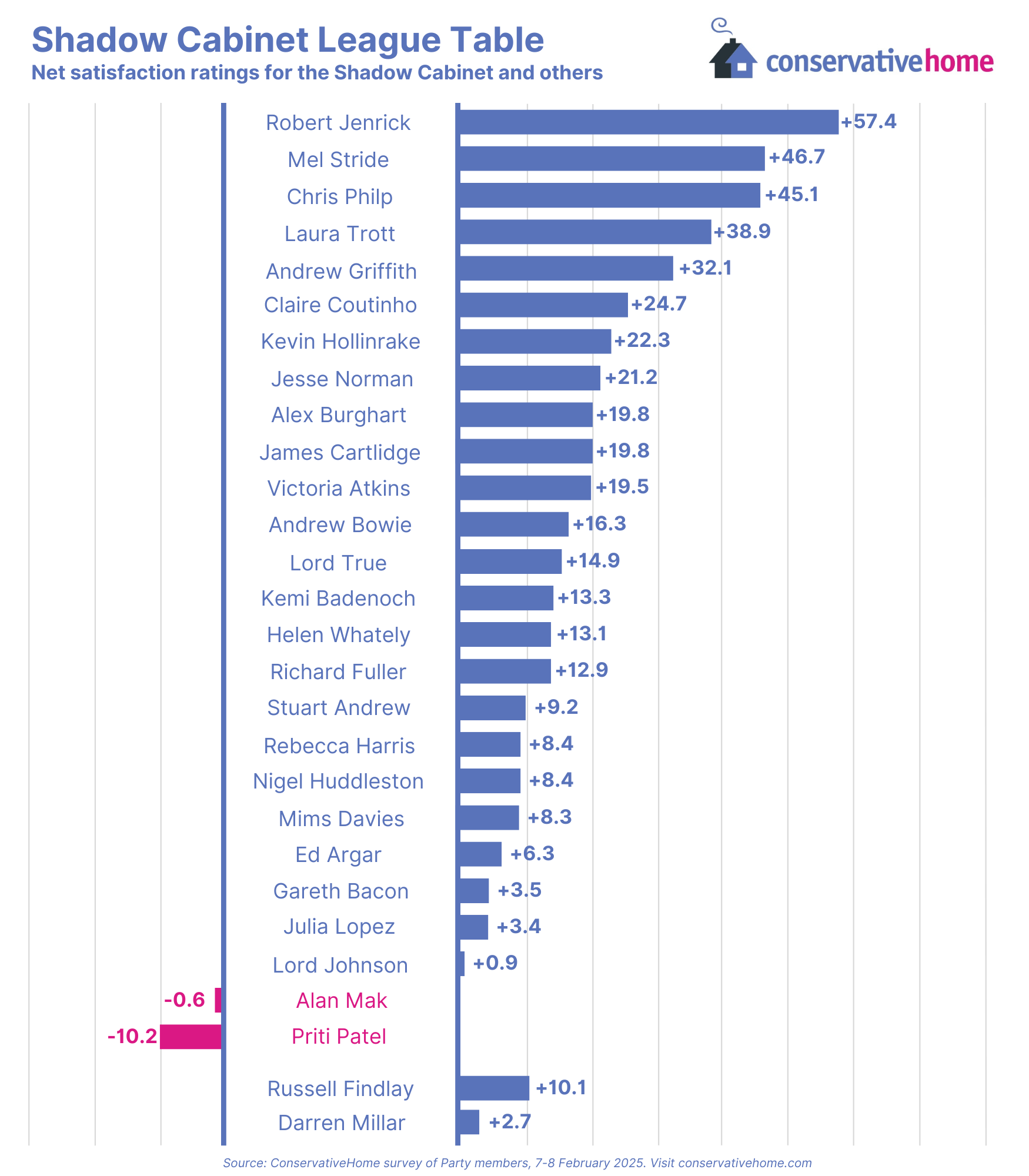
Our last Shadow Cabinet League Table was something of a watershed moment. Having led every single one since the election (normally by handsome double-digit margins), and topped the tables during the end of Rishi Sunak’s government, Kemi Badenoch was knocked off her perch.
Not just the perch, in fact, but the podium. The leader’s ranking dropped by almost 40 points, to +32, and she ended up in seventh place. The month just gone has not arrested the slide. Badenoch’s score has fallen another 19 points to just 13.3, and she’s 14th. This is almost, but not quite, the half-way line; there are fewer colleagues between the leader and the bottom of the table than the top.
This fall also happened before Wednesday’s disastrous (fairly or unfairly) PMQs, and the fresh bout of mutinous speculation that followed it. We might therefore assume that, barring some good news in the next couple of weeks, Badenoch’s score may fall yet further in the next league table – and another decline like this month’s, let alone last month’s, would put her in negative territory.
In this sort of environment we can only expect the leadership’s low-profile, slowly-but-surely strategy – which already cracked with last week’s immigration announcement – to crumble further. Even if the membership continues to narrowly favour it, Badenoch and her team need to change the narrative before her first impression as leader locks in. Only action can do that.
But it also highlights why the two-year wait on major announcements, and perhaps to an extent her entire leadership pitch, were unrealistic. Politics abhors a vacuum, and between Reform UK and a vast Labour back bench there is more than enough political drama to keep the media entertained without the Conservatives getting even a mention.
Winning oxygen in this attention economy was always going to require a tireless charm offensive with the media, and Badenoch has never given anyone any excuse for thinking she’d be inclined to do this. Her only notable set-piece interview since the last survey was with the TRIGGERnometry podcast, and even that has not got stellar reviews from the very-online bit of the Right it was presumably aimed at.
This combination of a low profile punctuated by a few, well-chosen media hits on favoured topics is how Badenoch built her reputation in government. It also did her no harm during the leadership contest. But those were attention-rich environments in which the Tories were the story by default. Opposition is very different, and the leader has not yet adapted to it.
Anyway, the rest of the table. We now have two ministers in negative ratings, and neither is a surprise. Alan Mak has been the lanterne rouge ever since Badenoch unveiled her shadow cabinet, and last month his score stood at just +0.6. His slipping below the line probably just reflects the air going out of the scores, although the news that he’s on her PMQs prep team won’t help.
Priti Patel gave a high-profile interview in which she suggested she and Boris Johnson should be thanked for the Boriswave. Enough said, really – her 37-point fall, from eight place to last, is only two points smaller than Badenoch’s in last month’s survey.
And the podium? The same three medallists as last month, but a significant change in the order: Robert Jenrick puts on 7.4 points and overleaps Mel Stride (who’s down 11) to take the gold-medal position. Is that a vindication of his energetic media strategy, a reflection of the salience of his favoured topics (although the latest ECHR row postdates this survey)? Or could it reflect, in part, a bit of buyer’s remorse?