Lord Ashcroft KCMG PC is an international businessman, philanthropist, author and pollster. For more information on his work, visit lordashcroft.com
Over the past two months, we have examined two voting blocs in British politics: a right-of-centre bloc, largely comprised of Reform and Conservative voters, and a left-of-centre bloc made up of Labour, Liberal Democrat and Green voters. But there is another important dividing line.
While the Greens and Reform have little in common in terms of policy, both argue that the major parties are all part of the same failed system. Both also aim to replace the established party within their own bloc. Especially following the Green’s victory in the Gorton and Denton by-election, Keir Starmer has sought to attack Reform and the Greens as two sides of the same coin – he has suggested that both are dangerous, and that both offer simple solutions to complex problems.
Is there any political mileage in this approach?
To answer this, we classify people as one of the following, according to their attitude to the Greens and Reform UK:
- Considerers, who say that they like a lot of what the party stands for and might well vote for it at the next election (though they might not currently be planning to do so)
- Sympathisers, who say that while they probably wouldn’t vote for that party, it is saying things which need to be said so they’re glad it’s around
- Rejecters, who don’t like what the party stands for and definitely rule out voting for it
- Unsure, who don’t know what they think about the party
We will use the term “Centrists” to describe people who are rejecters of both the Greens and of Reform. Currently, just 7 per cent of the population fall into this category – at a time when all politicians have negative approval ratings, this may seem a surprisingly small group (even in the context of a fragmented electorate and opinion polls often showing all parties below 30 per cent). Yet when the two blocs form the only likely basis for a governing coalition after the next election (whether that is by a party cannibalising the vote in its respective bloc to win a majority, or the formation of a coalition government between parties within a bloc), a group of voters who reject the insurgent party in both the left bloc and the right bloc make the situation more complex.
What do we know about the Centrist? Among those who are likely to vote at the next election, 42 per cent intend to back the Conservatives, compared with 29 per cent for Labour and 14 per cent Lib Dem. At the 2024 general election, Labour received 40 per cent of the vote among this group, with the Tories on 35 per cent and the Lib Dems 17 per cent. In 2019, the Conservatives took nearly half of their vote (47 per cent); Labour managed just 28 per cent, and the Lib Dems 16 per cent. In other words, the Conservatives have nearly recovered to their 2019 levels of support among centrists, whereas Labour have fallen back to their 2019 performance.
However, if forced to choose between having a government involving the Greens and a government involving Reform, centrists choose the former by an 18-point margin (59 per cent to 41 per cent). When asked about their view of the current government, Centrists are evenly divided between saying Labour is doing a good job or is preferable to the alternatives (45 per cent) and that it is doing a bad job and they want a change (46 per cent). Among voters as a whole the comparable figures are 36 per cent and 52 per cent respectively – a 15-point difference between the centrists and the overall electorate). We can see, then, that there are both opportunities and risks for Labour and for the Conservatives with centrist voters.
We can further analyse this framework via our demographic map below, along with people’s currently likely vote. The size of a bubble is proportional to the number of voters in the group. The closer points are together, the more similar the people in the respective groups are.
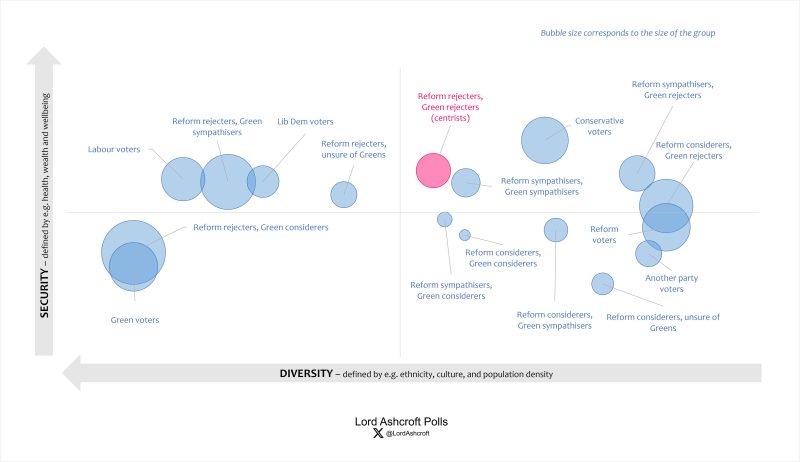
The bottom-right quadrant shows an appetite for anti-establishment politics and is now the location of people intending to vote for a party other than the seven major British parties. This suggests that any backlash against the large number of defections to Reform from the Conservatives will be concentrated in this part of the map. The Greens find themselves unchallenged in the bottom left part of the map, whereas the three traditional parties all find the bulk of their support in the top half of the map.
We can see that that our Centrists are slightly after “12 o’clock” on the map, in the “no man’s land” between the Conservative vote on the one hand and the Labour/Liberal Democrat vote on the other (giving the first justification for the name). People who sympathise with Reform and reject the Greens are about the same distance on the map from the Conservative vote as Centrists. Both groups are in the traditional Conservative heartland of the top-right of the map. This shows the difficult balancing act Kemi Badenoch faces.
Looking at views of Reform and the Greens among current Conservative, Labour and Lib Dem voters sheds further light on the situation:
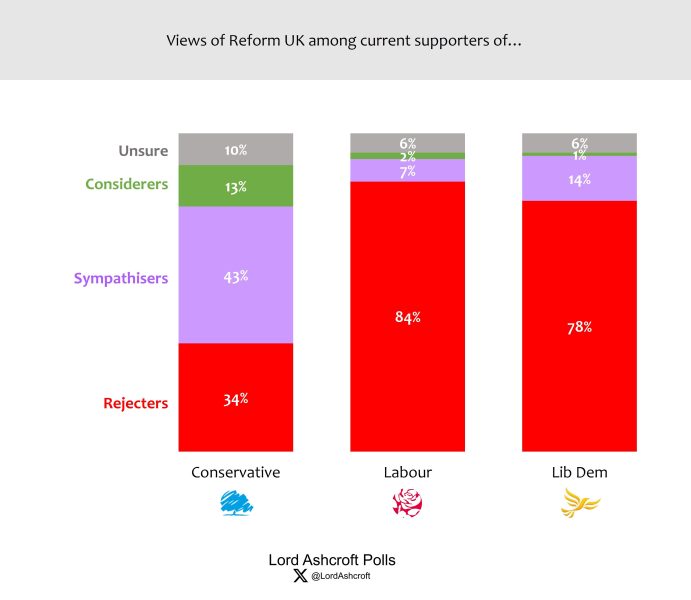
Unsurprisingly, we see high levels of hostility to Reform among Labour and Lib Dem voters: 78 per cent of Lib Dem voters and 84 per cent of Labour voters are rejecters. At the same time, consistent with our previous analysis about the difficulty of uniting the right, Conservative voters demonstrate also a marked reluctance to support Reform: 34 per cent are rejecters, whereas only 13 per cent are considerers. The analogous chart for the Greens is below:

Strikingly, fewer than half of Conservative voters are outright hostile to the Green Party. Although very few Tories would consider voting for the Greens, more than three in ten (31 per cent) are sympathisers. For Labour voters, that figure is around one in eight: despite Starmer’s admonitions, more Labour supporters are considers of the Green Party than rejecters of it. Among all three established parties, uncertainty about the Greens is higher than uncertainty about Reform. In view of my findings this month that some Green policies face deep disapproval, we might expect rejection of the Greens to increase and therefore the centrist group to become larger.
Anyone talking about an election which is probably years away must bear in mind the Wilsonian maxim that a week is a long time in politics. Yet if the landscape then resembles the current state of play, one key question will be which putative governing coalition is least chaotic – and this Centrist group of voters may hold the answer. The evolving size and attitudes of this group, and their positioning on our political map, will tell us a good deal about the trajectory of our politics.
Full data tables at LordAshcroftPolls.com
Lord Ashcroft KCMG PC is an international businessman, philanthropist, author and pollster. For more information on his work, visit lordashcroft.com
Over the past two months, we have examined two voting blocs in British politics: a right-of-centre bloc, largely comprised of Reform and Conservative voters, and a left-of-centre bloc made up of Labour, Liberal Democrat and Green voters. But there is another important dividing line.
While the Greens and Reform have little in common in terms of policy, both argue that the major parties are all part of the same failed system. Both also aim to replace the established party within their own bloc. Especially following the Green’s victory in the Gorton and Denton by-election, Keir Starmer has sought to attack Reform and the Greens as two sides of the same coin – he has suggested that both are dangerous, and that both offer simple solutions to complex problems.
Is there any political mileage in this approach?
To answer this, we classify people as one of the following, according to their attitude to the Greens and Reform UK:
We will use the term “Centrists” to describe people who are rejecters of both the Greens and of Reform. Currently, just 7 per cent of the population fall into this category – at a time when all politicians have negative approval ratings, this may seem a surprisingly small group (even in the context of a fragmented electorate and opinion polls often showing all parties below 30 per cent). Yet when the two blocs form the only likely basis for a governing coalition after the next election (whether that is by a party cannibalising the vote in its respective bloc to win a majority, or the formation of a coalition government between parties within a bloc), a group of voters who reject the insurgent party in both the left bloc and the right bloc make the situation more complex.
What do we know about the Centrist? Among those who are likely to vote at the next election, 42 per cent intend to back the Conservatives, compared with 29 per cent for Labour and 14 per cent Lib Dem. At the 2024 general election, Labour received 40 per cent of the vote among this group, with the Tories on 35 per cent and the Lib Dems 17 per cent. In 2019, the Conservatives took nearly half of their vote (47 per cent); Labour managed just 28 per cent, and the Lib Dems 16 per cent. In other words, the Conservatives have nearly recovered to their 2019 levels of support among centrists, whereas Labour have fallen back to their 2019 performance.
However, if forced to choose between having a government involving the Greens and a government involving Reform, centrists choose the former by an 18-point margin (59 per cent to 41 per cent). When asked about their view of the current government, Centrists are evenly divided between saying Labour is doing a good job or is preferable to the alternatives (45 per cent) and that it is doing a bad job and they want a change (46 per cent). Among voters as a whole the comparable figures are 36 per cent and 52 per cent respectively – a 15-point difference between the centrists and the overall electorate). We can see, then, that there are both opportunities and risks for Labour and for the Conservatives with centrist voters.
We can further analyse this framework via our demographic map below, along with people’s currently likely vote. The size of a bubble is proportional to the number of voters in the group. The closer points are together, the more similar the people in the respective groups are.
The bottom-right quadrant shows an appetite for anti-establishment politics and is now the location of people intending to vote for a party other than the seven major British parties. This suggests that any backlash against the large number of defections to Reform from the Conservatives will be concentrated in this part of the map. The Greens find themselves unchallenged in the bottom left part of the map, whereas the three traditional parties all find the bulk of their support in the top half of the map.
We can see that that our Centrists are slightly after “12 o’clock” on the map, in the “no man’s land” between the Conservative vote on the one hand and the Labour/Liberal Democrat vote on the other (giving the first justification for the name). People who sympathise with Reform and reject the Greens are about the same distance on the map from the Conservative vote as Centrists. Both groups are in the traditional Conservative heartland of the top-right of the map. This shows the difficult balancing act Kemi Badenoch faces.
Looking at views of Reform and the Greens among current Conservative, Labour and Lib Dem voters sheds further light on the situation:
Unsurprisingly, we see high levels of hostility to Reform among Labour and Lib Dem voters: 78 per cent of Lib Dem voters and 84 per cent of Labour voters are rejecters. At the same time, consistent with our previous analysis about the difficulty of uniting the right, Conservative voters demonstrate also a marked reluctance to support Reform: 34 per cent are rejecters, whereas only 13 per cent are considerers. The analogous chart for the Greens is below:
Strikingly, fewer than half of Conservative voters are outright hostile to the Green Party. Although very few Tories would consider voting for the Greens, more than three in ten (31 per cent) are sympathisers. For Labour voters, that figure is around one in eight: despite Starmer’s admonitions, more Labour supporters are considers of the Green Party than rejecters of it. Among all three established parties, uncertainty about the Greens is higher than uncertainty about Reform. In view of my findings this month that some Green policies face deep disapproval, we might expect rejection of the Greens to increase and therefore the centrist group to become larger.
Anyone talking about an election which is probably years away must bear in mind the Wilsonian maxim that a week is a long time in politics. Yet if the landscape then resembles the current state of play, one key question will be which putative governing coalition is least chaotic – and this Centrist group of voters may hold the answer. The evolving size and attitudes of this group, and their positioning on our political map, will tell us a good deal about the trajectory of our politics.
Full data tables at LordAshcroftPolls.com