Lord Ashcroft KCMG PC is an international businessman, philanthropist, author and pollster. For more information on his work, visit lordashcroft.com
Earlier this month I explored whether or not it was in Labour’s interests to promise a referendum on rejoining the EU. Here we look at the other side of the coin: Brexit and the Conservatives.
After an election defeat, a party has to show it has listened and learned. To admit no errors would be to suggest it has learned nothing. But a party which trashes its own record across the board looks either unserious or unprincipled. Where does Brexit fit in?
My most recent poll asked if life in Britain over the last few years had been better, worse or about the same than it would have been if we were still in the EU. On the left, the view is clear: around eight in ten Labour, Lib Dem and Green voters say “worse”. On the right, the view is more nuanced, as we see from the chart below.
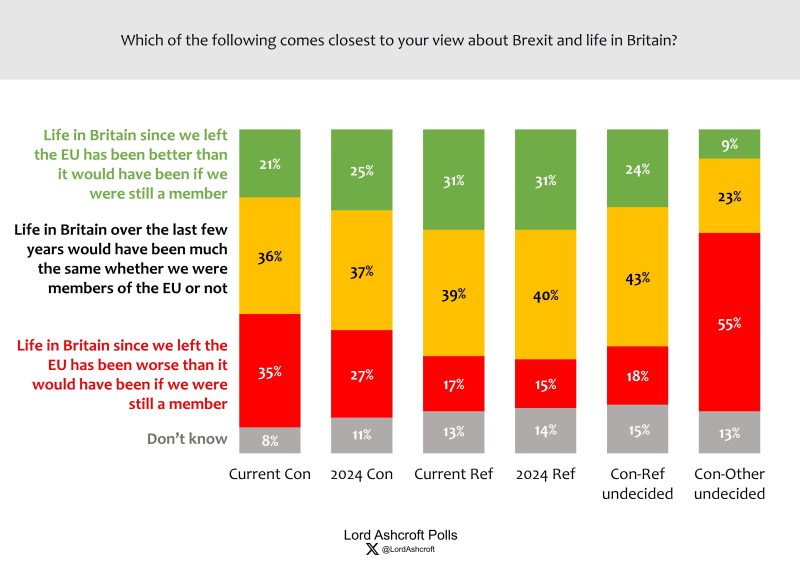
Reform voters are twice as likely to think that Brexit has changed the UK for the better than for the worse, and the balance of opinion among their current supporters matches the balance of opinion among its 2024 voter base. The Conservatives, however, have seen a shift. Their 2024 voters divided evenly, but those currently leaning towards the party tend to think that leaving has made things worse.
Voters hovering between the Tories and Reform incline slightly towards thinking Brexit has been beneficial (and fewer than one in five think it has made things worse). However, those who are undecided between the Conservatives and a party other than Reform are decidedly negative about the effects of Brexit. These groups are roughly the same size, and the Conservative will need to win over both in order to recover electorally.
As well as being divided on this question, the potential Conservative voting coalition includes significant numbers of both leavers and remainers. In fact, the Tories are the only party to draw support from both sides of the Brexit divide. The risk associated with a reopening of the EU debate is clear.
What may be less clear is the potential benefit.
In a fragmented five-party landscape, there is an increasing tendency for leaders to tell their core voters exactly what they want to hear, even if in places it is self-contradictory. Pleasing some of the people all of the time is not a realistic prospectus for governing Britain in the 2020s. Badenoch has the opportunity to position the Conservatives as a party for both sides of the Brexit divide and one that is capable of governing in a united interest, rather than for a small sectional interest. If this sounds woolly, Margaret Thatcher and Ronald Reagan were able simultaneously to broaden their electoral base and pursue an unapologetically conservative agenda.
Our political map helps tell the story. Bubble sizes are proportional to the size of the relevant voter group, and the closer bubbles are, the more similar the respective groups of voters. In the party colours, we have the locations of current support for the five largest parties. The other bubbles represent combinations of attitudes of particular relevance to the Conservatives.

There is a group of 2016 leave voters who so regret Brexit that they would vote to rejoin the EU. However, they are close to the centre of the political map and a long distance from any of the party bubbles. This suggests both that these people have little in common in the way of political outlook beyond their view of Brexit, and that they will be hard for any party to target. In other words, there is little mileage in trying to build an electoral coalition around Bregret.
We also asked whether three potential conditions associated with readmittance to the EU (joining the Euro, joining the Schengen area, and paying a higher membership fee than before) would be acceptable or unacceptable. We can see the position of the bubbles showing current likely Conservative voters who would consider all three unacceptable and those who would consider at least one condition acceptable. The the bubbles are similar sizes, demonstrating that the Conservative voter base is close to evenly divided on the issue (55 per cent of current Conservative voters would reject all three conditions, whereas 45 per cent would accept at least one). But they are also very close to the overall Conservative bubble, suggesting that the two groups have a lot of common political ground outside the Brexit debate.
The bitterest and most damaging political divides are those where there is clear distance between both sides on the map (as happened in 2019 with Labour’s red wall voters in the bottom right quadrant and its metropolitan remainers in the top left).
Advocates of rejoining argue that there is a settled consensus that Brexit was a mistake. But in the previous piece, we demonstrated that despite the headline landslide 23-point lead for rejoin in a hypothetical referendum, when questions of detail about the terms of rejoining are considered, the lead shrinks considerably. That is not to say that rejoin winning a referendum is implausible or even improbable: it is merely not inevitable. Questioning the details of any plan to rejoin does not open up Pandora’s Box for the Conservatives: their voters may disagree about these conditions, but it is not a polarising disagreement which risks tearing their electoral coalition apart.
Another important group is people who, while they might not like Brexit, are even less keen on the division and instability they believe would follow from reopening the debate. We asked people whether we should accept that Brexit has happened and try to make the best of it, or whether we should accept that Brexit has failed and try to rejoin at least some aspects of the EU. We can therefore examine two further groups: those who voted to remain in 2016 and now agree the UK should accept Brexit, and those who would vote to rejoin in a hypothetical referendum but nonetheless agree that the UK should accept Brexit. The first group is adjacent to the Conservatives on the political map, suggesting that they share a similar outlook on other political questions. The latter group lands in the top left quadrant, equidistant from Labour and the Conservatives on the political map; they occupy similar territory to the centrist voters we wrote about in April.
This means the Conservatives do not have to reject Brexit to appeal to the swing voters towards the “12 o’clock” position on the political map. The argument that Brexit is last decade’s issue, and the UK needs to move on rather than reopening old wounds, already resonates with them. It is an argument which is easy to make and easy to understand. Given the low ranking of Brexit in people’s list of issues, proponents of rejoin face an uphill battle. Badenoch would be well-advised not to let them take even one step up that hill.
Addressing the issues which voters rank as most important – the cost of living, immigration and healthcare – will mean tackling some emotive issues. Any serious attempt to do so entails grappling with things like social care, the UK’s national debt and low productivity. These have remained unresolved for a reason. (Indeed, they were still issues while the UK was in the EU). A future government seeking to make progress in these areas would have to make tough decisions and persuade a cynical public that they are necessary. It would have to get difficult legislation through a parliament where many MPs will have wafer-thin majorities and the government itself may well be relying on other parties. This would take a great deal of political skill, strong leadership, careful policy development and persuasive advocacy – divisive distractions like relitigating Brexit would hardly help.
What, then, should Badenoch say and do about Brexit?
The armoury of contemporary politicians is replete with silver bullets, but easy answers won’t do and the voters know it. Deciding to leave the EU presented opportunities and challenges. As a country we have to seize those opportunities and rise to those challenges. That means hard work and a government prepared to make tough choices for the long term. Just as Brexit was never the answer to every problem in 2016, it is not the cause of every problem in 2026. It is time to move on and move forward.
Full data tables at LordAshcroftPolls.com
Lord Ashcroft KCMG PC is an international businessman, philanthropist, author and pollster. For more information on his work, visit lordashcroft.com
Earlier this month I explored whether or not it was in Labour’s interests to promise a referendum on rejoining the EU. Here we look at the other side of the coin: Brexit and the Conservatives.
After an election defeat, a party has to show it has listened and learned. To admit no errors would be to suggest it has learned nothing. But a party which trashes its own record across the board looks either unserious or unprincipled. Where does Brexit fit in?
My most recent poll asked if life in Britain over the last few years had been better, worse or about the same than it would have been if we were still in the EU. On the left, the view is clear: around eight in ten Labour, Lib Dem and Green voters say “worse”. On the right, the view is more nuanced, as we see from the chart below.
Reform voters are twice as likely to think that Brexit has changed the UK for the better than for the worse, and the balance of opinion among their current supporters matches the balance of opinion among its 2024 voter base. The Conservatives, however, have seen a shift. Their 2024 voters divided evenly, but those currently leaning towards the party tend to think that leaving has made things worse.
Voters hovering between the Tories and Reform incline slightly towards thinking Brexit has been beneficial (and fewer than one in five think it has made things worse). However, those who are undecided between the Conservatives and a party other than Reform are decidedly negative about the effects of Brexit. These groups are roughly the same size, and the Conservative will need to win over both in order to recover electorally.
As well as being divided on this question, the potential Conservative voting coalition includes significant numbers of both leavers and remainers. In fact, the Tories are the only party to draw support from both sides of the Brexit divide. The risk associated with a reopening of the EU debate is clear.
What may be less clear is the potential benefit.
In a fragmented five-party landscape, there is an increasing tendency for leaders to tell their core voters exactly what they want to hear, even if in places it is self-contradictory. Pleasing some of the people all of the time is not a realistic prospectus for governing Britain in the 2020s. Badenoch has the opportunity to position the Conservatives as a party for both sides of the Brexit divide and one that is capable of governing in a united interest, rather than for a small sectional interest. If this sounds woolly, Margaret Thatcher and Ronald Reagan were able simultaneously to broaden their electoral base and pursue an unapologetically conservative agenda.
Our political map helps tell the story. Bubble sizes are proportional to the size of the relevant voter group, and the closer bubbles are, the more similar the respective groups of voters. In the party colours, we have the locations of current support for the five largest parties. The other bubbles represent combinations of attitudes of particular relevance to the Conservatives.
There is a group of 2016 leave voters who so regret Brexit that they would vote to rejoin the EU. However, they are close to the centre of the political map and a long distance from any of the party bubbles. This suggests both that these people have little in common in the way of political outlook beyond their view of Brexit, and that they will be hard for any party to target. In other words, there is little mileage in trying to build an electoral coalition around Bregret.
We also asked whether three potential conditions associated with readmittance to the EU (joining the Euro, joining the Schengen area, and paying a higher membership fee than before) would be acceptable or unacceptable. We can see the position of the bubbles showing current likely Conservative voters who would consider all three unacceptable and those who would consider at least one condition acceptable. The the bubbles are similar sizes, demonstrating that the Conservative voter base is close to evenly divided on the issue (55 per cent of current Conservative voters would reject all three conditions, whereas 45 per cent would accept at least one). But they are also very close to the overall Conservative bubble, suggesting that the two groups have a lot of common political ground outside the Brexit debate.
The bitterest and most damaging political divides are those where there is clear distance between both sides on the map (as happened in 2019 with Labour’s red wall voters in the bottom right quadrant and its metropolitan remainers in the top left).
Advocates of rejoining argue that there is a settled consensus that Brexit was a mistake. But in the previous piece, we demonstrated that despite the headline landslide 23-point lead for rejoin in a hypothetical referendum, when questions of detail about the terms of rejoining are considered, the lead shrinks considerably. That is not to say that rejoin winning a referendum is implausible or even improbable: it is merely not inevitable. Questioning the details of any plan to rejoin does not open up Pandora’s Box for the Conservatives: their voters may disagree about these conditions, but it is not a polarising disagreement which risks tearing their electoral coalition apart.
Another important group is people who, while they might not like Brexit, are even less keen on the division and instability they believe would follow from reopening the debate. We asked people whether we should accept that Brexit has happened and try to make the best of it, or whether we should accept that Brexit has failed and try to rejoin at least some aspects of the EU. We can therefore examine two further groups: those who voted to remain in 2016 and now agree the UK should accept Brexit, and those who would vote to rejoin in a hypothetical referendum but nonetheless agree that the UK should accept Brexit. The first group is adjacent to the Conservatives on the political map, suggesting that they share a similar outlook on other political questions. The latter group lands in the top left quadrant, equidistant from Labour and the Conservatives on the political map; they occupy similar territory to the centrist voters we wrote about in April.
This means the Conservatives do not have to reject Brexit to appeal to the swing voters towards the “12 o’clock” position on the political map. The argument that Brexit is last decade’s issue, and the UK needs to move on rather than reopening old wounds, already resonates with them. It is an argument which is easy to make and easy to understand. Given the low ranking of Brexit in people’s list of issues, proponents of rejoin face an uphill battle. Badenoch would be well-advised not to let them take even one step up that hill.
Addressing the issues which voters rank as most important – the cost of living, immigration and healthcare – will mean tackling some emotive issues. Any serious attempt to do so entails grappling with things like social care, the UK’s national debt and low productivity. These have remained unresolved for a reason. (Indeed, they were still issues while the UK was in the EU). A future government seeking to make progress in these areas would have to make tough decisions and persuade a cynical public that they are necessary. It would have to get difficult legislation through a parliament where many MPs will have wafer-thin majorities and the government itself may well be relying on other parties. This would take a great deal of political skill, strong leadership, careful policy development and persuasive advocacy – divisive distractions like relitigating Brexit would hardly help.
What, then, should Badenoch say and do about Brexit?
The armoury of contemporary politicians is replete with silver bullets, but easy answers won’t do and the voters know it. Deciding to leave the EU presented opportunities and challenges. As a country we have to seize those opportunities and rise to those challenges. That means hard work and a government prepared to make tough choices for the long term. Just as Brexit was never the answer to every problem in 2016, it is not the cause of every problem in 2026. It is time to move on and move forward.
Full data tables at LordAshcroftPolls.com