Dr Patrick English is the Director of Political Analytics at YouGov.
Headline vote intention figures make for dire reading for the Conservatives. January 2024, the first month of what we all understand to be an election year, has begun with an expansion of the Labour lead over the incumbent Conservative government, not a narrowing.
There are many potential reasons for this, which I won’t go into in this article, but Tory election campaign director Isaac Levido’s comments to a meeting of Conservative MPs last week can help to explain much of it: “divided parties fall”.
Right now, according to the latest YouGov poll, Labour are on 47 per cent of current vote intention, while the Conservatives are down on 20 per cent. This 27-point gap represents the highest lead for Labour since Liz Truss was prime minister. If that were indeed replicated at a general election, it would spell nothing short of Conservative party wipe out up and down the country.
However, while the wipe out possibility is front and centre of many minds within the Conservative Party, the media, and the commentariat, those closer to the Prime Minister’s inner-circle are less down and out. They point to one eye-catching set of people within current vote intention data which gives them what they say is cause for extreme hope: those currently telling pollsters they “don’t know” how they would vote if a general election were happening tomorrow.
No fewer than 20 per cent of people polled in YouGov surveys are telling us that they simply do not know who they would vote for if there were facing a ballot paper in a polling booth tomorrow.
Is 20 per cent a lot? Well put it this way: it suggests that the jury is out on all parties – including the Conservatives and Labour, and Rishi Sunak and Keir Starmer – for about one fifth of the population who are, at least for now, not telling us that they won’t vote at the next election, but that they probably would like to but just have no idea who for.
But is it a lot in historical perspective? In short, no.
In February and March 2019, a similar distance away from the ballot that year as we assume we currently are from a prospective October/November 2024 election, YouGov recorded figures of 22 per cent, 22 per cent, and 19 per cent for “don’t know”.
So far this January, we have recorded figures of 18 per cent, 18 per cent, and 17 per cent. If anything, uncertainty now looks a little lower than at the same stage in the 2019 election cycle.
They look more similar in fact to the number of people telling us they were unsure how they would vote in an imminent election at this stage in the 2017 cycle. In August of the year before (around 1tenmonths out from the vote itself), we recorded figures of 18 per cent, 16 per cent, and 17 per cent.
But what is special about this current crop of “don’t knows” is that they are heavily partisan in a way in which they have been in recent election cycles. The graphic below shows the average percentage of each of Conservative, Labour, and Liberal Democrat voters from the previous election giving us “don’t know” responses at similar times in the 2017, 2019, and 2024 general election cycles.
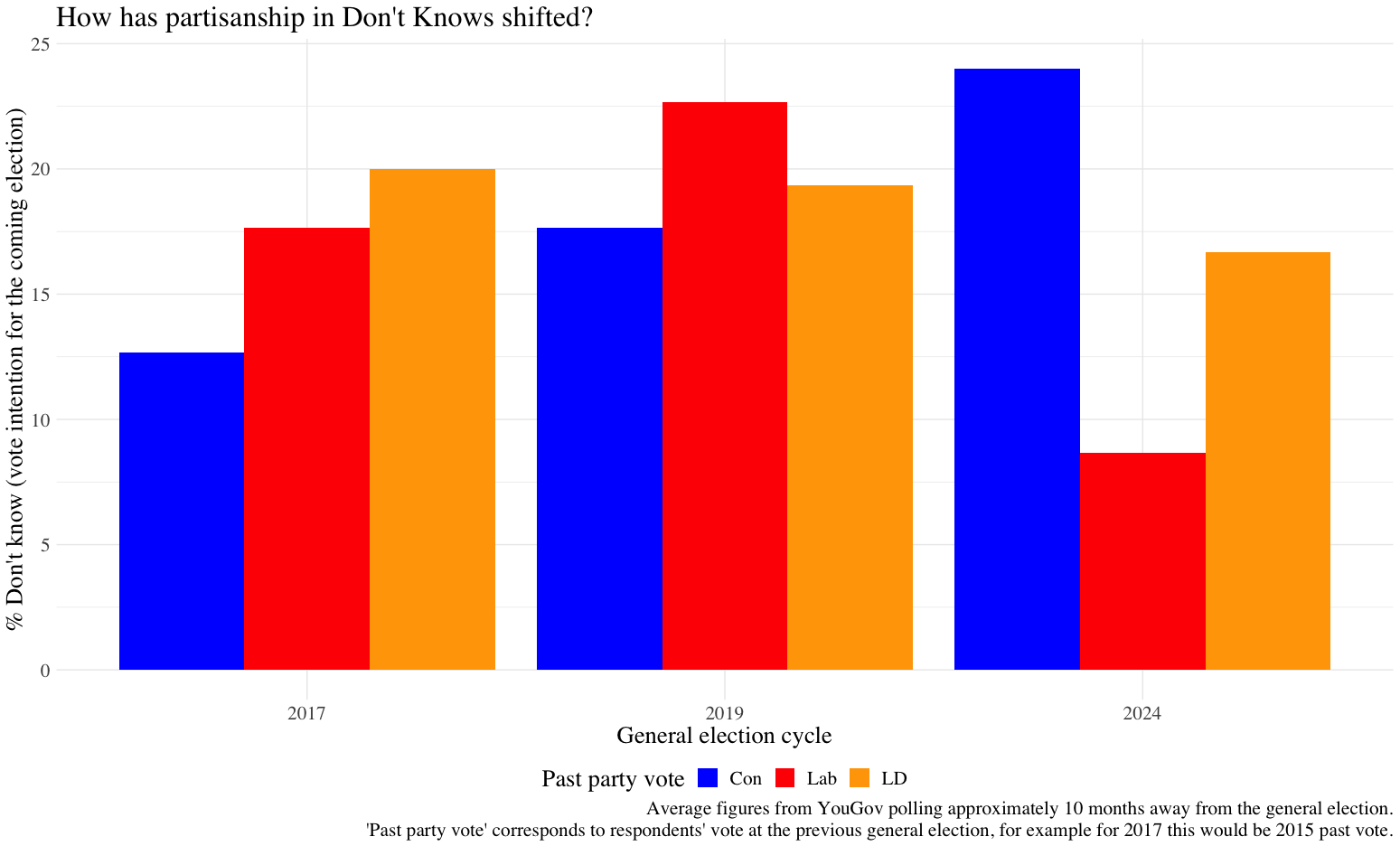
As we can see, at this sort of stage in the 2017 cycle, the three-poll average proportion of 2015 Conservative (13 per cent) and Labour (18 per cent) voters telling us they did not know who to vote for was largely fairly similar. A gap of five points, on this metric, is not overwhelmingly large. The Liberal Democrat figure was highest in that election, at 20 per cent.
Uncertainty in the 2019 cycle was generally up a bit compared with 2017, but there were similar gaps in terms of the percentage of 2017 Conservative (18 per cent) and Labour (23 per cent) voters telling YouGov at this stage in the 2019 cycle that they did not know who they would vote for, with Liberal Democrat uncertainty staying relatively consistent (19 per cent).
However, looking at the 2024 cycle, we see a fundamentally different pattern. The proportion of 2019 Conservative voters telling us they “don’t know” (24 per cent) absolutely dwarfs above the proportion of 2019 Labour (nine per cent) voters saying the same, and is significantly above that of the Liberal Democrats (17 per cent) too.
What consequence might this have for the election to come? Let’s assume that most of those telling us that they do intend to vote, but currently don’t know who for, do actually turn out, and that they are more likely to vote for the party they backed previously than to switch to another.
Then, the Conservatives may well have a much larger pool of the electorate currently likely to actually vote for them when the chips are down, and the “who governs?” question is asked, than the headline vote intention figures actually suggest.
But how realistic is that? And how much could it eat into Labour’s lead?
Some pollsters already attempt to answer this question in their headline vote intention figures. Opinium for example, after collecting their vote intention samples, remove all who say “don’t know” from this sample and re-weight the figures back to what they call a “likely voter” population. This, in theory, gives a handle on what, according to Opinium’s model, is likely to happen with the “don’t knows”.
But we can appeal to a much fuller model of this, which also gives us a much stronger sense of how “don’t know” behaviour will actually effect things seat-by-seat.
Levido was of course addressing Tory MPs shortly after a brand new YouGov MRP model was dropped into the mixing bowl by the Telegraph. Our model, based on over 14,000 interviews, showed that, if an election were being held now (or rather with current patterns of vote intention), the Labour party would win a majority of 120 seats.
In short, Starmer would take his party from their worst electoral defeat since 1935 so not only overturning the hefty Conservative majority won by Boris Johnson in 2019, but building a majority of their own the size of which not seen from any party since Tony Blair’s years in government.
What is particularly important about the MRP poll in reference to this discussion is that it accounts for what might happen with the “don’t knows”, baking it into estimates you see published at the constituency level.
This is in fact why, unlike other projections using headline vote intentions, our model did not show Labour north of 400 seats, or the Conservatives below 100. The MRP works out what it believes, given all the data is has, to be is the most likely pattern of voting for each type of voter in country – including those who say they “don’t know” how they currently vote.
It does so by building models of relationships between voters who have given a vote intention in the sample data, and using them to project how all different types and tribes of voters across the country would vote in an election being held at that time.
This can be seen as much more statistically advanced and sophisticated variation of “Don’t know reallocation/re-weighting” efforts noted above by pollsters such as Opinium.
Altogether, that means that our YouGov MRP projection is taking into account all of the above reasons and rationale for the Conservatives to maybe have a bit more optimism looking at the current polling than they otherwise might. This is, in effect, what things would look like in a best-case scenario regarding the “don’t knows” right now.
So, what YouGov are saying is that, even “accounting for the don’t knows”, the Conservatives are on to a hounding. If they are to stop Labour sweeping to victory, they not only need to bring back in even more “don’t knows” than models suggest they currently will, but also win back a large number of voters who have abandoned the party for their rivals to the right and left.