Lord Ashcroft KCMG PC is an international businessman, philanthropist, author and pollster. For more information on his work, visit lordashcroft.com
With both Labour and the Conservatives expected to suffer heavy losses in today’s local elections, attention will no doubt turn to the quality and likely longevity of their respective leaders.
To what extent are Keir Starmer and Kemi Badenoch electoral assets or liabilities for their parties?
In this month’s poll we asked a pair of related questions about Labour and the Conservatives. First, whether people liked both the party and the leader; liked the leader but disliked the party; liked the party but disliked the leader; disliked both the leader and the party, or if they didn’t know. The responses were as follows:
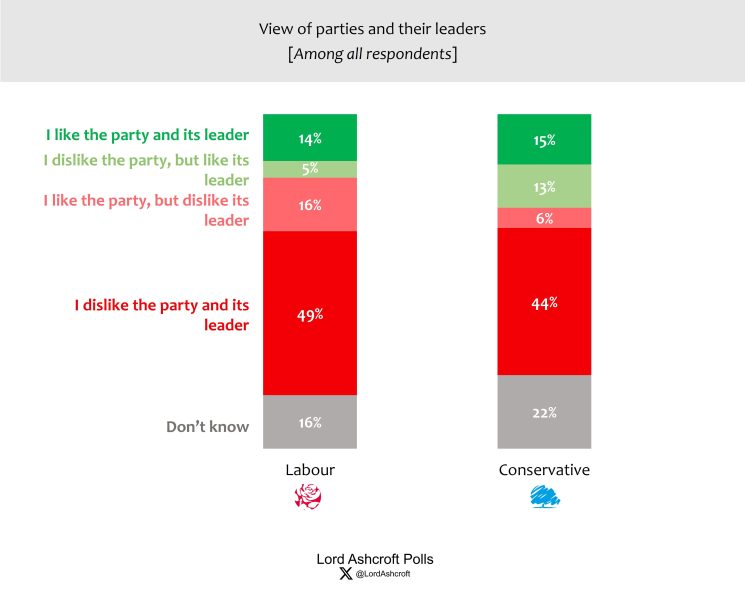
Unsurprisingly, many people think the same of the party as they do of the leader: 63 per cent have the same view of Starmer and Labour, and 59 per cent have the same view of Badenoch and the Conservatives. Equally unsurprisingly in today’s political landscape, by far the most common response is to dislike both the party and its leader. Yet around one in five differentiate the party from the leader. In Labour’s case, 75 per cent of such people like the party but dislike Starmer; in the case of the Conservatives, only 33 per cent of such people like the party but dislike Badenoch.
Put another way – stay with me – for every voter who is attracted to Starmer despite being put off by Labour, there are three voters who are put off by Starmer even though they like Labour. Conversely, for every voter who is put off by Badenoch despite being attracted to the Tories, there are two voters who like Badenoch despite being repelled by her party.
This suggests that while Starmer is a net liability for his party and its ability to win over voters, Badenoch is a net asset for hers. Can we take it at face value?
First-rate politicians can reach beyond their party’s core support and win votes from people who would otherwise not consider that party: Reagan Democrats are a case in point, as are Boris Johnson’s appeal in the red wall in 2019 (if not later) and Tony Blair’s success beyond Labour’s traditional heartlands. However, if a leader’s “additional” appeal is among voters who are never going to support that party, it can be redundant or even counterproductive.
Every month, we ask people to rate how likely they are to vote for each of the UK’s main parties on a scale from zero (definitely not) to 100 (definitely yes). If we look at the same question among people who do not completely reject the party in question (ie. give some score above zero), we find the following:
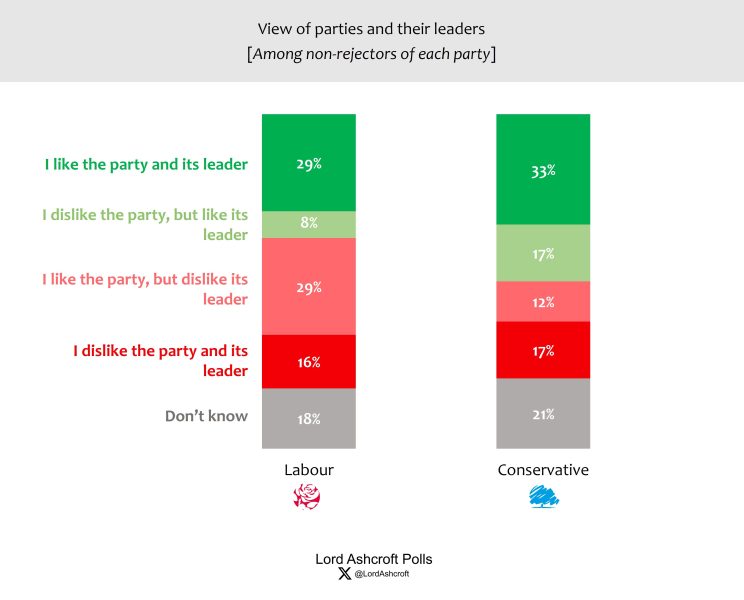
The pattern is strikingly similar to the previous chart. Among people who do not rule out voting Labour at the next election, 45 per cent dislike Starmer and just 37 per cent like him. In contrast, among the Conservative non-rejecters, 50 per cent like Badenoch and 29 per cent do not.
Another question is whether these groups of voters are coherent political blocs, or simply short-term crystallisations of opinion which will shift with the turbulent political landscape. A way to investigate this is by looking at our political map. This shows the four combinations of opinions for the above question, along with the party’s 2019 and 2024 votes. Plots for Labour are in red and plots for the Conservatives are in blue; the size of a bubble is proportional to the number of voters in the group. The closer points are together, the more similar the people in the respective groups are.
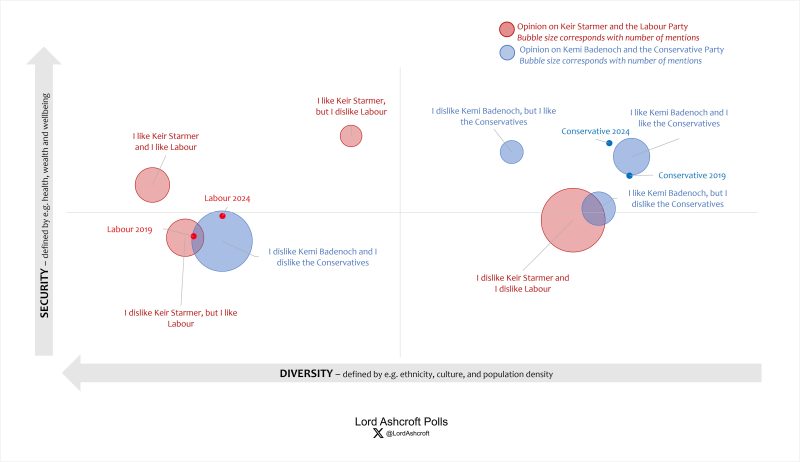
From Labour’s perspective, this shows that the people who like Starmer but who dislike Labour are a very long way from the position of Labour voters at either of the last two general elections. Conversely, the people who like Labour but who dislike Keir Starmer are in precisely the same territory as Labour’s vote at the past two elections.
Raw vote shares reflect this: just 28 per cent of the former group voted Labour at the last general election (with 34 per cent voting Conservative and 19 per cent voting Lib Dem), whereas 62 per cent of the latter group voted Labour in 2024. Consequently, Starmer has managed to attract the approval of a small group of people who didn’t support Labour even in their 2024 triumph, while angering a much larger group of the party’s natural supporters.
On the other hand, the people who like Badenoch but dislike the Conservatives are situated at around the “three o’clock” point on the political map. There is a fair distance between this and the current Conservative vote, but not the same chasm between the corresponding bubbles for Starmer.
This is the same position as people who voted Conservative in 2019 but who did not do so in 2024: territory the Conservatives lost during the previous parliament and is now hotly contested between the Conservatives and Reform. In 2019, the Conservatives won 53 per cent of the vote in this group; in 2024, this plunged to just 22 per cent. Our previous analysis on uniting the right suggests that for the Conservatives to have any chance of returning to government they must regain ground with this group of voters. So far, little ground has been regained.
Another of our regular questions may shed some light on this: whether people think the Conservatives have changed since their 2024 defeat or learned nothing from that loss. This time last year, just 25 per cent of people were more inclined to agree that the party had changed and learned a lesson from 2024; in our most recent poll, that had climbed to 31 per cent. While this is an improvement, a clear majority of people still believe that the Tories have learned nothing. After being in government for 14 years and after losing the 2024 election so heavily, any Conservative leader would find rebuilding public trust an uphill battle.
If politics is all about building and sustaining an electoral coalition, Starmer has alienated a swathe of the coalition which put him in power, while only appealing to a small number of people who have little in common politically with most Labour voters. Badenoch has held together a more cohesive voter coalition and has personal appeal among the voters the Tories need to win back, but these voters so far remain unpersuaded by, if not hostile to, the Conservative Party.
Neither leader can expect a pleasant local election night. Yet the underlying issues are mirror images: the Labour Party has a Keir Starmer problem and Kemi Badenoch has a Conservative Party problem.
Full data at LordAshcroftPolls.com
Lord Ashcroft KCMG PC is an international businessman, philanthropist, author and pollster. For more information on his work, visit lordashcroft.com
With both Labour and the Conservatives expected to suffer heavy losses in today’s local elections, attention will no doubt turn to the quality and likely longevity of their respective leaders.
To what extent are Keir Starmer and Kemi Badenoch electoral assets or liabilities for their parties?
In this month’s poll we asked a pair of related questions about Labour and the Conservatives. First, whether people liked both the party and the leader; liked the leader but disliked the party; liked the party but disliked the leader; disliked both the leader and the party, or if they didn’t know. The responses were as follows:
Unsurprisingly, many people think the same of the party as they do of the leader: 63 per cent have the same view of Starmer and Labour, and 59 per cent have the same view of Badenoch and the Conservatives. Equally unsurprisingly in today’s political landscape, by far the most common response is to dislike both the party and its leader. Yet around one in five differentiate the party from the leader. In Labour’s case, 75 per cent of such people like the party but dislike Starmer; in the case of the Conservatives, only 33 per cent of such people like the party but dislike Badenoch.
Put another way – stay with me – for every voter who is attracted to Starmer despite being put off by Labour, there are three voters who are put off by Starmer even though they like Labour. Conversely, for every voter who is put off by Badenoch despite being attracted to the Tories, there are two voters who like Badenoch despite being repelled by her party.
This suggests that while Starmer is a net liability for his party and its ability to win over voters, Badenoch is a net asset for hers. Can we take it at face value?
First-rate politicians can reach beyond their party’s core support and win votes from people who would otherwise not consider that party: Reagan Democrats are a case in point, as are Boris Johnson’s appeal in the red wall in 2019 (if not later) and Tony Blair’s success beyond Labour’s traditional heartlands. However, if a leader’s “additional” appeal is among voters who are never going to support that party, it can be redundant or even counterproductive.
Every month, we ask people to rate how likely they are to vote for each of the UK’s main parties on a scale from zero (definitely not) to 100 (definitely yes). If we look at the same question among people who do not completely reject the party in question (ie. give some score above zero), we find the following:
The pattern is strikingly similar to the previous chart. Among people who do not rule out voting Labour at the next election, 45 per cent dislike Starmer and just 37 per cent like him. In contrast, among the Conservative non-rejecters, 50 per cent like Badenoch and 29 per cent do not.
Another question is whether these groups of voters are coherent political blocs, or simply short-term crystallisations of opinion which will shift with the turbulent political landscape. A way to investigate this is by looking at our political map. This shows the four combinations of opinions for the above question, along with the party’s 2019 and 2024 votes. Plots for Labour are in red and plots for the Conservatives are in blue; the size of a bubble is proportional to the number of voters in the group. The closer points are together, the more similar the people in the respective groups are.
From Labour’s perspective, this shows that the people who like Starmer but who dislike Labour are a very long way from the position of Labour voters at either of the last two general elections. Conversely, the people who like Labour but who dislike Keir Starmer are in precisely the same territory as Labour’s vote at the past two elections.
Raw vote shares reflect this: just 28 per cent of the former group voted Labour at the last general election (with 34 per cent voting Conservative and 19 per cent voting Lib Dem), whereas 62 per cent of the latter group voted Labour in 2024. Consequently, Starmer has managed to attract the approval of a small group of people who didn’t support Labour even in their 2024 triumph, while angering a much larger group of the party’s natural supporters.
On the other hand, the people who like Badenoch but dislike the Conservatives are situated at around the “three o’clock” point on the political map. There is a fair distance between this and the current Conservative vote, but not the same chasm between the corresponding bubbles for Starmer.
This is the same position as people who voted Conservative in 2019 but who did not do so in 2024: territory the Conservatives lost during the previous parliament and is now hotly contested between the Conservatives and Reform. In 2019, the Conservatives won 53 per cent of the vote in this group; in 2024, this plunged to just 22 per cent. Our previous analysis on uniting the right suggests that for the Conservatives to have any chance of returning to government they must regain ground with this group of voters. So far, little ground has been regained.
Another of our regular questions may shed some light on this: whether people think the Conservatives have changed since their 2024 defeat or learned nothing from that loss. This time last year, just 25 per cent of people were more inclined to agree that the party had changed and learned a lesson from 2024; in our most recent poll, that had climbed to 31 per cent. While this is an improvement, a clear majority of people still believe that the Tories have learned nothing. After being in government for 14 years and after losing the 2024 election so heavily, any Conservative leader would find rebuilding public trust an uphill battle.
If politics is all about building and sustaining an electoral coalition, Starmer has alienated a swathe of the coalition which put him in power, while only appealing to a small number of people who have little in common politically with most Labour voters. Badenoch has held together a more cohesive voter coalition and has personal appeal among the voters the Tories need to win back, but these voters so far remain unpersuaded by, if not hostile to, the Conservative Party.
Neither leader can expect a pleasant local election night. Yet the underlying issues are mirror images: the Labour Party has a Keir Starmer problem and Kemi Badenoch has a Conservative Party problem.
Full data at LordAshcroftPolls.com