Lord Ashcroft KCMG PC is an international businessman, philanthropist, author and pollster. For more information on his work, visit lordashcroft.com
How does the media influence British politics?
Many believe the relationship is negative, even toxic – but how do different kinds of voters see things, and what are the implications for Kemi Badenoch and the Conservatives?
My poll last month asked whether political news in the UK is generally impartial or generally biased, and whether it generally does a good job or a bad job at keeping that the public informed. From this, we derive two measures with which to quantify attitudes to the media:
- A “net biased” score – the proportion of any given group that thinks the media is generally biased, minus the proportion which thinks it is generally impartial
- A “net informative” score – the proportion thinking political news generally does a good job at keeping people informed, minus the proportion which thinks does a bad job of doing so
We have deliberately asked the question in general terms, rather than about particular news outlets, in order to remove party political considerations from the question and encourage people to think about the situation in the round.
I found voters as a whole saying the media does a good job rather than a bad job of keeping people informed by 44 per cent to 37 per cent – a “net informative score” of +7. At the same time, people were more than twice as likely to say political news was generally biased than that it was generally impartial – we found a “net biased score” of +32. The chart below shows how these scores distribute among people’s current voting intention:

This shows that the average supporter of every major party considers political news generally biased, albeit to greatly varying extents.
Those currently leaning towards the Conservatives, Labour or the Lib Dems tend to consider political news more informative and less biased than people as a whole. Conversely, Reform and Green supporters take a similarly scornful view of the quality and impartiality of political coverage. SNP and Plaid Cymru voters, meanwhile, took a similar view to the general public about media bias but were more likely to think the news does a poor job keeping the public informed.
There is a striking chasm between the views of political media among Conservative, Labour and Lib Dem voters on the one hand, and Reform and Green voters on the other. The point is not that the respective groups are unduly credulous or cynical – simply the size of the gap. We could hypothesise that such a divide would naturally exist between established and insurgent parties. Has it always been like this? The chart below shows the current supporters and people who backed them at the last three general elections for the five British parties, as well as the two sides of the 2016 referendum (relying on past vote data collected near contemporaneously rather than asking people to recall how they voted several years ago).

This shows that even at the notably polarising 2019 general election and the 2016 EU referendum, the different political camps were divided far less sharply in their views of the media than they are now. We are familiar with the left bloc (Labour, the Lib Dems, the Greens and the SNP and Plaid Cymru in Scotland and Wales) and the right bloc (Reform UK and the Conservatives). But these charts show a second dividing line in British politics: between the traditional three parties (the Conservatives, Labour and the Lib Dems) on the one hand and the and populist parties (primarily Reform and the Greens) on the other.
Has the growth in support for populist parties driven increased scepticism of the media, or the other way round? Are both true – in which case, which driver is more potent? Or is neither true – in which case, what is the root cause? A starting point is to look at some different groups of voters using the framework above:
If support for a populist party drives media scepticism, we could assume this scepticism would endure among those who later switch away from this party. 2024 Reform voters who no longer intend to vote Reform have a net biased score of +57 and a net informative score of –15, whereas the comparable scores for the average 2024 Reform voter has scores of +61 and –23 respectively. Conversely, 2024 Green voters who no longer intend to vote Green have net biased score +46 and net informative score of +21, compared with scores of +58 and –1 respectively for all 2024 Green voters. This suggests enduring media scepticism among Reform switchers, whereas much of the media scepticism drains away from Green switchers, who even appear to have a heightened appreciation for the media’s informative abilities.
We also see that the voters Kemi Badenoch has won back from Labour and the Lib Dems are in the rare position of having average negative net biased scores (that is, they are more likely to consider the media impartial than biased). This territory is also where 2019 Conservatives who switched to the Lib Dems in 2024 are to be found. To complete the picture, those who have switched from a mainstream to a populist party since the 2024 election are generally as sceptical of the media as those who backed a populist party in 2024.
Could social media play a part in this phenomenon?
In our poll, 61 per cent said social media had had a harmful effect on political discussion by enabling false information and extreme views; only 21 per cent said it had improved discussion by allowing a wider range of views to be heard and reducing the power of mainstream media. The chart below shows how this opinion breaks down based upon people’s voting intention:

Supporters of the three established parties are especially negative about the impact of social media – indeed, on this issue, Conservative voters have more in common with Labour and Lib Dem voters than they do with Reform voters. Reform supporters themselves are more evenly divided on the merits of social media, but even they are more likely to think social media damages political discussion than improves it.
Green voters have similar views to the general population, being more hostile to social media than Reform voters but less so than Labour, Lib Dem and Tory voters. The only voter group more likely to think social media has improved political discourse than the opposite comprises those who are going to vote for another party – the category that includes supporters of Restore Britain, which has received vigorous backing from Elon Musk.
For some people, negative views of political media are part their disillusionment with the political system. Two questions can shed some light on this. First, we asked whether they thought Labour and the Conservatives are part of the same failed political system and that new ideas are needed, or whether newer parties and politicians would probably do no better at dealing with the issues facing Britain today. Second, we asked people to indicate on a 0-10 scale whether democracy still basically works even if they don’t always like the results, or if it no longer represents people properly and we need fundamental change.
Based on this, we identify the following groups:
- Insurgents, who say that political news is generally biased, that Labour and the Conservatives are part of the same failed system, and that British democracy is broken. This group makes up 18 per cent of the population
- Semi-insurgents, who say that political news in the UK is generally biased, and who either say that Labour and the Conservatives are part of the same failed system, or that British democracy is broken – but not both. This group constitutes 21 per cent of the population
- Establishment, who say that political news in the UK is generally biased, that new parties would not do any better, and that democracy still basically works (or are neutral). These people make up 17 per cent of the population
- Impartial, who agree that political news in the UK is generally impartial. These people account for 24 per cent of the population
The remaining 19 per cent of the population say that they don’t know whether the media are biased or impartial, and they are considerably less likely than the other groups to vote at elections. They are excluded from this analysis.
Looking at how attitudes differ between these four groups, we see that some two thirds of the insurgent, semi-insurgent and establishment groups agree that the media give undue prominence to personality and drama, and that this is the media’s fault; just 38 per cent of the impartial group think this. The same applies to the impact of the media on elections: 34 to 40 per cent of the former three groups considers the media to have a big influence on the outcome of elections, as against a quarter of the impartial group. However, when we ask whether politicians are treated too softly, too harshly or about right by the media, the breakdown is a lot more revealing:

Unsurprisingly, those who think the media impartial are the most likely to say it is treatment of politicians is tough but fair; those in this group who think otherwise divide roughly evenly between thinking the media treatment of politicians is too hard and that it is too soft. Those who consider the media biased are more likely to think the media is too soft on politicians than too hard. This increases sharply the more anti-establishment the group becomes: a comfortable majority of the insurgent group consider the media too soft. The idea that the media treats politicians too harshly peaks in the establishment group.
The chart below shows how these four groups of voters distribute on the political map based upon voting intention; the size of the group is proportional to the bubble size.
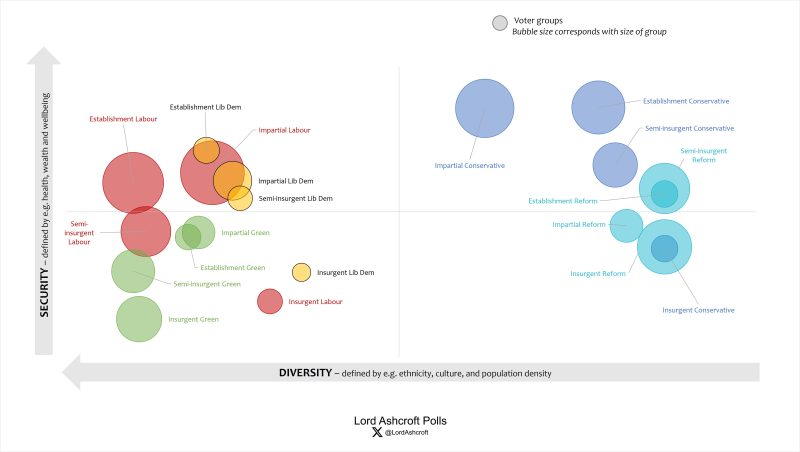
Notably, insurgent supporters of left bloc parties are a very long way down the vertical axis, while insurgent supporters of right bloc parties are in the bottom right quadrant, but much closer to the horizontal axis than the bottom of the chart. Even when we disregard the left/right distinction, there is a fundamental difference in worldview between those insurgents supporting a left bloc party and those insurgents supporting a right bloc party. The former are in a part of the map where pessimism and mistrust of institutions goes with the territory; that is much less so in the case of the latter.
Another striking feature is that the impartial Reform bubble is in the bottom right quadrant, further down than the establishment Reform and semi-insurgent Reform bubbles. The four Reform bubbles are also closer together than those for the other parties, whose insurgent and semi-insurgent bubbles are lowest down the chart. This suggests that there is something distinctive about Reform supporters: their position on the political map gives us much less of a clue about which group they will be in, and thus their views of political media.
What does all this mean for the Conservatives, and for Kemi Badenoch?
First, that there is very little to be gained from attacking the media.
The Reform supporters in the top right quadrant of our political map are those who are nearest to Conservative territory. They are very close to right bloc voters who think the media is biased but has a low influence on the outcome of British elections. For voters in this part of the map, an attack on the media would be an exercise in irrelevance; it would also be trying to compete with Nigel Farage on his home territory. But it could cost support elsewhere: the voters the Tories have won back from Labour and the Lib Dems, and the those for whom they will be competing with the Lib Dems at the next election, will not take kindly to a campaign of media-bashing.
Instead, Badenoch should welcome scrutiny – volunteer for it, even – and challenge her opponents to do the same. The country faces difficult problems and is increasingly polarised and fragmented. It cannot be governed by shallow soundbites or by the politics of victimhood and division. The British political media is far from perfect, but the accountability and scrutiny it brings is essential for anyone serious about leading the country.
Lord Ashcroft KCMG PC is an international businessman, philanthropist, author and pollster. For more information on his work, visit lordashcroft.com
How does the media influence British politics?
Many believe the relationship is negative, even toxic – but how do different kinds of voters see things, and what are the implications for Kemi Badenoch and the Conservatives?
My poll last month asked whether political news in the UK is generally impartial or generally biased, and whether it generally does a good job or a bad job at keeping that the public informed. From this, we derive two measures with which to quantify attitudes to the media:
We have deliberately asked the question in general terms, rather than about particular news outlets, in order to remove party political considerations from the question and encourage people to think about the situation in the round.
I found voters as a whole saying the media does a good job rather than a bad job of keeping people informed by 44 per cent to 37 per cent – a “net informative score” of +7. At the same time, people were more than twice as likely to say political news was generally biased than that it was generally impartial – we found a “net biased score” of +32. The chart below shows how these scores distribute among people’s current voting intention:
This shows that the average supporter of every major party considers political news generally biased, albeit to greatly varying extents.
Those currently leaning towards the Conservatives, Labour or the Lib Dems tend to consider political news more informative and less biased than people as a whole. Conversely, Reform and Green supporters take a similarly scornful view of the quality and impartiality of political coverage. SNP and Plaid Cymru voters, meanwhile, took a similar view to the general public about media bias but were more likely to think the news does a poor job keeping the public informed.
There is a striking chasm between the views of political media among Conservative, Labour and Lib Dem voters on the one hand, and Reform and Green voters on the other. The point is not that the respective groups are unduly credulous or cynical – simply the size of the gap. We could hypothesise that such a divide would naturally exist between established and insurgent parties. Has it always been like this? The chart below shows the current supporters and people who backed them at the last three general elections for the five British parties, as well as the two sides of the 2016 referendum (relying on past vote data collected near contemporaneously rather than asking people to recall how they voted several years ago).
This shows that even at the notably polarising 2019 general election and the 2016 EU referendum, the different political camps were divided far less sharply in their views of the media than they are now. We are familiar with the left bloc (Labour, the Lib Dems, the Greens and the SNP and Plaid Cymru in Scotland and Wales) and the right bloc (Reform UK and the Conservatives). But these charts show a second dividing line in British politics: between the traditional three parties (the Conservatives, Labour and the Lib Dems) on the one hand and the and populist parties (primarily Reform and the Greens) on the other.
Has the growth in support for populist parties driven increased scepticism of the media, or the other way round? Are both true – in which case, which driver is more potent? Or is neither true – in which case, what is the root cause? A starting point is to look at some different groups of voters using the framework above:
If support for a populist party drives media scepticism, we could assume this scepticism would endure among those who later switch away from this party. 2024 Reform voters who no longer intend to vote Reform have a net biased score of +57 and a net informative score of –15, whereas the comparable scores for the average 2024 Reform voter has scores of +61 and –23 respectively. Conversely, 2024 Green voters who no longer intend to vote Green have net biased score +46 and net informative score of +21, compared with scores of +58 and –1 respectively for all 2024 Green voters. This suggests enduring media scepticism among Reform switchers, whereas much of the media scepticism drains away from Green switchers, who even appear to have a heightened appreciation for the media’s informative abilities.
We also see that the voters Kemi Badenoch has won back from Labour and the Lib Dems are in the rare position of having average negative net biased scores (that is, they are more likely to consider the media impartial than biased). This territory is also where 2019 Conservatives who switched to the Lib Dems in 2024 are to be found. To complete the picture, those who have switched from a mainstream to a populist party since the 2024 election are generally as sceptical of the media as those who backed a populist party in 2024.
Could social media play a part in this phenomenon?
In our poll, 61 per cent said social media had had a harmful effect on political discussion by enabling false information and extreme views; only 21 per cent said it had improved discussion by allowing a wider range of views to be heard and reducing the power of mainstream media. The chart below shows how this opinion breaks down based upon people’s voting intention:
Supporters of the three established parties are especially negative about the impact of social media – indeed, on this issue, Conservative voters have more in common with Labour and Lib Dem voters than they do with Reform voters. Reform supporters themselves are more evenly divided on the merits of social media, but even they are more likely to think social media damages political discussion than improves it.
Green voters have similar views to the general population, being more hostile to social media than Reform voters but less so than Labour, Lib Dem and Tory voters. The only voter group more likely to think social media has improved political discourse than the opposite comprises those who are going to vote for another party – the category that includes supporters of Restore Britain, which has received vigorous backing from Elon Musk.
For some people, negative views of political media are part their disillusionment with the political system. Two questions can shed some light on this. First, we asked whether they thought Labour and the Conservatives are part of the same failed political system and that new ideas are needed, or whether newer parties and politicians would probably do no better at dealing with the issues facing Britain today. Second, we asked people to indicate on a 0-10 scale whether democracy still basically works even if they don’t always like the results, or if it no longer represents people properly and we need fundamental change.
Based on this, we identify the following groups:
The remaining 19 per cent of the population say that they don’t know whether the media are biased or impartial, and they are considerably less likely than the other groups to vote at elections. They are excluded from this analysis.
Looking at how attitudes differ between these four groups, we see that some two thirds of the insurgent, semi-insurgent and establishment groups agree that the media give undue prominence to personality and drama, and that this is the media’s fault; just 38 per cent of the impartial group think this. The same applies to the impact of the media on elections: 34 to 40 per cent of the former three groups considers the media to have a big influence on the outcome of elections, as against a quarter of the impartial group. However, when we ask whether politicians are treated too softly, too harshly or about right by the media, the breakdown is a lot more revealing:
Unsurprisingly, those who think the media impartial are the most likely to say it is treatment of politicians is tough but fair; those in this group who think otherwise divide roughly evenly between thinking the media treatment of politicians is too hard and that it is too soft. Those who consider the media biased are more likely to think the media is too soft on politicians than too hard. This increases sharply the more anti-establishment the group becomes: a comfortable majority of the insurgent group consider the media too soft. The idea that the media treats politicians too harshly peaks in the establishment group.
The chart below shows how these four groups of voters distribute on the political map based upon voting intention; the size of the group is proportional to the bubble size.
Notably, insurgent supporters of left bloc parties are a very long way down the vertical axis, while insurgent supporters of right bloc parties are in the bottom right quadrant, but much closer to the horizontal axis than the bottom of the chart. Even when we disregard the left/right distinction, there is a fundamental difference in worldview between those insurgents supporting a left bloc party and those insurgents supporting a right bloc party. The former are in a part of the map where pessimism and mistrust of institutions goes with the territory; that is much less so in the case of the latter.
Another striking feature is that the impartial Reform bubble is in the bottom right quadrant, further down than the establishment Reform and semi-insurgent Reform bubbles. The four Reform bubbles are also closer together than those for the other parties, whose insurgent and semi-insurgent bubbles are lowest down the chart. This suggests that there is something distinctive about Reform supporters: their position on the political map gives us much less of a clue about which group they will be in, and thus their views of political media.
What does all this mean for the Conservatives, and for Kemi Badenoch?
First, that there is very little to be gained from attacking the media.
The Reform supporters in the top right quadrant of our political map are those who are nearest to Conservative territory. They are very close to right bloc voters who think the media is biased but has a low influence on the outcome of British elections. For voters in this part of the map, an attack on the media would be an exercise in irrelevance; it would also be trying to compete with Nigel Farage on his home territory. But it could cost support elsewhere: the voters the Tories have won back from Labour and the Lib Dems, and the those for whom they will be competing with the Lib Dems at the next election, will not take kindly to a campaign of media-bashing.
Instead, Badenoch should welcome scrutiny – volunteer for it, even – and challenge her opponents to do the same. The country faces difficult problems and is increasingly polarised and fragmented. It cannot be governed by shallow soundbites or by the politics of victimhood and division. The British political media is far from perfect, but the accountability and scrutiny it brings is essential for anyone serious about leading the country.