Lord Ashcroft KCMG PC is an international businessman, philanthropist, author and pollster. For more information on his work, visit lordashcroft.com
Net zero is set to be a major battleground at the next election.
The issue is central to Labour’s mission, with the Liberal Democrats and Greens every bit as fervent, while the Conservatives and Reform UK have pledged to drop the 2050 target and do away with regulations they say hold the economy back. My latest research looks at what voters make of the climate debate in general and net zero in particular.
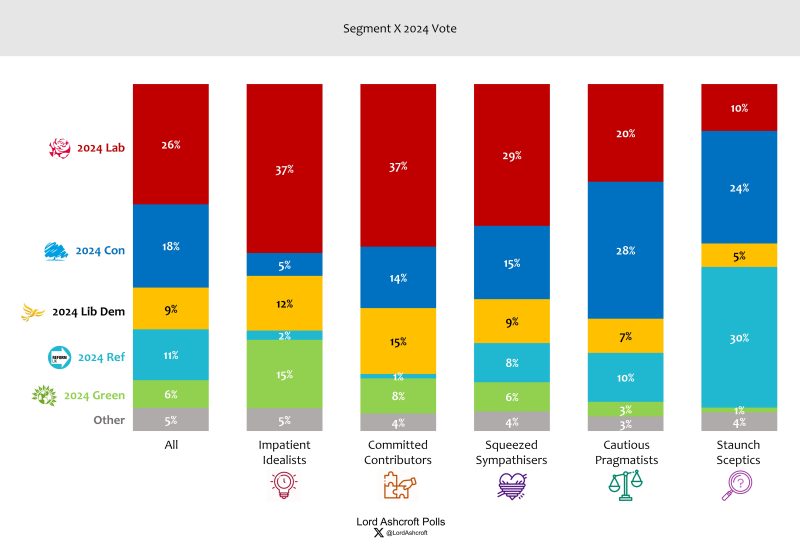
 My polling shows that the British public divides into five distinct “tribes” on the issue of climate change and net zero. Impatient Idealists want faster action and think net zero is worth paying for; Committed Contributors are the most likely to have changed their own behaviour; Squeezed Sympathisers believe the climate is changing but say they can’t afford to pay more; Cautious Pragmatists are not hostile to the environmental agenda but prioritise other things; and Staunch Sceptics think the threat is exaggerated and resist bigger bills. This is how each tribe voted at the 2024 general election:
Just over half of all respondents said they thought climate change was entirely or mainly caused by human activity.

Only just over one in ten overall said climate change was caused entirely by natural processes or was not happening at all. More than nine in ten Impatient Idealists thought human activity was the sole or main cause, compared to 14 per cent of Staunch Sceptics – though only one in ten of the most sceptical group said they thought climate change was not happening at all.
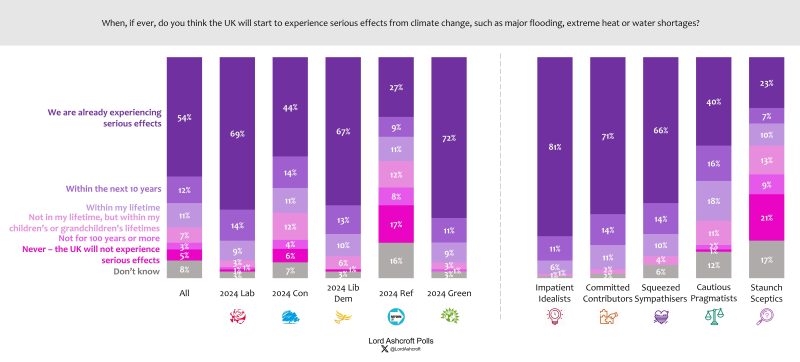
A majority said they thought the UK was already experiencing serious effects from climate change, including more than four fifths of Impatient Idealists. Only one in twenty thought the UK would never experience serious effects, rising to more than one in five Staunch Sceptics – though this group was slightly more likely to say that serious effects were already happening.
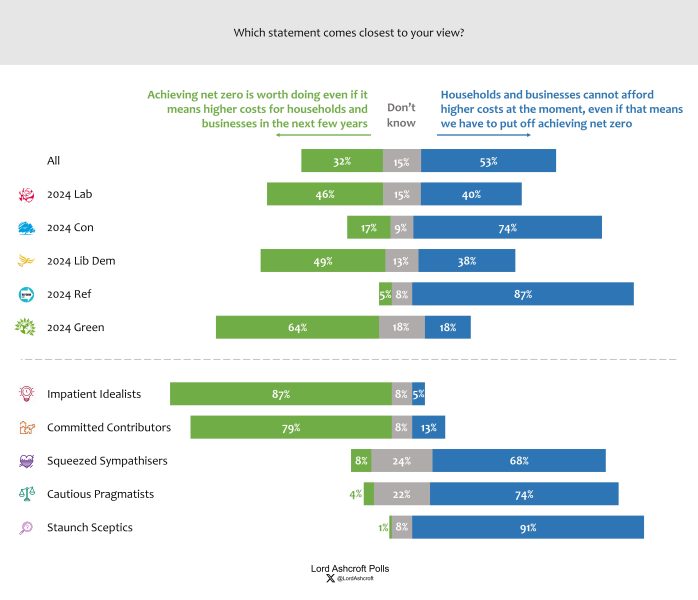
A majority agreed that households and businesses cannot afford higher costs at the moment, even if that means we have to put off net zero – compared to just under one third who agreed that net zero was worth doing even if it brings higher costs. Labour and Lib Dem voters leaned towards achieving net zero even if it means higher costs, though by fairly small margins, while large majorities of Conservative and Reform voters preferred putting off net zero to keep costs down.
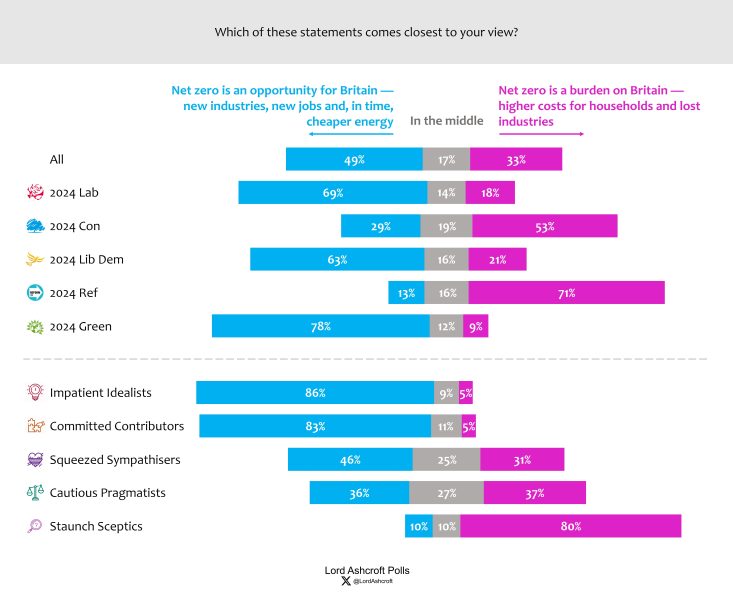
Voters as a whole saw net zero as an opportunity for Britain rather than a burden by a 16-point margin – though a majority of Conservative and Reform voters took the opposite view, as did four fifths of Staunch Sceptics.
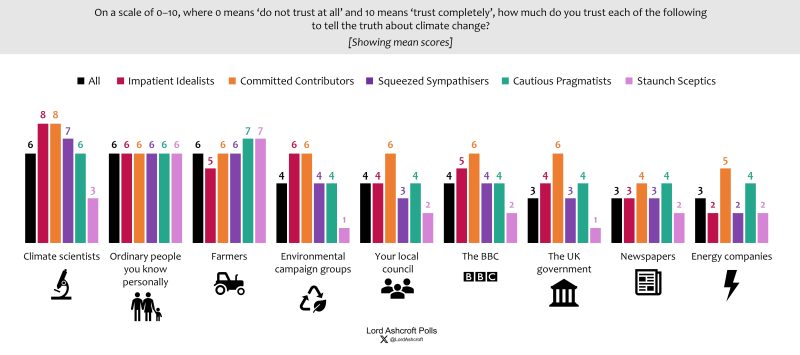
When we asked how much they trusted various sources to tell the truth about climate change, the three highest rated overall were climate scientist, farmers and ordinary people they knew. However, while ordinary people were rated the same by all segments and there was some variation on farmers, trust in climate scientists ranged from 8/10 among Impatient Idealists to only 3/10 among Staunch Sceptics.
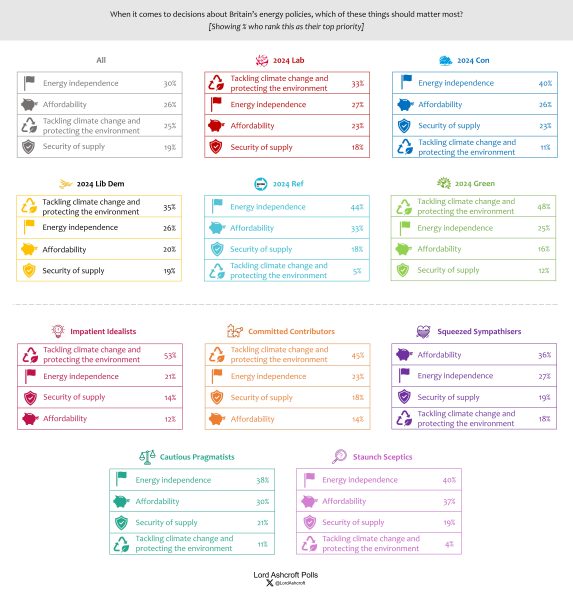
For the general population, the most important priority for energy policy was energy independence (not relying on overseas suppliers), followed by affordability. Tackling climate change and protecting the environment was in third place, ahead of security of supply (keeping the lights on). Tackling climate change was top of the list for Labour, Lib Dem and Green voters, as well as Impatient Idealists and Committed Contributors; it was bottom of the list for Conservative and Reform voters and for Squeezed Sympathisers (for whom affordability took precedence), Cautious Pragmatists and Staunch Sceptics (who prioritised energy independence).

Voters overall were more likely to prioritise cutting emissions to mitigate climate change than preparing for its potential effects. The opposite was true for Conservatives, Reform voters, Cautious Pragmatists and Staunch Sceptics.
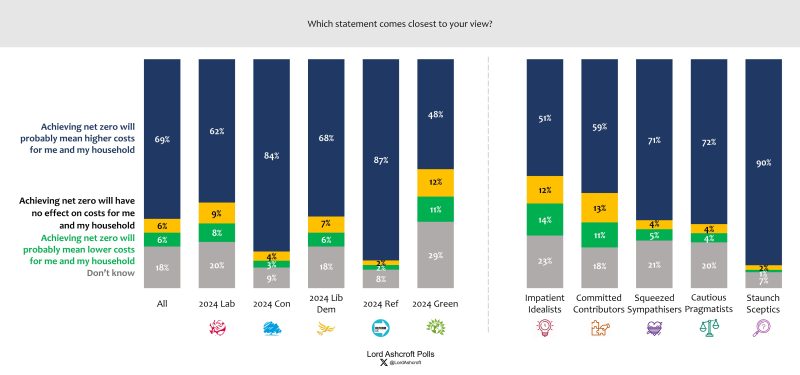
Nearly seven in ten of the population – including majorities of all segments and most voter groups – said they thought achieving net zero would probably mean higher costs for their household. Green voters were also much more likely than not to think net zero would mean higher household costs.
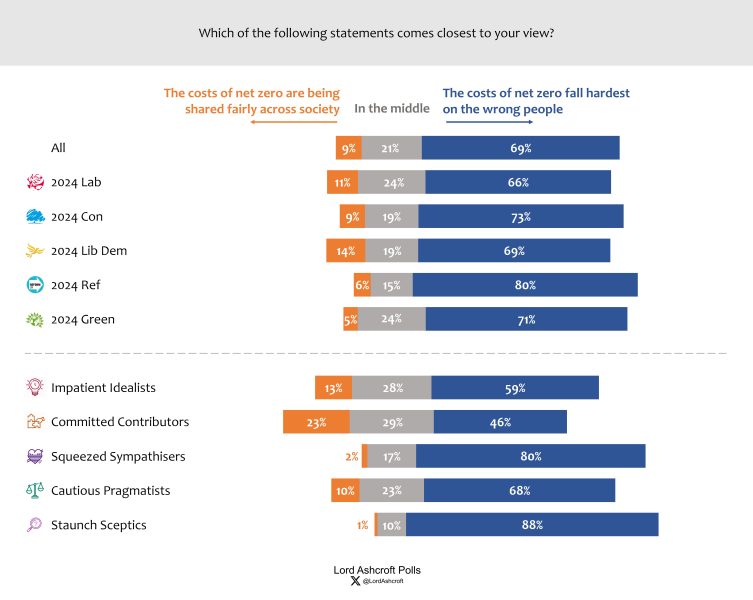
A large majority of the population and all parties’ supporters agreed that the costs of net zero fall hardest on the wrong people. Committed Contributors were the most likely to think the costs were being shared fairly across society, though fewer than a quarter thought this was the case.
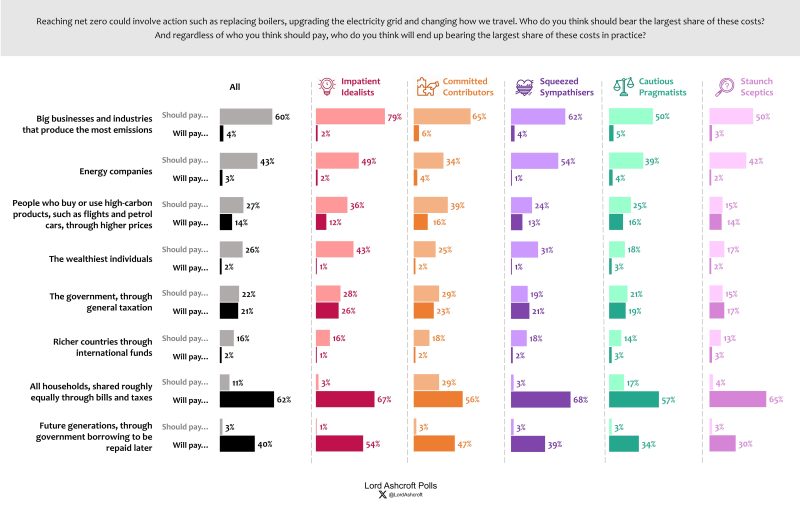
Majorities in all segments thought big business and industries that produce the most emissions should bear the biggest share of the costs of net zero, and that all households would end up doing do through bills and taxes. Energy companies were the second most likely to be nominated for paying costs, and future generations the second most likely actual payer.

The population as a whole favoured allowing new North Sea oil and gas exploration by a 16-point margin. Large majorities of Conservatives, Reform voters, Cautious Pragmatists and Staunch Sceptics took this view, and Squeezed Sympathisers did so by a 14-point margin. Lib Dem voters were evenly divided. Labour voters tended to favour continuing the ban, as well as a majority of Green voters, Impatient Idealists and Committed Contributors.
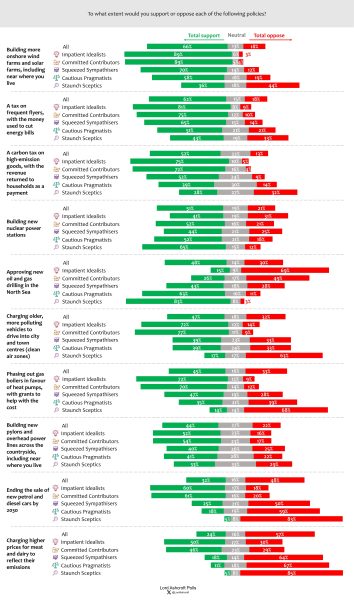
Presented with a range of policy ideas, majorities overall supported the idea of more wind and solar farms, a tax on frequent flyers, a carbon tax on high-emission goods with revenue returned to households, and building new nuclear power stations. People were more likely than not to support new North Sea oil and gas drilling, clean air zones, phasing out gas boilers with grants for heat pumps, and new pylons and power lines. They opposed ending the sale of new petrol and diesel cars by 2030, and charging higher prices for meat and dairy products. Impatient Idealists supported all ideas except new North Sea drilling.

Similar numbers said they would be more likely to vote for a party that promised to slow down or scrap net zero targets and that they would be more likely to vote for party that promised to speed them up. However, they were more likely to say that scrapping net zero would make them less likely to vote for a party than that speeding up net zero would make them less likely to support a party. Just under half of 2024 Conservative voters said promising to slow or scrap net zero would make them more likely to vote for a party, with 11 per cent saying it would make them less likely; around one third said it would make no difference. Six in ten Impatient Idealists said they would be more likely to vote for a party that promised to accelerate net zero; 62 per cent of Staunch Sceptics said they would be more likely to vote for a party that slowed or scrapped it.
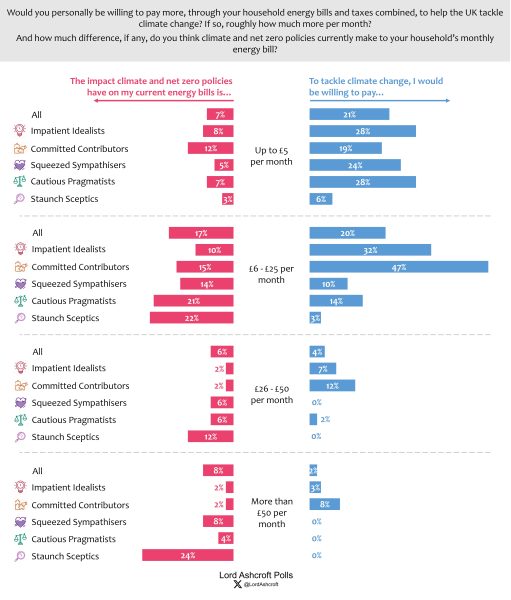
More than four in ten (41 per cent) said they were unwilling to pay anything more through bills and taxes to help tackle climate change – including a large majority of Staunch Sceptics but also a majority of Squeezed Sympathisers. Just over one fifth said they would be willing to pay up to £5 a month extra on their household’s energy bill to help tackle climate change, and a further 20 per cent said they would be prepared to pay between £5 and £25 extra.
When we asked how much people thought climate and net zero policies currently added to their energy bill, the most common answer (46 per cent) was “don’t know”. Just under a quarter estimated up to £25 a month; 13 per cent said they thought such policies made no difference to their bill.
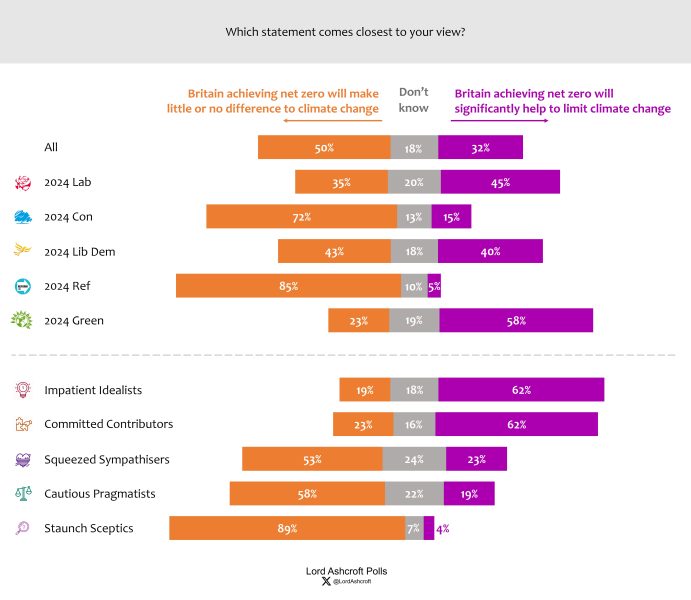
Half of all voters said they thought Britain achieving net zero would make little or no difference to climate change, compared to just under one third who said it would significantly help to do limit climate change. Majorities of 2024 Green voters, Impatient Idealists and Committed Contributors thought achieving net zero in Britain would help, but fewer than half of Labour and Lib Dem voters agreed. Majorities of 2024 Conservative and Reform voters, as well as Squeezed Sympathisers, Cautious Pragmatists and Staunch Sceptics said Britain would make little or no difference.
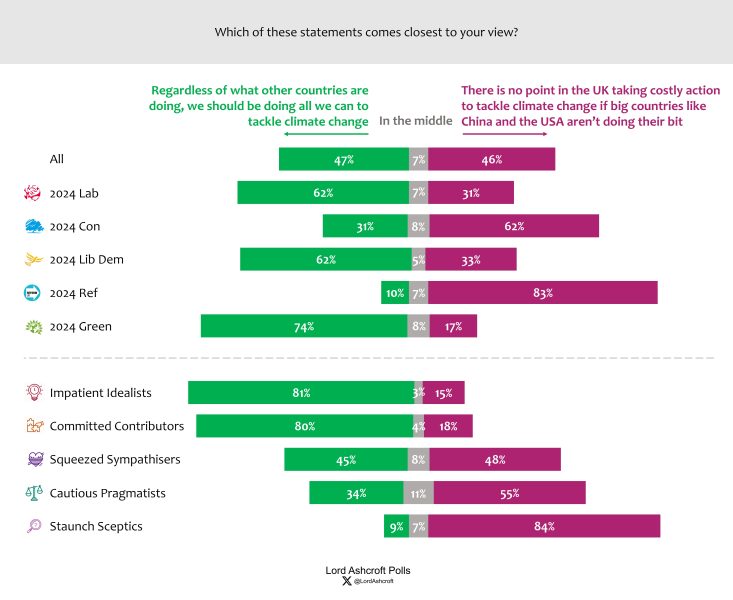
Voters overall were evenly divided between thinking Britain should do all it can to tackle climate change regardless of what other countries are doing and that there is no point taking costly action on the issue if bigger countries are not doing their bit. Majorities of 2024 Labour, Lib Dem and Green voters, together with four fifths of Impatient Idealists and Committed Contributors, thought Britain should do all it could regardless of other countries; majorities of 2024 Conservatives and Reform voters, together with most Cautious Pragmatists and Staunch Sceptics, took the opposite view.
The full report – ‘After You… Why people agree about climate change but nobody wants to pay’ – is available at LordAshcroftPolls.com along with full data tables
Lord Ashcroft KCMG PC is an international businessman, philanthropist, author and pollster. For more information on his work, visit lordashcroft.com
Net zero is set to be a major battleground at the next election.
The issue is central to Labour’s mission, with the Liberal Democrats and Greens every bit as fervent, while the Conservatives and Reform UK have pledged to drop the 2050 target and do away with regulations they say hold the economy back. My latest research looks at what voters make of the climate debate in general and net zero in particular.
Just over half of all respondents said they thought climate change was entirely or mainly caused by human activity.
Only just over one in ten overall said climate change was caused entirely by natural processes or was not happening at all. More than nine in ten Impatient Idealists thought human activity was the sole or main cause, compared to 14 per cent of Staunch Sceptics – though only one in ten of the most sceptical group said they thought climate change was not happening at all.
A majority said they thought the UK was already experiencing serious effects from climate change, including more than four fifths of Impatient Idealists. Only one in twenty thought the UK would never experience serious effects, rising to more than one in five Staunch Sceptics – though this group was slightly more likely to say that serious effects were already happening.
A majority agreed that households and businesses cannot afford higher costs at the moment, even if that means we have to put off net zero – compared to just under one third who agreed that net zero was worth doing even if it brings higher costs. Labour and Lib Dem voters leaned towards achieving net zero even if it means higher costs, though by fairly small margins, while large majorities of Conservative and Reform voters preferred putting off net zero to keep costs down.
Voters as a whole saw net zero as an opportunity for Britain rather than a burden by a 16-point margin – though a majority of Conservative and Reform voters took the opposite view, as did four fifths of Staunch Sceptics.
When we asked how much they trusted various sources to tell the truth about climate change, the three highest rated overall were climate scientist, farmers and ordinary people they knew. However, while ordinary people were rated the same by all segments and there was some variation on farmers, trust in climate scientists ranged from 8/10 among Impatient Idealists to only 3/10 among Staunch Sceptics.
For the general population, the most important priority for energy policy was energy independence (not relying on overseas suppliers), followed by affordability. Tackling climate change and protecting the environment was in third place, ahead of security of supply (keeping the lights on). Tackling climate change was top of the list for Labour, Lib Dem and Green voters, as well as Impatient Idealists and Committed Contributors; it was bottom of the list for Conservative and Reform voters and for Squeezed Sympathisers (for whom affordability took precedence), Cautious Pragmatists and Staunch Sceptics (who prioritised energy independence).
Voters overall were more likely to prioritise cutting emissions to mitigate climate change than preparing for its potential effects. The opposite was true for Conservatives, Reform voters, Cautious Pragmatists and Staunch Sceptics.
Nearly seven in ten of the population – including majorities of all segments and most voter groups – said they thought achieving net zero would probably mean higher costs for their household. Green voters were also much more likely than not to think net zero would mean higher household costs.
A large majority of the population and all parties’ supporters agreed that the costs of net zero fall hardest on the wrong people. Committed Contributors were the most likely to think the costs were being shared fairly across society, though fewer than a quarter thought this was the case.
Majorities in all segments thought big business and industries that produce the most emissions should bear the biggest share of the costs of net zero, and that all households would end up doing do through bills and taxes. Energy companies were the second most likely to be nominated for paying costs, and future generations the second most likely actual payer.
The population as a whole favoured allowing new North Sea oil and gas exploration by a 16-point margin. Large majorities of Conservatives, Reform voters, Cautious Pragmatists and Staunch Sceptics took this view, and Squeezed Sympathisers did so by a 14-point margin. Lib Dem voters were evenly divided. Labour voters tended to favour continuing the ban, as well as a majority of Green voters, Impatient Idealists and Committed Contributors.
Presented with a range of policy ideas, majorities overall supported the idea of more wind and solar farms, a tax on frequent flyers, a carbon tax on high-emission goods with revenue returned to households, and building new nuclear power stations. People were more likely than not to support new North Sea oil and gas drilling, clean air zones, phasing out gas boilers with grants for heat pumps, and new pylons and power lines. They opposed ending the sale of new petrol and diesel cars by 2030, and charging higher prices for meat and dairy products. Impatient Idealists supported all ideas except new North Sea drilling.
Similar numbers said they would be more likely to vote for a party that promised to slow down or scrap net zero targets and that they would be more likely to vote for party that promised to speed them up. However, they were more likely to say that scrapping net zero would make them less likely to vote for a party than that speeding up net zero would make them less likely to support a party. Just under half of 2024 Conservative voters said promising to slow or scrap net zero would make them more likely to vote for a party, with 11 per cent saying it would make them less likely; around one third said it would make no difference. Six in ten Impatient Idealists said they would be more likely to vote for a party that promised to accelerate net zero; 62 per cent of Staunch Sceptics said they would be more likely to vote for a party that slowed or scrapped it.
More than four in ten (41 per cent) said they were unwilling to pay anything more through bills and taxes to help tackle climate change – including a large majority of Staunch Sceptics but also a majority of Squeezed Sympathisers. Just over one fifth said they would be willing to pay up to £5 a month extra on their household’s energy bill to help tackle climate change, and a further 20 per cent said they would be prepared to pay between £5 and £25 extra.
When we asked how much people thought climate and net zero policies currently added to their energy bill, the most common answer (46 per cent) was “don’t know”. Just under a quarter estimated up to £25 a month; 13 per cent said they thought such policies made no difference to their bill.
Half of all voters said they thought Britain achieving net zero would make little or no difference to climate change, compared to just under one third who said it would significantly help to do limit climate change. Majorities of 2024 Green voters, Impatient Idealists and Committed Contributors thought achieving net zero in Britain would help, but fewer than half of Labour and Lib Dem voters agreed. Majorities of 2024 Conservative and Reform voters, as well as Squeezed Sympathisers, Cautious Pragmatists and Staunch Sceptics said Britain would make little or no difference.
Voters overall were evenly divided between thinking Britain should do all it can to tackle climate change regardless of what other countries are doing and that there is no point taking costly action on the issue if bigger countries are not doing their bit. Majorities of 2024 Labour, Lib Dem and Green voters, together with four fifths of Impatient Idealists and Committed Contributors, thought Britain should do all it could regardless of other countries; majorities of 2024 Conservatives and Reform voters, together with most Cautious Pragmatists and Staunch Sceptics, took the opposite view.
The full report – ‘After You… Why people agree about climate change but nobody wants to pay’ – is available at LordAshcroftPolls.com along with full data tables