One of the big complaints of politics from the last years of Blair until the horrendous election defeat for the Tories in 2024 was that politics had become about managing Britain not vision and clear ideological divides.
With more than just two main parties in the frame since then – all trying to define themselves against the other – that managerial pitch which both had it’s final win in October 2022 with Rishi Sunak, and it’s final fall with the hasty dismissal of Keir Starmer by his own party, has given way to some clear political primary colour differences about how the two parties see the future. There’s nothing ‘uni’ about it.
Welfare reform and Keir Starmer’s attempt just to slow the pace of growth in the welfare bill, did for him – and the political career of Liz Kendall.
I found, by chance, a prophetic tweet from Sir James Cleverly on the night of that welfare bill vote in July 2025 – that he was rinsed for by the left at the time – and which turned out to be spot on:
“Tonight’s humiliating events mean that Labour MPs know that Starmer will not lead them into the next election. His authority is gone. The questions they are now asking are; when will he go, and who will replace him?”
We know now.
The point here is that getting welfare reform wrong right now is a potential government killer. It still has that potential and for any party.
PMQs yesterday was a testy affair which really demonstrated the difference in approach. Badenoch accused Burnham of trying to survive on vibes but kick the problem down the road. The flaw in Milburn’s ‘heavy spend upfront for savings in a decade’ is stark.
We don’t have a decade to wait. That’s pretty much her case. And if jobs for the younger generation is part of the solution, remove barriers now – that Labour put in place – to hiring. The Prime Minister isn’t creating jobs, businesses create jobs.
Burnham is going for the “look at the nasty party” defence.
Tory Welfare cuts are “crude cuts”. But here’s the distinction: Labour think cuts are crude, full stop. They would instinctively like to keep spending and not cut, because that’s in their DNA. They will try to answer the fiscal dangers of their solution by arguing they are compassionate. To whom? A generation of youngsters who are stuck without jobs? Yes, but what about the generations to come saddled with debt, and the generation who do have jobs and will get jobs expected, increasingly heavily, to pay for those that don’t?
It would seem some 78 percent of party members responding to our latest ConservativeHome survey agree with Badenoch’s view
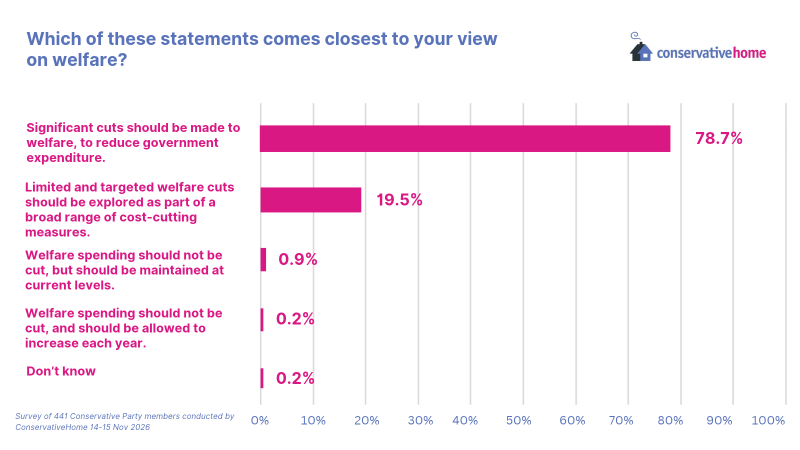
Now as a finding it may be reassuring that so many members back cutting the welfare bill, as soon as possible but it is perhaps hardly surprising except to show the membership – which remember was quite split in early 2025 about leadership policy direction – seems to have coalesced its support. Even without choosing the top option, the vast majority of all those who didn’t, want limited and targeted welfare cuts as part of a broad range of cost cutting measures. One suspects our columnist John Oxley may this morning have hit on why that 19.5 per cent are not fully in the 78 per cent group.
So what about the form such cuts should take?
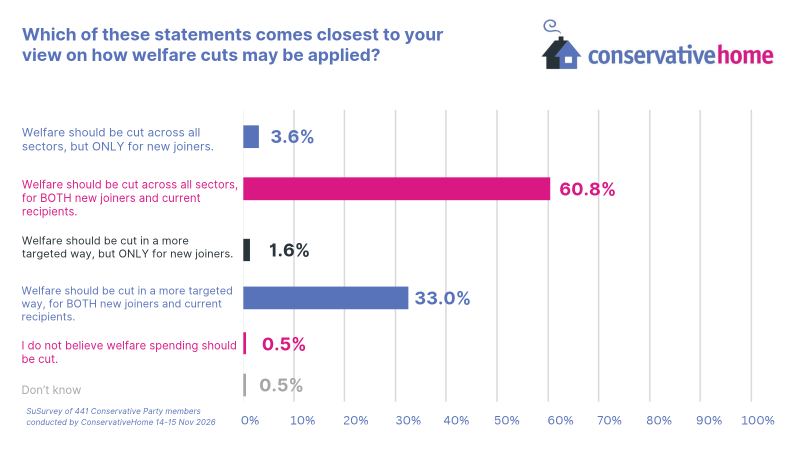
It seems just 3.6 per cent think there’s any point in starting the savings required by apllication to new joiners. To make a real difference 60.8 per cent think it’s got to be across the board and for those already in receipt of welfare as well as new joiners. However a not insignificant third of responders want targeted cuts. That may be the age old conundrum of do you spread the pain across the widest number of people, or do those who belive in cuts believe in them for some and not for others, which has traditionally been the biggest problem in this field: one person’s rerasonable cut, is another’s red line in the sand.
Even the Conservatives in what they say about welfare are not lacking in empathy and compassion. They make clear the most vulnerable should morally and ethically be supported by those who can pay to do so. It’s not the abolition of welfare at stake here. Burnham (and you can see it in that PMQs exchange) is passionate about the state being the safety net – that phrase that i suspect will rightly haunt him – “you can’t have national security at the expense of social security” tripped off the tongue but says worrying things about how Labour view the role of the state. What did members make of that moral question?
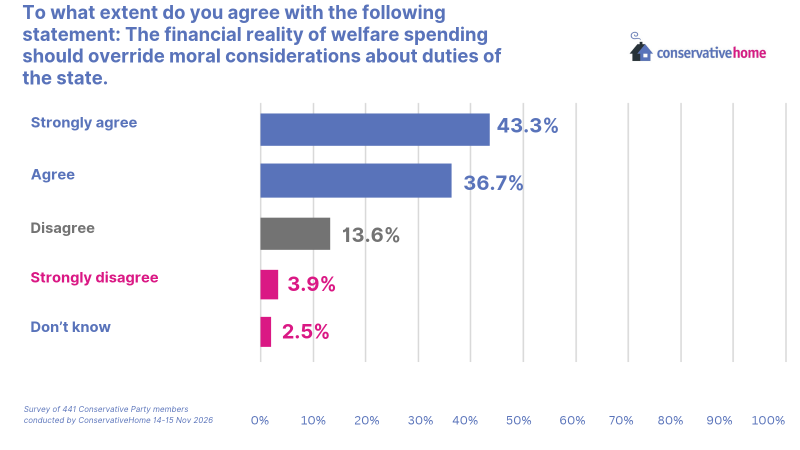
The answer is pretty stark. Where we are right now, and what the implications are for not tackling the growing welfare budget 80 per cent of our responders think the economics are so clear that resolving them should override moral considerations about the ‘duties of the state’. Here then is perhaps the biggest clear water of the tupe I started with. Labour’s equivalent member survey I’ve no doubt would have that out come for this third question completely reversed.
Milburn has opened the door on a fundamental question for this parliament, for these politicians, for now – and no ten year plans or ten year solutions are really going to cut it, both literally and metaphorically.